Which way round does the bobbin go in a vintage Singer?

Standard

If it’s a long bobbin for a Vibrating Shuttle machine, it’s easy – you hold the shuttle with the pointed end down, and the bobbin drops into the top of it with the thread coming off from left to right across the front.   If the thread’s coming off from the back of the bobbin, that’s wrong.  It needs to be left to right, on your side.

Yes, I know a picture would have been a great help there, but I forgot to take one.  At this time of year I have to wait for a bit of sunshine in which to take a halfway-decent snap, and more often than not as soon as we get the slightest hint of a blue sky, Elsie drags me into the garden to be her assistant/labourer and by the time I get back inside, put the kettle on and remember there’s a picture I need to take, the sun’s gone in.

Anyhow …

If it’s a round bobbin machine, it depends on what model it is, and if you’re thinking to yourself “does it matter which way round I put the bobbin in?”, the answer is oh yes it does.

Now obviously this isn’t a problem if you only ever use one type of vintage Singer, because you’ll have read the book of words for it and know perfectly well which way round the bobbin goes in it.  But what if you’ve just scrounged the lovely old 66K that Mrs Thing next door but one was about to take to the dump along with her weekly accumulation of empty gin bottles and copies of the Daily Mail and you can’t wait to see if it works?  Or your friend Sally of the School Gate Gang’s got an old Singer which won’t sew properly and she’s asked if you’ll have a look at it for her if there’s coffee and cupcakes involved?  Maybe you have a 99 and a 201 and every now and then you have a brainfart about the bobbins?  Whatever, here’s how you tell which way round the bobbin goes in a pre-mid-1960’s Singer (and for all I know about the later machines, in one of them too).

Check out the bobbin case, which is the proper name for that bit of your machine into which you drop your bobbin.  If you look round the sides of the hole into which your bobbin goes, you will see a diagonal slot in it, like this …
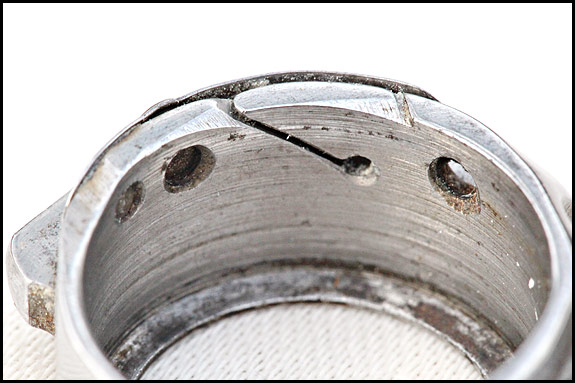
Detail photo of Singer 99 bobbin case

That’s a 66/99 bobbin case (they’re identical), and as you can see, the slot exits the case to the left, or to put it another way, anti-clockwise.
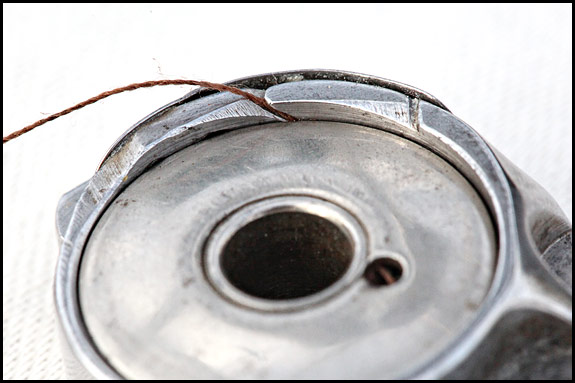
Picture of bobbin in Singer 99 bobbin carrier

And there’s that same bobbin case photographed from the same angle, now with a bobbin in it the right way round i.e. with the thread coming off it anti-clockwise.  Yep, the thread comes off the bobbin the same way that the slot exits the case.

Having got the bobbin in, your next step of course is to pull the thread to the right so it runs under the tension spring and into the notch, then pull it across the top of the bobbin and close your slide plate.

When you do that, you’re actually making sure that the thread leaves the bobbin through the hole at the bottom of the slot, then under the tension spring in exactly the right way for the spring to apply constant tension.  Pulling on the thread pulls it down the slope of the slot, and ensures that it stays in the hole as it feeds off the bobbin.

If your bobbin is in the wrong way round, pulling on the thread doesn’t necessarily slide it down the slot into the hole, so you may well get inconsistent bottom tension.
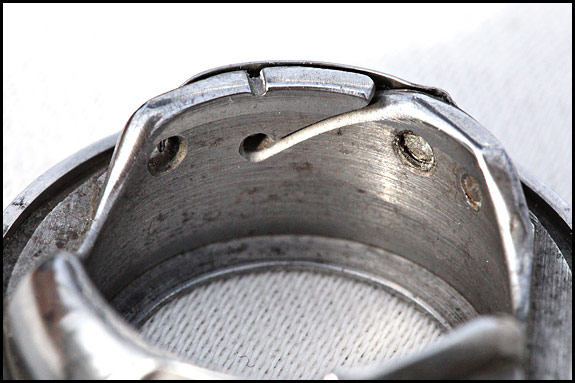
Detail of Singer 201 bobbin carrier

Now here we have the bobbin case out of a 201, and as you can see, the slot faces the other way i.e. it exits the case to the right, or clockwise.  So which way does the thread need to leave the bobbin on a 201?
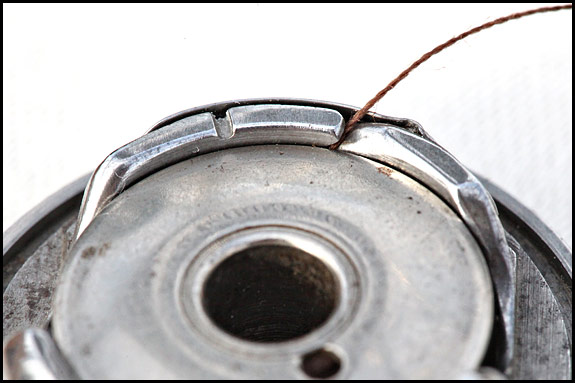
Detail photo of thread leaving Singer 201 bobbin

Yep, that’s right.   Clockwise.  OK, I completely forgot to photograph a 15 bobbin case, but you can take it from me that it has a slot in it which provides exactly the same clue as to which way round the bobbin goes.

And that’s it.  All you need to do is take a look at the slot in the side wall of the bobbin case, and that tells you which way your thread needs to leave the bobbin …
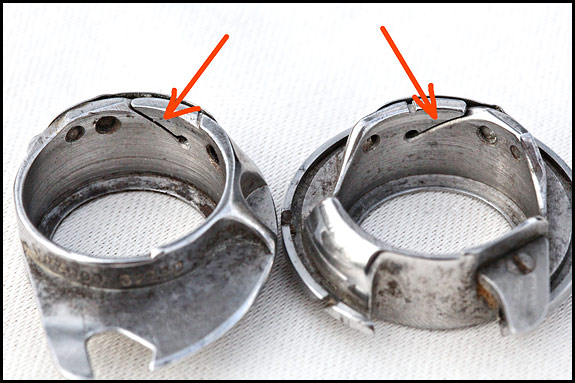
Picture of Singer 66/99 and 201 bobbin carriers

66/99 on the left, slot exits anti-clockwise therefore thread comes off the bobbin anti-clock.  201 on the right, slot exits clockwise, so your thread comes off clockwise too, like this …
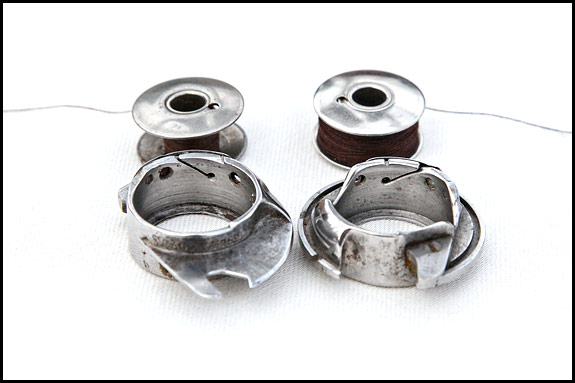
Picture of Singer 66/99 and 201 bobbin carriers and bobbins

Finally, just in case it hasn’t occurred to you, if you take this information together with what I’ve rabbitted on about in earlier posts, you now know how to put both the needle and the bobbin in any vintage Singer the right way round, as well as which way to thread the needle – and all this without an instruction book.

And by the way, if you’re still tut-tutting about these grotty old bobbin carriers, you should have seen the state of them before Elsie insisted on getting the thick of the muck off …

The Ruby Buttonholer and the Vanguard Buttonholer

Standard

This post was going to be titled “The Ruby Buttonholer and the Vanguard Buttonholer and how to tell them apart”, but in fact there’s only one way to tell them apart.  You see what it says on the box.  If you haven’t got the box or the instructions, you’re basically stuffed.  Oh yes …

Picture of two Ruby buttonholers and a Vanguard buttonholer

From the left we have here the big Ruby buttonholer, the Ruby Buttonholer Type RB, and the Vanguard Buttonholer.  The big Ruby’s the odd one  out, so if we ignore that and concentrate on the other two, what differences do we see?

The first difference is body colour, but that’s actually no help at all if you’re trying to tell them apart, because we’ve seen both of them in all kinds of blue-grey and grey-grey, as well as one or other of them in a sort of buttermilk/pale cream.  I have a feeling we’ve also seen a black one, but I wouldn’t swear to it.

The other visible difference between those two is that little doohickey sticking out towards the front of the Vanguard, to which this red arrow is pointing …

Detail shot of Vanguard Buttonholer

That’s a setting screw which varies the width of the stitch from narrow to wide, and it’s not to be confused with the control which varies the width of the buttonhole.  Buttonhole width is the one which you can see on the side of the body with the 1-2-3 markings.

But alas, the presence of that stitch width wotsit does not mean it’s a Vanguard!  Nope, there are Vanguards with and without that, and the same goes for the Ruby.

It really is the case that if you haven’t got the box or the instructions, you can’t tell them apart, because they are indeed one and the same thing.

So, if you see a Vanguard Buttonholer for sale, it’ll look like either of those two with the plastic body but it may be a different colour, and it may or may not have variable stitch width.

If you see a Ruby Buttonholer for sale, it could be that contraption on the left in the team photo, but it’s more likely to be the plastic-bodied one.

If you see a Ruby Buttonholer Type RB for sale, it’s definitely the plastic-bodied one.  It may or may not have variable stitch width, and it may or may not have with it Part Number 17, which is the means by which a Ruby RB can allegedly be fitted to an industrial machine – as if anyone would want to do that.

We have nice examples of all three for sale on the Bits ‘n’ Bobs page, where you’ll also find snaps showing the boxes and instructions.

The press stud

Standard

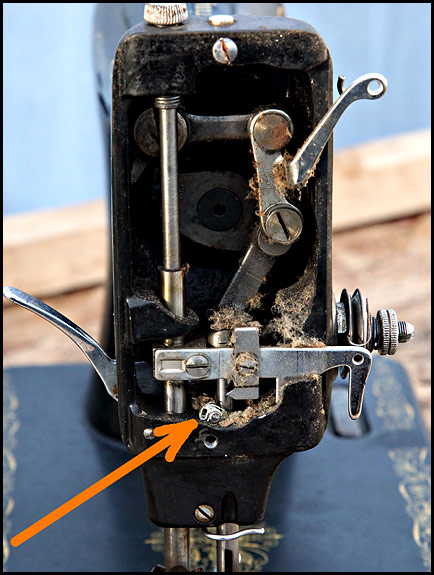
Picture of area behind faceplate of Singer 99K

Well, we’ve seen worse fluff than this behind a 99’s faceplate, but we’ve never before found a press stud in there when we started cleaning one out.

I think they’re called poppers or snap fasteners in other parts of the world, but whatever they’re called, I doubt they’re often found inside sewing machines.  The arrow’s pointing at half of this one, by the way.  The other half was deeper inside, behind the needle bar.

That has got to be a bored child, hasn’t it?

The Semi Industrial Sewing Machine

Standard

Ahah!

We finally have an explanation of what a “semi-industrial” sewing machine is.

A gentleman who flogs “semi-industrial” 201’s and suchlike on Ebay is now saying that

“The machines I sell are classed as Semi-Industrial as they are of Industrial strength all metal construction.”

Yes, well …

(Thanks to Karen for drawing my attention to that one)

OK, so on Ebay, “semi industrial” means “not made of plastic”, “heavy duty” seems to mean “made of cast iron”, and that explains why even the truly awful Singer 275 is touted as a “heavy duty semi-industrial machine” on there.

As I think I’ve said somewhere else, at this rate it won’t be long before the Hello Kitty Sewing Machine’s semi-industrial too …


Vintage buttonholers

Standard

We were in a bit of a silly mood earlier today, and at one point Elsie said “Why don’t you do a team photo of the buttonholers?”.  I couldn’t think of any reason why not, so here you go …

Picture of 12 Vintage buttonholers for Singer sewing machines

Top row left to right is a Green’s from the land of the Vegemite sandwich, Precision (the one that comes in the maroon tin), Greist, Greist Rotary, Singer 489500 (the one which is usually seen in the green “Jetson” case), and the bigger of the two Ruby buttonholers.

Bottom row left to right is a Y.S.Star buttonholer, the common or garden Ruby type RB, Singer 86718 (the red plastic case one), Famous Buttonhole Maker, Singer 86662 (the usual one in the card box) and a Singer USA 160506 (the dark green plastic case one).

I know we have examples of most of these for sale, even if I haven’t got round to putting them on the “Bits ‘n’ Bobs” page yet, and I’ve just now realised that we missed out the Vanguard one from this picture.  No biggie though – a Vanguard’s just a Ruby RB with a different coloured shell.

Hmmm … I guess we need to do the same for zigzaggers next.

The studio, buttonholers, a 201K, the harmonium. And logs.

Standard

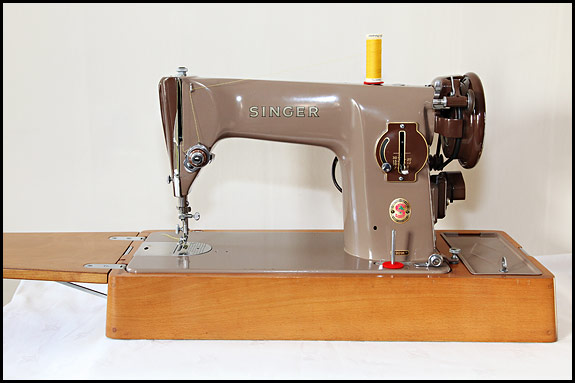
picture of Singer 201K23 in beige/brown

Detail picture of Singer 201K23

Detail photo of Singer 201K23

Detail of Singer 201K23 stitch length regulator

Well, I finally finished the bathroom cupboard and between us we got it painted (magnolia – we’re not very adventurous where decorating’s concerned).  No sooner had the paint dried than I set up the studio i.e. put the board over the bath, spread out the white hotel tablecloth on it, plonked a sewing machine on top and started snapping away.

And when I came to open the files in Photoshop, I discovered that oh poo the new magnolia-coloured “wall” was now producing a colour cast.  Long story short, the studio has now moved into our bedroom.  The board and tablecloth which sat on the bath now sit on top of The Harmonium, as the later Singer drawing-room cabinet is referred to (‘cos we think it looks like one when the machine’s down and the top’s over), and as long as I time the picture-taking to avoid the direct sun which comes in around noon at this time of year, I have better light now as well as more room to move.

Anyhow, these ‘ere snaps fresh from the new studio are of a really nice 201K23 which we’ve now added to the “Singers for Sale” page, and I’m not saying anything more about this machine now lest I be inclined to go off on one about the way 201’s are hyped up on Ebay.  Having said that, though, I can’t help wondering how come an identical machine to this one seemingly in similar cosmetic condition but with a scruffy case lid has this very evening sold on Ebay for £170!

Whatever, we finally realised over the New Year that we do indeed have a surfeit of buttonholers (you can say that again -E), so I’ve just added a Singer 160506 (the one in the green plastic case) with extra templates, and before much longer I’ll be adding still more to the “Bits ‘n’ bobs” page.

There’s another Swiss zigzagger listed now too, by the way, and I must say you’d be hard pushed to find a better one either here or in the States.

Finally, having for the last two months been burning a load of timber we scrounged from a building site, last week we managed to clear enough space in one of our log sheds for a couple of loads of proper logs from our friendly neighbourhood log lady, and we finished stacking those this afternnon.

In case you ever need to know, I can now tell you with some authority that an average pickup load of mixed hardwood logs cut at 10″ and split consists of about 330 logs, which when stacked one row deep along a wall amounts to 33 square feet of logs, or a stacked volume of 0.7 cubic metre.  And round our neck of the woods, that’s very close to 25p a log, which I guess seems expensive – until you weigh up the advantages of heating by woodburning stove …

Singer 28 for sale

Standard

Singer 28K with 128-style high-level bobbin winder

Singer 28K with 128-style bobbin winder

We don’t often have a vibrating shuttle machine in need of a good home, but I’ve just put this really pretty Singer 28K on the “Singers for Sale” page.

What’s interesting about it apart from anything else is its bobbin winder.  As you can see, that’s a high-level one, so you could be excused for thinking that this machine is obviously a 128 so Sid’s had a brainfart again.

But it’s not.   It might have the high-level 128-style bobbin winder, but it doesn’t have the magic button on the shuttle carrier which ejects the shuttle, therefore it’s a 28.  It could of course be a 128 which has had its shuttle carrier swopped for one off a 27 or 28, but it hasn’t.  So it isn’t.  A 128 that is.

It’s a 28.  For sure.  The serial number says so.  It’s a 1935 machine, from the last but one batch of 28K’s, which were almost but not quite 128K’s.

Whatever, it’s got a nice bentwood case, it works a treat, and it’s got a very pretty faceplate …

picture of faceplate of 1935 Singer 28K

A happy, healthy and peaceful New Year to one and all (more or less) 🙂


Singer UK brochure and price list 1940

Standard

Or if not actually 1940, it’s certainly thereabouts.  This comes courtesy of Colette, who very kindly scanned the booklet her Mum picked up from the Singer shop in downtown Pinner when shopping for her new sewing machine …

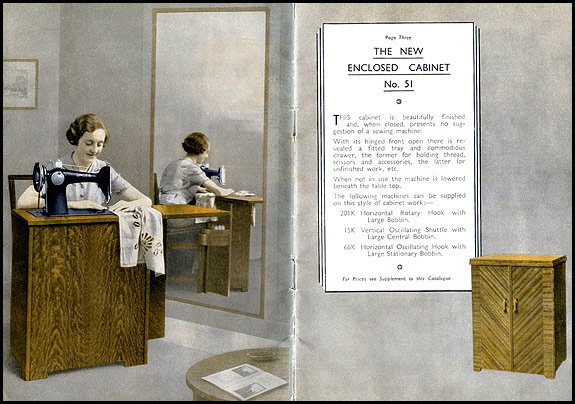
Singer Enclosed Cabinet no.51

I’m not sure when the No.51 Cabinet was introduced, but it certainly wasn’t long before the start of the 1939-45 war.  Whenever, we like it lots because it’s both compact and very practical, and we usually have at least one of these in good condition listed on the Singers for sale page.  It takes any full-size vintage Singer, the treadle mechanism works a treat, and it can be supplied as it could when new with the option to switch easily from treadle to electric power as the fancy (or the power cut) takes you.

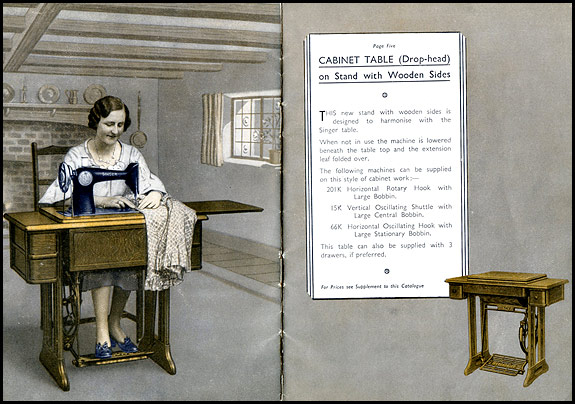
Singer drop-head cabinet table with wooden sides

We often have one of these available too!  This is the standard treadle base which replaced the ornate cast-iron one, and it was available with either three or five drawers.  If it looks to you more like two drawers or four, that’s because Singer always counted the wide central tilt-to-open bit which runs across the front between the side drawers as a drawer.  Which I guess it is, kind of.

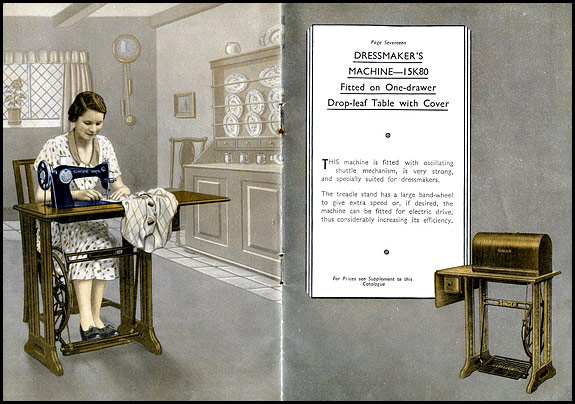
Singer One-drawer Drop-leaf table with Cover

I don’t know quite how popular the one drawer table with the bentwood cover was, but you don’t see many of them nowadays.  I could see the point if you could drop your portable into that table top, faff about a bit and start treadling, but you couldn’t, so maybe the idea was to use up a vast stock of bentwood case tops prior to the changeover to suitcase-type cases?

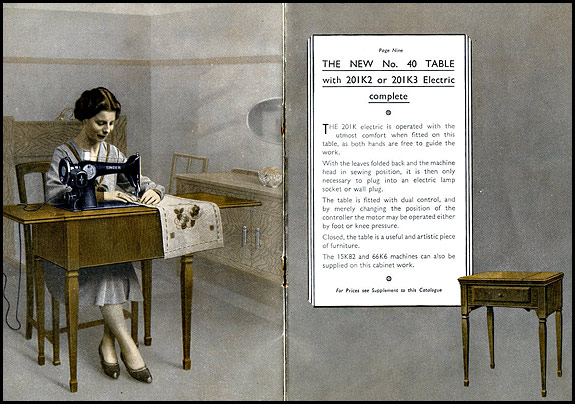
Singer No 40 table

The No.40’s not at all common nowadays, though you do see them from time to time – often in the sort of rooms which still have a dusky pink Dralon sofa, a Bontempi organ and a print of Tretchikoff’s “Blue Lady” on the wall.  What’s far more common is the later, modern version – particularly the one which takes a 99 rather than a full-size machine.

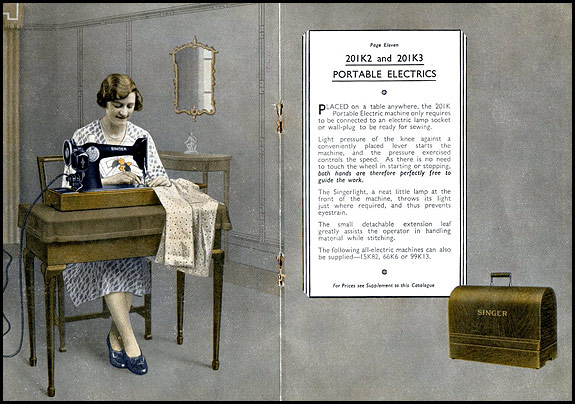
Singer 201K2 and 201K3

This is one of the many things which puzzle me about vintage Singers – why did they run the 201K2 (potted motor) alongside the 201K3 (belt-drive motor)?  I’d love to know what the sales pitch was!  Note that these electrics are knee-levers, which apparently sold well for years despite the somewhat agricultural appearance of the knee-lever itself.

Singer 99K

Here’s the old faithful 99, which they were still making the best part of 20 years after this brochure was printed.  Note that it’s no longer in a  bentwood case, and that you could rent one or have one on free trial.

Have you noticed how in those days you always sewed with your right leg crossed over your left?

Singer add-on electric motor and foot pedal

“Any Singer salesman will gladly demonstrate this motor in your own home on your own machine if you will call or write to the local Singer shop.”  I’ll bet – and no doubt talk you into part-exchanging your old 27 for a nice new 201 while he’s at it.

Note that apparently you don’t cross your legs whilst fitting a motor.

Singer 15K80 on "artisan" base

This is a rare bird nowadays – a 15K on what’s often referred to as the “artisan” treadle base.  This is the base with the bigger-diameter treadle wheel for faster sewing, which I think evolved into the one with the knee-lever presser-foot lift used for the 1200.  And you don’t see many of those either!

Singer attachments in godzilla tin

The standard attachments are shown in this brochure in the black crinkle-finish “godzilla” tin, which raises the question as to which machines were sold with them in the cardboard box instead?  I have no idea, but I do know that we can usually supply full sets in either.

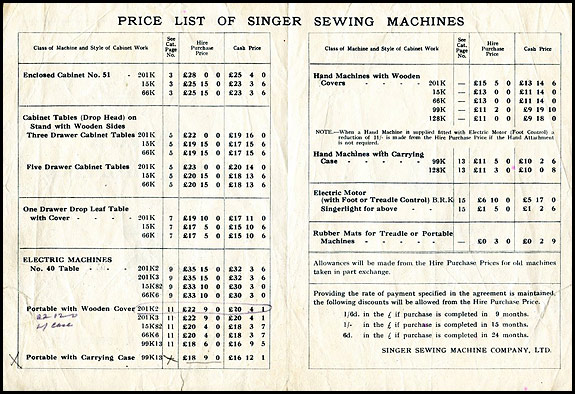
Singer UK price list 1940

Now if this isn’t actually the 1940 price list, believe me it’s as good as.  By this time they’ve moved on from quoting “list price” and “net cash price” to the much less confusing “hire purchase price” and “cash price”, but still with the discount for early settlement.

It’s difficult to give present-day equivalent costs because it all depends on how you do the calculations, but if we take for example a bog-standard 66 in a 5-drawer cabinet table, that’s listed here at £18 13s 6d cash or for our younger readers £18.67.  If we go by the Retail Price Index, that’s £795 today, but if we use instead average wage values, it would cost you £2370.  Either way, it just goes to show that these things were never cheap – and that buying a good one now is a real bargain!

There’s a lovely smell

Standard

coming up the stairs this morning …

Picture of spelt buns cooking on top of woodstove

Neither of us can actually remember when we started making our own bread.  But we got our cast-iron mill so we could grind our own flour at least 20 years ago, and we got that because we were fed up with the half-stale bread flour we used to buy from the shops, so it’s true to say that we’ve been baking since the mid-1980’s.  Or thereabouts.

By “we”, I mean of course Elsie most of the time, but I also make breadbuns, as well as a very nice spelt scone (pronounced the proper way).  According to Elsie I’m far too particular in the making and I never let anything bake long enough.  According to me, Elsie is a bung it baker and always tends to over-bake so her bread has a rock-hard crust.  Fortunately the same doesn’t apply to her pastry, which is usually baked to perfection or thereabouts.

Whether making a loaf in the oven or bread buns on top of the woodstove, the recipe stays the same, and just in case anybody out there’s interested, here it is …

Grind 800gm of organic spelt grain.  Tip it into a large bowl and add 10ml of salt.

In a measuring jug, add 400ml of boiling water to 200ml of cold water, stir it and chuck out all but 200ml.  Dissolve 5ml of sugar in that, then with a fork whisk in 15ml of dried yeast powder (slowly!).  Put a tea-cosy over it and leave to fester for 15 minutes or so.

Chuck yeast liquid/sludge into the flour and knead for at least 5 minutes, adding warm water as required to get the right consistency – very pliable, but not sticky (YouTube might be handy if you’re completely in the dark about that).

Cover the bowl with a plate or whatever and leave overnight.  In the morning, knead again for a few minutes then either bung it in a bread tin and bake in a hot oven until done, or divide into 6-8 portions and bake on top of your woodstove.  For that we use a wossname which Elsie got online from some place in Welsh Wales, and it needs greasing (it also needs careful preparation when you first get it but that’s another story).  You need to remember to rotate it from time to time to even-out the temperature, as well as to turn the buns over as they bake.

The temperature of your woodstove matters greatly when baking on the top thereof, and it’s very much a case of trial and error.  If it helps to know, if you put a standard cheapo Stovax stove thermometer on the top of your stove, the ideal temperature for baking is towards the top of the central silver band, which is reckoned to be 230-250 Centigrade, though how accurate that might be is anybody’s guess.  If in doubt, go under rather than over temperature.

And here endeth the lesson for today, except to point out that apart from having a scrummy taste, one other advantage of using spelt flour is that it’s fine for people who can’t tolerate wheat.

On the sewing machine front we’ll continue with more of the same once all this festivity has settled down, but in the meantime, if you’re wondering what else I’ve been up to (apart from The Finishing Of The Bathroom Cupboard), check out Elnablog

The wossname is actually a Welsh Bakestone which I got from www.welshbakestone.co.uk and it is awesomeIf you have a woodstove, you should get one!   E.

The bakestone is in fact made not of stone but of very thick and very heavy mild steel plate, but it is indeed a fine thing to have.  S.

Trust you to have the last word.  E

The Singer 285

Standard

Now here’s a funny thing.  As in peculiar, that is.

A couple of weeks ago, I spotted on Ebay another of those completely OTT hyped-up listings for a bulletproof, semi-industrial, heavy duty and the rest of it machine which was ideal for making tents, tarpaulins, suits of armour yadda yadda yadda and which had a start price of well over £100.  I don’t know if the seller was having a larf or what, but the machine in question was a … Singer 285K.

The very next day, I got an email from a gentleman asking if I could help identify the machine which he’d just bought for £15.  He attached a couple of very nice snaps of a rather run-down looking … Singer 285K.

Having answered that email and breathed a sigh of relief that he hadn’t asked me how I rated the 285 (since you ask, not really heavy enough for a boat anchor and not pretty enough for a door stop), I had a rush of blood to the head and decided to Google it.  And lo, look what comes up at the top of the page.  Yep, the good Mr Remlinger (he of the red vest) has shared his thoughts upon the matter.

Don’t forget this is a “heavy-duty, semi-industrial” machine he’s talking about, with an Ebay start price of over £100  … 😉