Queen Cotton – and a question about armpits

Standard

Seeing as how we Brits are poised to celebrate the fact that Betty Windsor has now served 60 years in the same job, I tried ever so hard to come up with an appropriate topic for today’s epistle so I could bill it as a Jubilee Special.  But alas, the only connection I could make between “Jubilee” and “vintage Singers” was Singer’s own Jubilee in 1951, and a post about that would still have been deadly boring however much I funked it up.  So we’ll just have to make do with this, which, if nothing else, does at least have the word “Queen” in common with this weekend’s festivities.  It’s the best I could do.

OK, it might be a bit late now to be making yourself a retro frock to wear to Sunday’s street party, but if you fancy knocking one up later, there’s plenty of inspiration to be had in the fashion show with which this fascinating film finishes.  Somewhat surprisingly for 1941, the whole thing’s in Glorious Technicolor, so not only do we see proof that people in wartime Britain didn’t really live in a black and white world, but also for once we get to see what colour those fabrics were.  Well, more or less.

There’s so much to love about this film right from the very start, with the band apparently playing bits of two or three different tunes in no particular order during the credits.  Check out the bloke with the fag cigarrette at 2.07, and consider how bizarre that must now seem to those too young to have grown up when smoking in the office was practically compulsory.  Warm to the sweetie with the wonderful smile at 3.02, and ask yourself what that’s about.  Note the high-fashion clogs at 5.20, and just imagine the amount of teasing that poor girl would have got from her workmates for wearing stockings in t’mill.  Unless of course it was a very posh mill.

Talking of posh, for once the narrator of this film is not the ubiquitous Alvar Lidell, but whoever he is, isn’t it marvellous how he pronounces necessary “nyecessary” and chemist “chyemist”?  I bet he lived in a nice hice.  And isn’t the woman to whom he hands over at 10.10 well spoken too?  She sounds like just the kind of girl every middle-class mother must have been hoping her son would one day bring home for a nice pot of Earl Grey and a slice of Battenberg with herself and Father.

Come to think of it, that’s a Jubilee connection of a kind – Battenberg cake!  I never did understand why, when Prince Louis (Phil the Greek’s grandaddy) changed the family name from Battenberg to Mountbatten during World War One so as not to upset the locals, the cake didn’t change to Mountbatten cake.  But I digress.  (I do wish he wouldn’t call Her Majesty’s dear husband Phil the Greek, but he always has – E)

When we get to the fashion show there’s many a treat in store, but the lilac creation at 11.57’s a show-stopper for sure.  Can anybody lip-read at 12.07 and tell us what her on the left’s saying to her mate about it?

Finally, when we get to 12.57 and the floor show finishes, note how no sooner has her with the green basket swanned off the floor than the punters are all on their feet and heading for the exit, no doubt keen to get to the pub and start the bitching.

Elsie and I thoroughly enjoyed it – and we enjoyed a lot of the others on that British Council Film site too.  Well worth watching if you ask me, just for the social history – even if the background music to many of them does set your teeth on edge.

Finally, a question about period frocks.  When I grew up in the 1950’s, my grandmother was still wearing many of her 1940’s clothes.  Many of her ideas were still unchanged from when she was a young woman in Edwardian times, so to this day I don’t know if one thing about her summer frocks was Edwardian 0r 1940’s or somewhen in between.  In fact, for all I know it might just have been one of grandmother’s peculiarities.  She had a lot of those.

The mystery concerns the very soft D-shaped cotton pads measuring 3″ or so along the straight edge, which where filled with some sort of soft wadding such that they were perhaps 3/8″ thick.  These were attached by means of two press studs to each underarm of the dress, so that when it was worn, the pads hung down against grandmother’s sides, close up under her armpits.

They were of course worn to absorb perspiration, and they were simply washed after each wearing and dried for re-use.   So, if that rings any bells … what were they called, were they manufactured or home-made, and was anybody else still wearing them in the 1950’s apart from my grandmother?

A hot, sunny Sunday morning in the bottom right-hand bit of England …

Standard

We’d both had our breakfast by 7.30 this morning.  Muesli with organic milk followed by a huge glass of orange juice for Elsie; muesli with apple juice followed by two cups of coffee for me.  We’d also collected today’s eggs.

By 8.45 we were back home after having watered the big allotment, which is only half a mile away, and picked just over 10kg of rhubarb.  (We watered the little allotment yesterday)

By 9.15 we’d also watered the garden by means of watering cans, there being a hosepipe ban in force, and picked another 3kg of rhubarb while we were at it.

At 9.45, I got on my bike to nip to Waitrose to get a few bits and bobs and some cash out of the machine, having by then made a start on chopping the rhubarb which Elsie was still washing.  Before I left, I took a quick snap for those of you who have might have difficulty envisaging what 13kg of rhubarb looks like …

Actually, that’s probably just under 10kg of it on account of how the first five jars were already in the water bath by then and there was a fair amount of it in the big bowl out of frame to the right.  Note in the background a large and very scrummy organic orange from the farm shop just outside town, which Elsie had been grating the rind off prior to us sharing it later.  The orange, that is.  Not the rind.

And now you want to know what that’s about.  Well, it’s just one of the many things that we do which we can’t understand why normal people don’t do.   We freeze the grated rind of organic oranges to use in our Awesome Carrot Cake, the secret recipe for which I might one day be persuaded to reveal.

Right, where was I?  Yes, Waitrose.  That’s it.  So I get the items on my little list, and then wander round the fruit and veg section before heading to the checkout.  It’s just one of those things I do by way of quiet amusement.  For example, only a couple of days ago I was intrigued to spot bags of fresh basil each labelled in large print “MAJESTIC BASIL”, so I asked a nearby Waitrose person what the difference was between MAJESTIC BASIL and adjective-less basil in lower case.  She didn’t know for sure, but suggested that it was “just marketing really”.  I guess she was right, because their fresh rosemary is ROMANTIC ROSEMARY, their fresh tarragon is TANTALIZING TARRAGON, and so on.

What a great deal of nonsense.

This morning I spotted the “fresh” rhubarb.  Only it was anything but.  It was half-dead rhubarb, fit only for the compost heap.  According to the shelf-edge ticket, though, it was “essential Waitrose rhubarb”.

And it was £5.99 a kilo.  Yes, £2.72 a pound.  For rhubarb.  Which grows itself.  In practically any soil, anywhere.  Anybody who can lay claim to a square meter of soil can grow rhubarb until it comes out their ears.  But if they can’t, they can pay £5.99 a kilo for it from Waitrose.  And if that’s not expensive enough for them, they can pay £7.98 a kilo for the same thing properly trimmed and packed in a plastic bag.  To save you doing the arithmetic, you’re looking at over £50-worth of rhubarb there, and that’s at the lowest Waitrose price.

Some trips to our local Waitrose are obviously more entertaining than others, but I was in luck this morning, for I was first through a checkout manned by a very earnest-looking young man called James.  James had what I assume to be a trendy haircut, and was also wearing glasses of the “designer” type.  He was very neat and tidy, and he smelled pretty.  (I was going to say “smelled like a tart’s handbag” but thought the better of it.)

James had obviously been instructed to engage the customers in conversation, so after asking me if I needed any bags today rather than if I needed any bags, he enquired how I was today.  I had a feeling I knew what I was in for, so in an effort to head it off I just said “I am very well, today, thank you”.  But that, and avoiding eye contact, didn’t work.

“Looks like another hot one today.” says he.

“Yes”, says I.  I forget what the next cliché was, but I just kept on packing my groceries and I didn’t respond to it.  However, with but a couple of items left to scan, he hit me with “Are you doing anything interesting today“?

Now … if this had been a Walmart checkout in Asscrack, Arkansas or wherever, I’d have had no problem whatsoever with that.  But this is England, and I for one am not a fan of this sudden craze for supermarket staff “engaging the customer” whilst going through a checkout.  However, I was in a good mood this morning so just I looked at him, smiled and said “Would you do me a favour please?  Back off with the cheery chat and just tell me what the total is?”.

Alas, the poor lad was offended.  “It’s not cheery chat!” says he, petulantly.  “I’m just talking”.

It’s probably just as well that by now, two more customers had moved into line behind me, so I no longer had the opportunity to explain to young James that the art of “engaging” with customers involves noting the way in which they react to what you say and tailoring your spiel accordingly.   And if the customer is obviously not a keen conversationalist, the best thing to do is just think “grumpy bugger” and zip it.

Whatever, I was back home to Elsie and the rhubarb-bottling before 10.30, with the remainder of the chopping-up to do while she did the processing.  That and general faffing took us to 11.30 and thoughts of getting our lunch together which, being but common people, we call dinner.  That involves picking and washing the lettuce, carrots and the assorted greens which only Elsie eats, cutting up hard-boiled eggs and wondering why whichever ones you buy, shop tomatoes never have as much taste as the home-grown ones which won’t be ready for ages yet.

In case you’re wondering, Elsie had some mysterious frozen left-over stuff with pasta in it which looked horrible but apparently tasted OK when reheated thoroughly, and I had my usual organic cheddar sandwich followed by one with homemade jam in it.  Organic wholemeal bread, of course.

So why am I telling you good people all this stuff?  Frankly, it’s because the sun is blazing down outside as it has been since it got up this morning, there’s not a breath of air, and it’s far too hot to do anything much more energetic than sit here in front of the computer with the blind down while Elsie reclines on the sofa in the kitchen reading her book about who’s really running the country.

Come this evening though, we’ll be running round like mad things …

Vintage Singer Automatic Zigzagger 160985

Standard

I just put this US-made black zigzagger up for sale on the Accessories page together with a couple of spare cams, and that’s reminded me to post this commercial for it from 1956 …


Note how the zigzagger’s first of all demonstrated on a Model 15 but at 2.20 it changes to a Featherweight (before it changes again to a Slant-o-Matic).  I wonder if even back then they kept getting FW-owners asking if it was too big to go on their machine, as they still do nowadays?

Whatever, that’s how Singer set about convincing the women of America that their lives could hardly be complete without this new toy, although quite what he with the accent is all about at the end, I can’t imagine …

Christiania for sale – and what is somebody who sews?

Standard

Yes, I do realise that it’s hard to see what exactly the connection might be between the funky tricycle in the picture and vintage Singer sewing machines, but bear with me, dear reader, if you will …

For reasons that are far too boring to go into here, Elsie and I need to find a new home for our beloved Christiania cargo trike, and I’m rather hoping that having the phrase “Christiania for sale” in the title of this blog post may help us to do just that.

Lest your curiosity be aroused, let me tell you that this fine machine is a one-size fits all Christiania Classic with a galvanised steel frame, disc brakes on the front and roller brake on the rear, and it has 8-speed hub gears so it’s very low-maintenance.  You can, as many Danes do, get a couple of kids in the box (both seating and canopy for them are available) and keep fit while you make it one less car on the school run, or you can get three Singer portables or one Singer treadle in it, which is the best I can do by way of a connection.  You can also get a hundredweight of mangels or mangolds or mangelwurzels in it, but that’s another story.  (and one best forgotten if you ask me – Elsie)

We bought it new in June 2010, it’s in jolly good condition, and the current list price including the extras ours has is something over £1800.   We therefore start talking at £1100, and an email to sidandelsie (at) btinternet.com will start the process whereby you can become the new owner of this versatile and very environmentally-friendly vehicle.

OK, advert over, so lets move on to sewers.

What is the word for somebody who sews?  If you’re British, and the somebody who sews is employed in a factory to sew on a machine, you call her a machinist, which is fine, even though a machinist is also a bloke who works machinery such as lathes, milling machines and so on.

But what is the Brit word for somebody who sits at home and sews, if she uses a machine but isn’t a dressmaker?

I keep seeing people on the interweb use the word “sewist”, which is an abomination guaranteed to offend the sensibility of any right-thinking person.  Using “sewist” is even worse than using the word “harp” to describe the throat space of a sewing machine irather than the irritating musical instrument often played at downmarket English wedding receptions in an attempt to lend an air of class to the proceedings .

But what about “sewer”?  If you’re in the US of A, the word rhymes with “mower” and it means somebody who sews.  But if you’re a Brit, it rhymes with “brewer” and it means a pipe which conveys sewage.

So I have two questions.  Is “sewer” actually in real-world use in the US to mean somebody who sews?  And is there such a thing as a British term for somebody who uses a sewing machine at home but who isn’t a dressmaker?

Come to think of it, make that three questions.  If it’s not a sewer, what is the American name for the big pipe under the road which takes away your sewage?

A little history

Standard

That’s a snap of a 1939 Singer 99K which we bought in Beckenham last year.  When I got that machine home, we found that in the base of it was a receipt made out to a lady who bought it secondhand in Sheffield in 1975.   When we’d finished work on it, we put the receipt inside the original instruction book, and you might just be able to see it sticking out the top in this picture, which is the one I used on the blog when I listed this machine for sale.

Before long we sold it to Linda in East Anglia, who named it Vera, and in due course Linda sent us an email, which I quote here by her kind permission …

Hope this finds you both well. I just wanted to say I am still  walking around with a smile on my face, and still  just love looking at Vera!

In the instruction book was a receipt,  for  a  Mrs Marshall  of Sheffield, well we  googled the address, and would you believe, it was a  Mrs Marshall still living there.  There was a phone no….. So I phoned her, and yes she bought Vera in 1975 in Sheffield. She said she had loved  her Singer, and had handed it on to her Daughter, and this is where I thought I  just might  be in trouble, because she said, she did not know her daughter had got rid of it!  Whoops!  Anyway, she took my phone no…..

She has just phoned me to say, she has spoken to her Daughter, and daughter said,  they  did not have the room for it,  so her Husband took it and  DUMPED IT, in a Tip in  Newcastle 20 years ago!   Amazing, I just hoped I have not caused a Family row!   Lovely to know a little of her history.

Isn’t it just?  Of course the question now is how on earth it found its way from a tip in Newcastle to a house clearance place in Beckenham …


Rewiring a 185K – and the Bottling of the Rhubarb

Standard

Yes indeed, the rhubarb season is upon us once again, but before we get to that, I’ve been asked to do a thing on rewiring a 185K which has the permanently-connected mains leads, as opposed to the plug-in ones used on pretty much every other vintage Singer domestic.  So here we go …

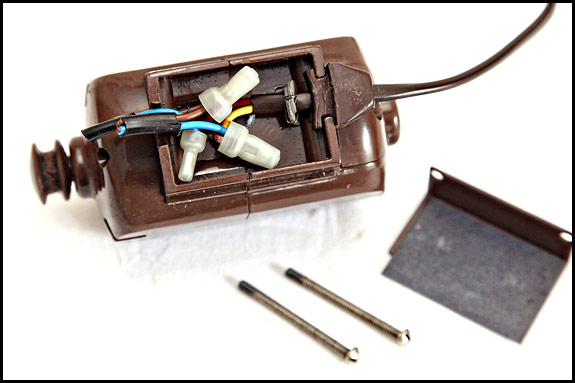
Now, you’ll have to pretend a bit here, because that’s the only 185 motor I can find right now and when it came to us it had already been rewired.  Badly.  If it was still original, those two cut-off black cables on the left wouldn’t be cut off, and they’d be brown, and they’d have a brown plastic thingy round them where they come out of the terminal box under the motor, like the cable on the right does.  I cut off those replacement leads to the mains plug and the foot controller when we bought this one in, but you can still see what a lash-up it was.

(In case you’re wondering, yes, that is a bunch of threads wrapped round the motor pulley, and no, I’ve never worked out how that happens either.)

That single cable going off to the right goes to the Singerlight, and it has its brown bush/sleeve thingy present and correct.  The reason why the corresponding one’s missing from the left hand side is doubtless because whoever did the wiring found that it was, to use a technical term, stuffed.  Those brown bushes harden with age, the lugs on them which keep them secure in the hole tend to come off, and when that happens, they are as much use as a chocolate teapot.

So he put it back together without one on that side, as we see more clearly below …

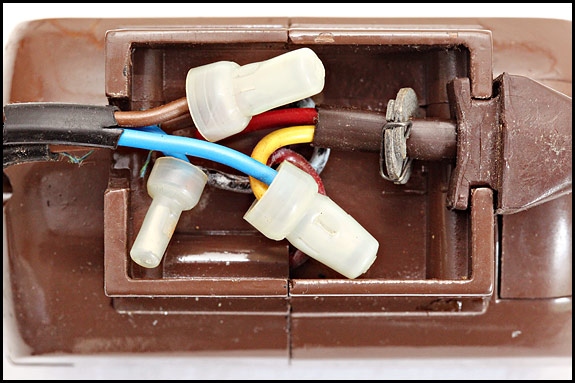
There’s your plastic bush on the right with the Singerlight lead going through it, and you can see what I mean about those lugs.  It won’t matter greatly if those particular ones come off because the lead to the Singerlight doesn’t generally get waggled about a lot, but the ones to the foot pedal and mains plug certainly do.  That’s why they need one of those bushes round them, and also some proper strain relief.

That light-coloured thing round the Singerlight lead just inside the bush is the original strain relief – a cunning little two-part affair made of fibreboard and a spring clip, which works well on the original flat twin cable but doesn’t work at all on anything else.  It’s also a pig to remove and replace, unless you’re privy to a secret technique handed down across the generations by horny-handed sewing machine repair men.

But what, you ask, are those off-white queerthings?  They, dear reader, are Scruits, unless you’re in the States, in which case I think they’re wirenuts.  But I’m not really sure.  Whatever, they used to be a very common way of joining two or three stranded conductors together, and they work a lot better than you’d think.  Basically all you do is strip half an inch or so of insulation off each conductor that you wish to join, align them alongside each other, and twist the ends together clockwise.  You then screw the Scruit on, remembering to twist it clockwise, and bingo – the metal inner of the Scruit tightens itself onto your wire ends and you have a secure connection.

The Scruits in the picture are the later nylon-bodied type, and these particular ones have been crimped after they were screwed them on, presumably because whoever fitted them had no faith in the Scruit doing its job and no intention of ever undoing the connection.  Earlier Scruits came in a truncated conical form made of hard black plastic, and earlier still they were porcelain.  I like Scruits, I do, but then I was brought up when they were still widely used.

And that picture illustrates why re-wiring a 185K is seldom a straightforward business.  It’s not the Scruits that’s the problem, but the lack of strain relief and of a suitable bush when you can’t re-use the original  one.  Frankly I have no suggestions as to how you might go about making a proper job of it in the absence of a re-usable bush.  All I know for sure is that if we couldn’t rustle up a bush in good condition and also come up with an effective way of providing suitable strain relief for the new cables, we wouldn’t offer the machine for sale.

So there you go.

Moving on now to rhubarb, ours is at least a fortnight late this year because of the horrible cold weather.  We picked a bit last week because we really fancied stewed rhubarb and icecream for pud and while we were at it we made half a dozen jars of jam, but today was the start of the season proper with 21lb picked this morning.  That’s filled thirteen Kilner jars with enough left over to make a gallon of rhubarb wine …

This year we’re trying out the water-bath method of bottling because Elsie’s sure it uses less energy than doing them in the oven, and rhubarb’s a good subject to test the method with because we’ll have an abundance of it for the next few weeks.  If we get any jars which don’t seal properly, we can always put them in the fridge for eating soon then just pick more rhubarb and try again.

Readers who are into this sort of thing may care to note that our rhubarb is a mix of Hammonds Early and Brandy Carr Scarlet, the lifter-outer in the foreground is from Lakeland Plastics and is essential for this method of preserving, those Kilner jars are the 1978-1990’s type which are known as Red Tops irrespective of whether the rings are red, orange or white, and if you’re after spares for your Kilner jars, it’s worth checking out this site

We’ll probably do another dozen or so jars of bottled rhubarb this coming week (each jar makes 2 crumbles), but we’ll also be making a lot of scrummy rhubarb and elderflower jam because judging by the look of the blossom, we’re not going to be making much damson this year.

Finally though, a question for our American and Canadian readers about home preserving terminology.  Where you are, do you guys call this procedure bottling, or is it canning ?

Gosh, it’s the first of May already

Standard

Hooray! Hooray!

’tis the first of May. 

Outdoor sex

begins today.

Or so the young people of this fair land were wont to sing in days of yore.  Allegedly.  Come to think of it, that’s exactly the kind of ditty a Morris side would sing as a prelude to a dance.  Not that I have a penchant for Morris dancing, you understand.  Oh no.  Not me.  But if I did have, it wouldn’t be for hankie-wavers like the chaps in that picture.   And certainly not for rapper sides or cloggers either.

Be that as it may, or indeed as it May, today marks not only the start of the Morris dancing season, but also a few changes around here.

One is that the “Bits ‘n’ Bobs” page has gone, and in its place we now have both an “Accessories” page and a “Parts” page.  “Accessories” has on it most of the stuff that used to be on “Bits ‘n’ Bobs”, and “Parts” is pretty much what you’d expect.  Or rather it soon will be, because at present it’s in a state of flux whilst I sort it out.  Do check it out from time to time, especially if you’re after a widget, a wossname, or even perhaps a doohickey.

Those of you who keep an eye on the “Singers for sale” page will no doubt have noticed that there’s been nothing new on there for several weeks now.  Funnily enough I’d noticed that too, and the reason is simple – we’ve had nothing new to list.  In the last month we’ve found new homes for a 99 and for three 201’s which sold before I had chance to list them, and that’s just about cleared us out of machines for sale, except for a few 99 hand-cranks still in the pipeline.  For that and several other reasons, we’re now shifting the emphasis away from machines and concentrating instead on accessories and parts for them.

One of those several other reasons is The Motor Car, which, if all goes well, we’ll finally be getting rid of this summer.  Experience taught us long ago that very few people can be relied upon to pack a sewing machine properly for delivery by Parcelfarce or courier, so if you want to buy in sewing machines, you need a car.  But when you don’t need one for anything else, it makes no sense at all to keep it.

More about being carless in due course, but for now, you may sleep easy in your bed knowing that what we lose by not having machines to sell we gain by having parts as well as accessories.  Business as usual, really – just a bit different.

As for Morris dancing … one of the very sad things about it is that when a halfway-decent side does turn out somewhere, nowadays most people don’t watch them dancing.  Instead, they stand around aimlessly taking rubbish pictures of it with their phones.  Furthermore, it seems to be inevitable that any video of Morris dancing that’s posted online will be so badly shot that it’s positively painful to watch, which is a shame.  This one’s actually better than most, so try to ignore the dodgy camerawork and be amazed by the real skill of a Border side from Sheffield called Boggart’s Breakfast as they dance The Impossible Dance.  You’ll see why it’s called that …

Vintage Singer UK brochure featuring her with the frock – part two

Standard

OK, here’s the rest of that wonderful Singer brochure featuring Ann Droid and her stripey frock, and thanks to Alison we now know that this was almost certainly published in 1951.  Our copy’s somewhat faded in places 60 years on, which is why these scans aren’t all that brilliant …

“Do you prefer cabinetwork of contemporary design?” indeed!  As far as we’re concerned, the best thing about these Cabinets, which we always thought were Tables, is the fact that the legs are readily detachable.  That’s a real boon when the machine you just brought home is in one of these things and you can’t quite bring yourself to take the table down to the dump recycling centre once you’ve taken the head out of it, so the only place left for it is in the attic alongside the other two.

Having said that, Elsie’s determined to get one of them down from the roof soon and take it with us next time we do a boot sale – unless of course by publishing this post I manage to whip up a demand for them that we’ll be pleased to meet.  Which I very much doubt, but I live in hope.

Be that as it may, we’ve now got to the middle of the brochure, and because of the way the centre pages are laid out as a double page spread, it just doesn’t work scanned as two separate pages.  I’ve had to link to it here so off you go now for a squint at that.

As you can see there, we’ve moved onto treadle machines, and the choice of head is simple – would Madam prefer a 15 or a 201?  According to the printed text, the choice of base was equally straightforward – pick one of three variants of the “modern” (i.e. wooden legs) treadle base – 3-drawer, 2-drawer or 1-drawer.

So far so good.  However, the notes added by the salesman (with his fountain pen, of course) muddy the waters somewhat.  Judging by his sketch, he seems to have been offering a 7-drawer with wooden legs, to which his note “NEW £46” seems to refer, and that’s interesting because neither Elsie nor I can recall ever seeing such a thing.  He’s also made a note of a “drop head with iron stand” at £20, which must surely have been old stock because the printed text actually states that the iron legs “have been superceded” by the wooden ones.

His note at the bottom right-hand says “Dressmakers model table top with cover £15”, and I’m not sure what to make of that because “Dressmaker” in this context was usually Singer staff talk for a 201.  Even more puzzling, the top right-hand note says “modern style folding head with 7 drawers £28”, which would seem to relate to that base with the four extra drawers drawn in.  But if it does, what’s with that “NEW £46” above it?

If anybody can shed any light on those notes and/or the pricing, do please let us know, but before we leave the treadles I’ll just clear up one thing.  There was never a 99 treadle.  If you do see one, it’s not kosher.  It’s a DIY job.

OK … now we come to another double page spread, but this one does work as two halves …

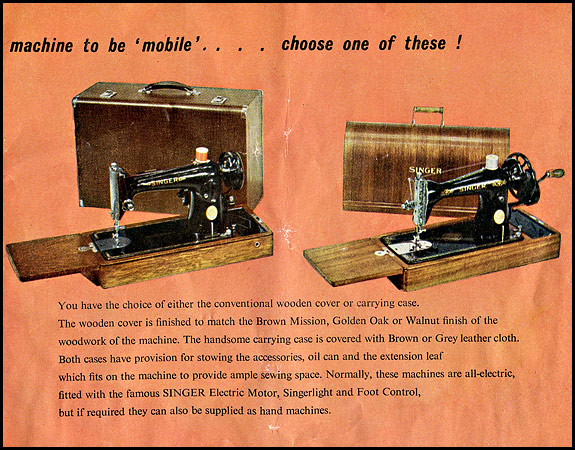
Interesting that one of these “full size machines” is the 99K, which is of course a three-quarter size machine!  And how about the claim that they “can be easily carried from room to room”?  A hand-cranked 99 in its case weighs 14.5kg (32lb) and an electric 201’s heavier still at 20.5kg (45lb), which strikes me as a fair old weight for anyone to easily carry from room to room.

And look, there’s that “Brown Mission” again!  If that’s not a daft name for the colour of a wood finish, I don’t know what is.  And was the suitcase-type case really available in grey leather cloth?   If it was, did it look as uninspiring as it sounds?

Whatever, note that the text on the page above says “Normally, these machines are all-electric, fitted with the famous Singer electric motor, Singerlight and Foot Control”, yet the 201 illustrated is a knee-lever machine!

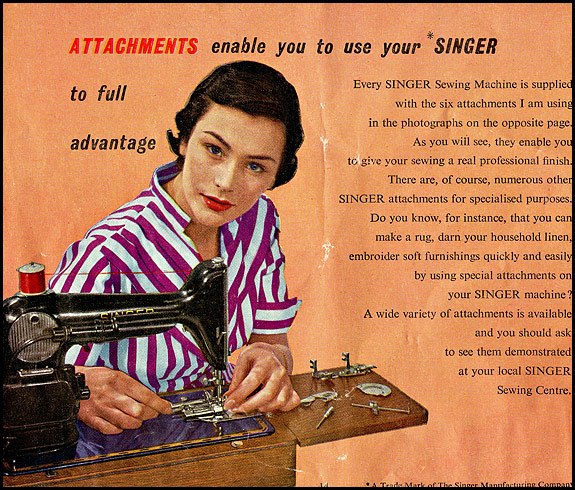
Personally I’m convinced that this brochure is 1951, but here’s your proof that it’s definitely pre-1954.  If it was any later, Stripey would be wanting to show you her new 222, not the 221 shown here.  And at this point I’d better explain for those of you who aren’t Featherweight Fans (or even Pheatherweight Phans) that a Featherweight is either a 221 or a 222.

The 221 was introduced in the mid-1930’s, and Singer eventually made over 1,000,000 of the things.  Then in 1954 they brought out the 222, which is just a 221 with a free-arm and feed dog drop, but they only made 100,000 or so of those, which is presumably why they’re sometimes advertised as “rare”.

Incidentally, many of its devotees think the 222 was the first domestic machine with a free-arm, but they are wrong.  The Elna Grasshopper was the first, by a good 10 years.  But I digress.

I just love the suggestion that a 221 is “easily carried wherever you go – from room to room – on a long trip – or just for an afternoon’s sewing at a friend’s house.”  An afternoon’s sewing at a friend’s house?  Who is the woman kidding?  Or is that code for “so easy to cart about with you to show off to your friends and make them really jealous”?  Whatever, Featherweights are undoubtedly cute and they certainly have a huge following with quilters in the States, but for our money they’re over-rated.  There.  I said it.

Lovely use of Proper English there, and interesting to think that 60 years ago that wouldn’t have been thought in the least patronising.  Or boring.  Back then, Singer were still on top of their game.  They were the absolute masters at marketing domestic sewing machines, and there’s not the slightest hint anywhere in this brochure of the rot which was soon to set in

Oh look – she’s doing that sincere expression again, bless her.

Now, there’s a couple of matters arising from those pictures of the six attachments that were supplied with new machines in 1951 (or thereabouts).  One is that, surprisingly, by this time the ruffler was not one of the standard attachments.  And the other is the quilter.  I really do wish they’d called it what it is i.e. a quilting guide.  So many people seem to think that “the quilter” is some awesome attachment which does something really clever, when all it actually does is allow you, within certain limits, to sew parallel to and at a fixed distance from the last line of stitching in your quilt.

And finally we turn to the outside back cover …

with its cutaway of Mission Control.  Which raises an interesting question – when did Singer shops in the UK finally stop offering the dressmaking courses, and for that matter the finishing service?  If you happen to know, we’d love to hear from you.

Going off at a tangent now, when I first saw Stripey’s frock it immediately reminded me of a silly idea that Kodak UK came up with in the mid-1960’s. They thought it would be fun (or whatever) to have the women who worked in the shops which shifted the most Kodak films wearing very loud blue and white stripey frocks with a yellow Kodak badge on the left breast during the summer film-buying season.

At the time, my mother was one of those women, and I have this vivid recollection of her coming home from work one day with this large brown paper parcel in the wicker basket on the front of her bike.  She was not happy.  It was very nice of Kodak to give her two cloth badges, a pattern and more than enough material for two dresses, but if nothing else, when did they suppose she was going to find the time to make them?

If I remember rightly, she eventually got a neighbour to knock one up, tried it on, decided she wasn’t going to look like a deckchair for Kodak or anyone else, and that was the end of that …

A remarkable machine plug modification

Standard

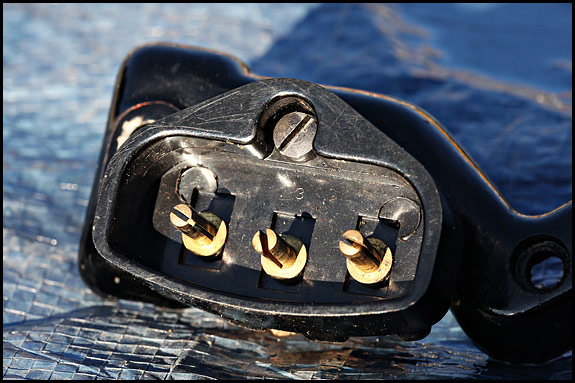
Some time ago, we bought in a 201 for parts and as usual, one of the first things I did with it was to cut the motor plug off the lead.  I was about to chuck it in the appropriate spares bin when I noticed that it had been modified …

See that black lump between the two screw heads, and the square thing sticking out above it in the picture?

Well, once I’d removed the two screws and pulled the queerthing up so it photographed clearly, that’s what it looked like!

That’s it from the other side, and yes, it is indeed on the end of a couple of earth wires.

So, somebody has first of all laboriously made that little widget from steel strip.  They’ve then opened up the cable entry hole in the Bakelite plug body so it will take two three-core cables instead of the usual two twin-core ones.  Having stripped all six wires at the right length for four of them to connect to the three contacts inside the plug body, they’ve then pushed the two earth wires back outside and soldered them to the widget.

After that, all they had to do was find a couple of skinny bolts longer than the original ones with which to fasten the two halves of the plug body together (and that in itself is no mean feat), then put a dab of black paint on the solder to make it all look prettier.  Et voilà – an earthed machine plug.

But what, you ask, does it earth to?  Well, given that the socket on the machine into which the plug plugs is made of Bakelite, the answer is the that it earths to the only thing it can do – the screw which holds the socket onto the motor mounting bracket!

Comme ça …

That’s the best snap I could manage, but hopefully you’ll see that as the plug in the foreground is pushed into the socket in the background, the tag on the widget slides under and against the head of that fixing screw.

Now, if only it had occurred to me, I could have put the meter across that little lot and seen just how good that earth actually was in view of the number and nature of the contacting surfaces between the earth pin of the 13amp plug on the end of the mains lead and the body of the 201 itself.  But it didn’t.  Occur to me, that is.  So I didn’t.  Meter it.

Presumably our hero connected both earth wires because the one that didn’t go to the mains plug went to a metal-bodied foot controller rather than the usual vintage Singer Bakelite one, but who knows.

Whatever, as far as I can see, this is the only way you can earth (or more accurately “earth”) a classic vintage Singer electric and retain the original motor plug and socket.  Quite why anybody would want to embark on this task in the first place is way beyond my understanding, but if I wore a hat, I’d certainly take it off to whoever had the patience and the determination to complete it.

The Singer Automatic Zigzagger and its cam sets

Standard

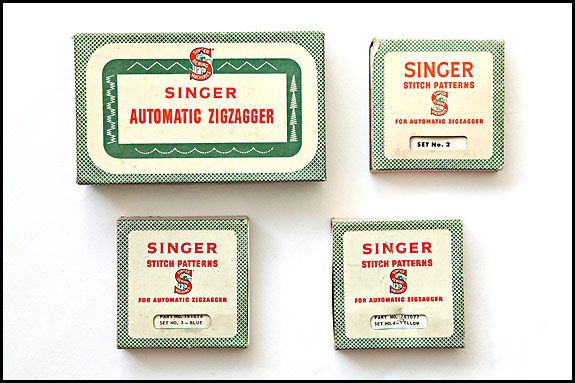
Wow.  I finally got it together to take these pictures!  Somebody asked ages ago about the extra sets of cams (or as Singer called them, “stitch patterns”) for the big black zigzagger, and I’ve been meaning to do this post ever since.

And now it’s happened, because I’ve just listed a blue set for sale on the Bits ‘n’ Bobs page and I needed to get the camera out for that.

The zigzagger pictured above is actually Elsie’s own 161157, but it could just as easily be a 161102 or even a 160985.  They’re the same dog with different spots, and few of us are blessed with the ability to tell them apart without reading the number on the actuating arm.

Set 1 is the 4 red cams which came with the attachment.  Set 2 is white, 3 is blue, 4 is yellow, and the part numbers for both the sets and the individual cams depend on whether they’re the earlier heavy ones or the later lighter ones made of so-called pot metal.

Elsie’s volunteered to run off stitch samples with all 16 cams, so I’ll photograph those and do a post on them in due course.

If that hasn’t happened by the middle of May, can somebody give us a poke please?