The Jetson case … and Elsie’s nettle beer

Standard

Somebody asked me the other day what a “Jetson buttonholer” is or was, and I said I’d do a post about it.  So here we go.

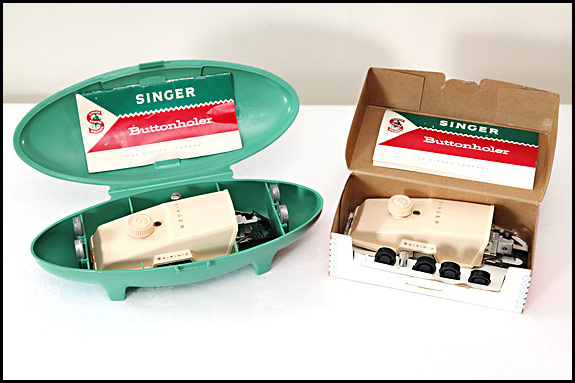
That green thing is what is commonly referred to as the Jetson case – so called after the green spaceship in “The Jetsons”,  an early 1960’s American television cartoon.  In it is contained the Singer Buttonholer489510, its four alternative templates, the fixing screw and the feed dog cover plate (hiding under the buttonholer itself) …

There’s also a sort of muddy dark pink version of that case, in which should be found the Buttonholer489500, which is identical except it’s for slant-shank machines.  And the answer to the question “if the buttonholers are identical, how do you tell them apart?” is that in the absence of a part number on it, the straight-shank one says “STRAIGHT” on top of the metal near where it fits onto your presser bar, and the slanty one says “SLANT”.

Note that those templates are metal, and that they’re exactly the same as those for the Buttonholer 160506 (the nice black one in the dark green textured plastic case).  However, you only got your Buttonholer 489510 in that Space Age case if you bought it in the States!  Here in the UK, we got the cheapo packaging …

We also got plastic templates instead of the metal ones …

So.  Which would you have preferred?
Thought so.

Anyhow, that’s the Jetson thing done, and it’s reminded me to point out that I put some more goodies on the Bits ‘n’ Bobs page yesterday.  They’re mixed in with some of the stuff that’s been there a while (including a Buttonholer 489510), so do scroll down and have a nosey.

On the home front, things are hotting up now even if the weather isn’t.  The rhubarb’s all coming along nicely, the greenhouse is crammed full of green things all a-growing, Elsie hoed the spuds up in the garden for the first time yesterday, and she picked the first radishes of the year.  We seem to be about a week away from the start of the home-grown lettuce, although everything’s a few weeks behind last year.  We bottled our first rhubarb on April 15th last year, but it’s going to be a good fortnight or so before that happens this year.

One thing that has already happened though is The Brewing Of The Nettle Beer …
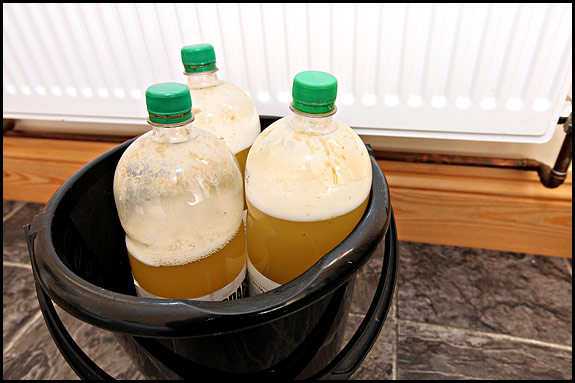
Doesn’t that look scrummy?  Actually I don’t think so either, but Elsie does.  That’s the first gallon (less half a pint taken for quality control purposes), sitting quietly in a bucket in the bathroom yesterday, and seeing as how you’re now bound to be seized with a sudden urge to make some yourself, here’s the secret recipe …

Fill a supermarket carrier bag with young nettle tops, take them home and wash them.  Chuck them in your preserving pan or similar and add enough water to cover, taken from one gallon.  If you fancy spicing it up a little, add a tablespoon or so of chopped root ginger.  Maybe even a pinch of Cayenne pepper too, although Elsie makes it without either.

Bring to the boil and simmer for 15 minutes.  It will smell foul (no it doesn’t, it smells like spinach -E) and it will look disgusting.

Remove from heat, fish out nettles, add juice of 2 lemons, a tablespoon or so of cream of tartar and 1lb brown sugar and stir well until dissolved.

Add the remainder of your gallon of water.

When cooled to body temperature, add about half a teaspoon of beer yeast and stir.  If you don’t have beer yeast, use wine yeast instead.  If all you have is ordinary baker’s yeast, try that and let us know how it works.

Now, if you’re into home brewing, pour into a fermenting bin and carry on like you do for proper beer.  If you’re not, pour into clean PET bottles and leave for 5 days before sampling.

The pressure will build up sooner than you might think, so be sure to keep an eye on the bottles.  If they start bulging, let a bit of the pressure off 2-3 times a day if needed, but don’t overdo it or you’ll lose the fizz.

We’ve never yet had a bottle burst or blow the cap off, but we always let it do its thing in a bucket in the bathroom and throw an old towel over just in case …


“I am a typical Singer girl”

Standard

No you’re not, dear.  You’re Ann Droid, a figment of somebody’s fevered imagination, and you freak me out with your weird expressions, your wooden poses and your eyebrows.  Can’t say I’m a big fan of the frock either, but never mind.

Unfortunately we can’t date this brochure with any accuracy, but I think you’ll agree it has to be 1950’s.  Early 1960’s at the very latest?  Whatever, that very much of-its-time earnest expression coupled with the very properly-worded question on the cover sets the tone for the entire contents, as we shall see …

Good old-fashioned proper English, but obviously written by a chap who always wore his jacket in the office and still wore shirts with long tails and a separate collar.  Arm-bands too, probably.  Horn-rimmed glasses for sure, and always addressed as Mister Jones.   Same seat on the bus into the office every morning, and not much longer to go before his gold watch and his pension.

But wait – what’s that snappy slogan going on there at the end of that block of text?  “Where there’s sewing there’s SINGER and where there’s SINGER there’s service” indeed.  Wow.  Personally I think they should have kicked that idea round the block a few more times before going firm on it, but at least they made the effort to get a bit lively.

And finally we get down to the nitty-gritty.  We learn that the 99K is “the smaller type of domestic machine” and has “proved ideal for normal sewing requirements”.  Gosh, and to think that 50 or 60 years later the very same 99K is regularly touted on Ebay as a “heavy duty semi-industrial” machine.  Maybe they improved with age?

Interesting that the 15K’s “designed for constant hard work in the home … or in the dressmaker’s workroom”, but the best they can say about the 201, which is nowadays considered to be the real workhorse, is that it does tricks by way of reverse and drop feed.

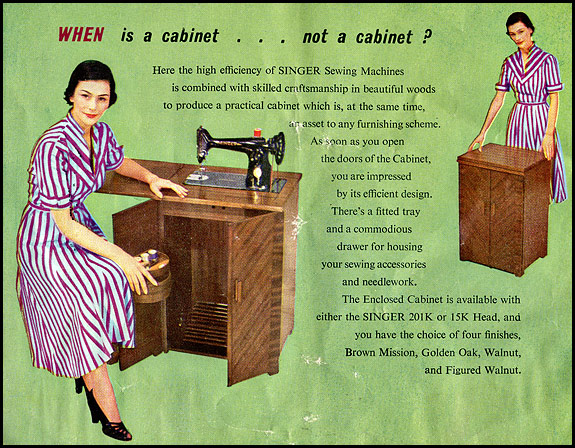
Ooooh look!  The Queen Anne table, as often seen in those Eastbourne living rooms with the the patterned carpet, the Dralon three-piece suite with matching pouffe, the Bontempi organ in the corner and the framed print of Tretchikoff’s “The Chinese Girl” still on the wall above the electric coal-effect fire.

I love the bit about it being “a pleasing piece of furniture with many other uses” when the machine’s folded down and the top closed.  Beyond standing a couple of framed snaps of the grandchildren and/or an arrangement of dried flowers upon it, I wonder what those “many other uses” actually amounted to.

But now we’re talking!  The good old Enclosed Cabinet No.51, which I hadn’t realised was actually available in four finishes, one of which was “Brown Mission”.  Don’t ask us.  We haven’t a clue either.

Whatever the veneer, we like the 51 we do, because it’s eminently practical, it doesn’t take up much space, the treadle action’s nice on it, and it was available as a Convertible on which you can swop between treadle power and electric as the fancy takes you.

Elsie’s just read that last bit over my shoulder and says I shouldn’t big up the 51 cabinet any more in case people think I’m only saying how good it is because we have three spare ones in the house at present and wouldn’t mind seeing the back of a couple of them, but that’s not the case at all.  We really do like them.

Honest.

More deathless prose from Mister Jones and more of Ann Droid and her stripey frock to come when we do the remaining pages …

And now … clarification of “vintage Singer sewing books for sale!”

Standard

We’ve had three people asking if the Singer books we now have for sale on the “Bits and Bobs” page are originals or copies.

The question seems to have arisen because I originally wrote “We have a few spare copies of these books” and  “Clean and tidy copy” and so on.  I’ve just edited the listings, but I thought it best to make it clear that the books we have for sale are not copies.  They are originals.

We may have more than one copy of some titles, but all the copies we have are originals.

Not copies.

Some copies are in slightly better condition than other copies, but even the worst copy is in good condition, considering it’s not a copy.

They’re all original copies of the books.

They are what came off the printing press when they were first published in America

They are old.

We don’t do fake repro.

And now … vintage Singer sewing books for sale!

Standard

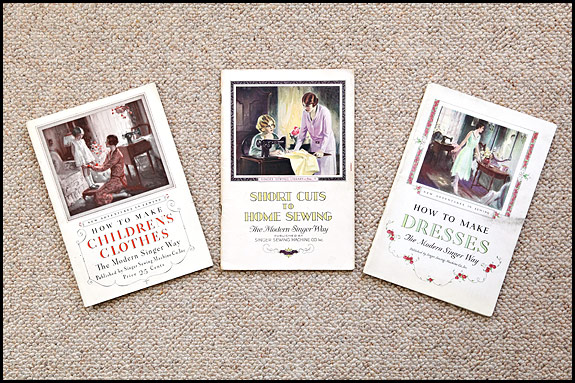
Gosh, I finally got it together to sort out a few spare copies of these wonderful Singer USA books and get them listed on the “Bits ‘n’ Bobs” page. They’re originals, they date from the 1930’s, and as far as I know they were never sold in the UK.  All three are fascinating reading – and if you’re at all into antique/retro dressmaking, they’re right up your street!

“Sort Cuts To Home Sewing” starts with a worthy foreword by the Singer Sewing Machine Company, who were obviously not big on paragraphing.  But no matter, because we then dive straight into it with the ubiquitous Mary Brooks Picken and her quaint way of wording things e.g. “Ever since I was a very little girl I have loved to sew myself”.  The mind boggles, but whatever toots your flute …

She may have been a strange child, but in later life Mary BP certainly knew her stuff.  There’s oodles of invaluable information on caring for your Singer, including stitch formation and tension, oiling, common causes of machine troubles and so forth, as well as how to sort out your bobbin thread guide by the application of a pair of pliers!  And after that, there’s everything (and I do mean everything) you need to become an expert user of the binder, the foot hemmer, the adjustable hemmer, the tucker and the ruffler, with plenty of excellent illustrations.

“How To Make Children’s Clothes” is perhaps more of a nostalgia thing, unless of course you’re into making costumes for Amateur Dramatics.  Having said that, though, it’s full of practical hints and tips which apply just as much now as they did 80 years ago – even if you don’t have an urgent need right now to rustle up a bloomer frock for a four year old.  Difficult to put down once you start looking through it, this is may well be an invaluable little book for fashion students.

“How To Make Dresses” is absolutely essential if you’re a student of fashion.  You have to have it!  You need it too if you’re a theatre costumier, or for that matter if you just have a thing about 30’s style.  Good stuff on seams, using and altering patterns, assembling and finishing dresses, hemming and so forth, including period gems like the bit on “Clothes’ Becomingness”.  Remember ladies, “a dress can rarely be smart that is not first becoming”.

Be that as it may, these three little books are now listed for sale individually, but we do also have a set of four (the above three plus “How To Make Draperies”) which are in remarkably good condition.   Quite frankly we’re as yet undecided whether to let them go, but if you’re interested in the set, you could do worse than send us an email …

Wiring diagram for vintage Singers

Standard

I keep getting asked about wiring diagrams for vintage Singers, so here goes …

What follows relates to pretty much every standard domestic Singer electric sewing machine sold in the UK between 1930-ish and the mid-1960’s.  If your machine has a socket on it that takes a plug which looks something like these, we’re in business.

picture of vintage singer sewing machine plugs

Before we go any further, though, let me say yet again that there is no earth (ground) connection on these machines.  Yes it’s a three-pin plug and socket but no, one of them is not an earth connection.  There is no easy way of properly earthing a pre-1960’s domestic Singer, and in my opinion no earthly need to (hah!) as long as your consumer unit has an effective RCD.   If baffled by last bit, see here

If your machine takes those plugs, then the socket on it looks like this, although your pins might be solid rather than slotted like these are …

Picture of vintage Singer sewing machine motor socket

Obviously yours won’t be graced by those nice purple numbers, but we need them in the picture to show how the socket relates to the wiring diagram below.

Wiring diagram for vintage Singers

That’s the universal vintage Singer domestic wiring diagram in its simplest form, and you’re looking at it the same way as in that photo above.  Sorry about the watermark, but it took me ages to do that diagram in Photoshop, and if people are still going to steal the image, at least now they can do some advertising when they use it somewhere else.

In case it’s not obvious, “mtr” is motor,  “ctr” is controller – and yes, it really is that simple!  The practice might not be, but the principle certainly is.

Note that the connections are usually numbered on the back of the socket, but often they’re not on the plug, so do check that you have everything the right way round before connecting to the mains.

And that, dear reader, is as far as this explanation’s going, because if you can’t work out everything you need to from the above, it’s probably safer to leave your wiring to someone who can …

Les’s Longpods, the awful 285K – and our 100th post!

Standard

That’s Broad Bean “Les’s Longpod” on Monday of this week, that is – and those plants will grow up to produce loads of seriously scrummy broad beans, or if you’re in the US, fava or field beans.  They freeze well too.  It’s a variety we grow each year from saved seed, and it’s named after an old boy called Les, who gave us the seed when he gave up his allotment, on which he’d been growing it year in year out since the Siege of Kut.  (Since 1969, actually – Elsie)

Talking of times past, and seeing as how not many folks seem to use such things nowadays, I’d better explain that those beans are growing under some of our prized barn cloches.  We’ve got 49 of them, which means we’re the proud owners of 196 2ft x 1ft sheets of glass.  I know we bought 100 sheets from a glass merchant years ago, but I hadn’t realised until now that Elsie must have cut more than 96 of them since then from glass we’ve scrounged.

Barn cloches are a PITA to assemble every March and dismantle later in the summer, but we only reckon to break one sheet of glass a year in the process.  It’s worth the faffing about though, because they’re ever so much better than those plastic contraptions you see in garden centres.  They last for ages too – we bought some new wires a year or two back, but most of ours were well rusted when we acquired them 20-odd years ago.  We like barn cloches, we do.

It’s all happening in the greenhouse too.  That stuff in the pot is American Cress, which is one of those peculiar salad crops like Green In Snow and Mizuna which Elsie eats.  I of course play safe with the three different types of lettuce which are coming along nicely too. (More than three actually but he hasn’t realised that – Elsie)  In fact, we’ve stuff sprouting and coming up all over the place now.  We really ought to get our act together and get the spuds planted before much longer, but we’re still waiting for a delivery of spent mushroom compost for the top allotment, and that needs to go on before the spuds go in.  Still, Elsie’s got it all under control.  Apparently.

But hey, the veg is not the only thing that’s growing. Would you believe this is blog post number 100?  No, neither would I, but it is.  Even more surprising, I happened to look at the site stats the other evening and … 611 page views in the previous 24 hours!!??

What’s that about?

I don’t get it, but then I guess I don’t have to.

Anyhows … to celebrate our modest success in topping 600 page views in a day, here’s another of those wonderful old Singer commercials.  This one features, of all things, the truly dreadful 285K.  “Independent sewing experts” may well have given it “top value rating” at the time, but the truth is it’s a horrible machine which has since gone down in history as possibly the worst one Singer ever made …

Have a good weekend, folks.

Ebay – I suppose it had to happen …

Standard

My attention’s just been drawn to the above listing, which is item number 251020131277 now on Ebay.co.uk

Check out the picture, and then compare it with this one, which is on our Bits ‘n’ Bobs page and is of the Vanguard buttonholer which we have for sale …

Notice the white scuff marks on the box?

At least they didn’t pinch all the text too – only the bit which says “with feed cover plate and screw plus original instructions complete with original sample buttonhole stapled to them” …

(Thanks for the email Carol!)

Singer 201K feed dogs – how to lower them

Standard

In response to public demand (two requests for this in the same week is “public demand” as far as I’m concerned), here’s how to lower and subsequently raise the feed dogs on a 201.  What follows applies to both the Mk1 and the Mk2, and hopefully it’ll be a bit easier to follow than the original machine instructions are.

OK then, let’s do this thing.  You need to swing your machine head up on its hinges, and maybe hold it there with something or other while you furtle about underneath the bed.   When you’ve done this dogs-dropping lark the once, the next time won’t take you two shakes of a lamb’s tail so you won’t need to bother propping it up.

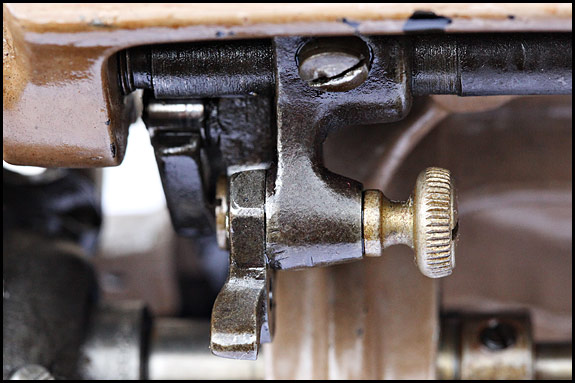
What you’re looking for is this gubbins, which is located just under the front edge of the bed, three inches or so in from the left …

Now, when you want to lower the dogs for embroidery or whatever, the first thing you do is unscrew that knurled screw head, so it looks like this …

The screw might be tight, in which case you can either get a pair of pliers on it or use a wide-bladed screwdriver in the slot in the screw head.  Don’t forget that you want to turn it anti-clockwise!  In theory it will unscrew about as far as in that snap and no more, but on some machines you’ll find that it will unscrew completely and drop out.  Don’t panic if it does – just screw it back in a turn or so.

That’s what it looks like from a different angle, and perhaps you can just see the threaded hole into which that screw was screwed.  Now that’s unscrewed, the wossname with the threaded holes in it and that little arm sticking up is free to pivot downwards, so your next move is to push downwards on the arm, so that the other threaded hole lines up with the screw, as in the following picture …

By swinging that wossname down, you’ve rearranged the linkage so that feed dogs are dropped and they no longer move the work past the needle, and if we look at it square on, the whole thing now looks like this …

And when you screw the screw back in (fairly tight) so as to lock it all in that posiiton, it looks like in the picture below.

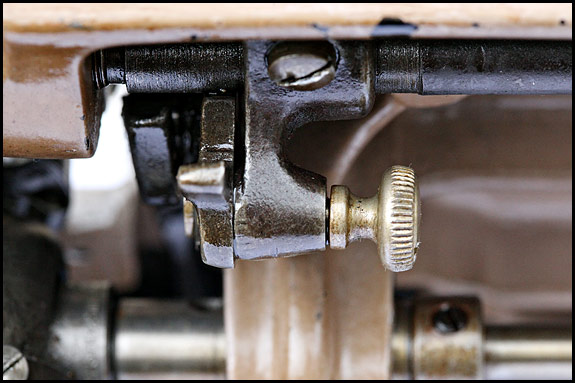
That is the “dropped dogs” setting, and you’re done, so you can lower the head back down into its base now and embroider (or indeed darn) away to your heart’s content.  And here for comparison is the same picture but with the normal setting.

Finally, just in case you haven’t realised, the easy way to remember this is that you drop the little arm down to drop your feed dogs.

Another 201K for sale (nearly) and our new bikes.

Standard

Picture of Kalkhoff Agattu Ltd Edition electric bicycle

That’s Elsie’s new bike, that is, with her on it allotment-bound.  It’s a Kalkhoff Agattu pedelec, which is a rather expensive but very high quality German electrically-assisted bicycle.   I’ve got one the same now, only mine’s got my scruffy old half-dead black panniers on it rather than those posh blue ones of Elsie’s.  And in case you’re wondering, the answers to the questions we get asked most often about them are …

Round here we can do 30-35 miles before the batteries need recharging (which uses about 9p-worth of electric), but I’m sure we’d do well over 50 if we moved to the Fens.

The battery’s got a theoretical life of over 1000 charge/discharge cycles, and it’s guaranteed two years (as is the bike).

The motor drives the chain, not the wheels, so it too benefits from the 8-speed hub gears.

The motor supplies one of three levels of assistance – half as much effort as the rider’s putting in, the same, or twice as much – and that’s all worked out automatically by the electronics.

Yes, they are legal in the UK .  They’re bicycles, not electric mopeds, and no, you don’t have to wear a magic hat whilst riding one.

Yes, they are supremely comfortable, and yes the frame is aluminium so no, it won’t rust,.

Yes, the brakes are indeed hydraulic, and no, the lights work off the dynamo on the front wheel, not off the battery.

And no, riding down hills doesn’t charge the battery.

Let’s just say that they’re jolly good, and we now seem to be more or less back on track for The Giving Up Of The Motor Car, about which more in due course.  That’s obviously going to have an effect on our ability to buy-in machines for resale after we’ve fettled them, which leads me nicely on to the subject of 201K’s for sale.

Last Sunday, I was literally a couple of hours away from listing another Mk1 201 on the Singers for Sale page when we got an enquiry from a gent asking did we have one.  Yes we did, it was exactly what he wanted, and it left here yesterday bound for Norfolk.   And no sooner had it left than we got another email from a lady in London town asking … have we by any chance got a nice Mk2 201 for sale?  Yes we have, or to be more precise will have once we’ve given it The Treatment, so at least we know what we’re going to be doing next!

Now, and I kid you not, no sooner had I sorted that out and Elsie was gone in the bath than in comes another email asking – do we have a long waiting list for 201’s?  To which it was tempting to reply “No, but at this rate we very soon will have!”.  But I didn’t, so it looks like we now have two more 201’s pretty much accounted for even before we’ve started work on them.

So, where is this all leading?  To a waiting list, dear reader.  That’s where.  At least for the time being, if you’re after a nice 201K, the way forward is to drop us an email and tell us what exactly you’re in need of.  Specifically, it’s helpful if we know your preference for Mk1 or Mk2 (the difference between them being only looks and 4.5Kg), and how important cosmetic condition is to you assuming that the machine’s 100% mechanically.  It’s also handy to know how bothered you are about the type and condition of its base and case.

Right, I’m off to get the kettle on and then amend the Singers for Sale page accordingly …

The handwheel and the stop motion on a vintage Singer – part two

Standard

Following on from the last post, we’ll now look at how to replace the handwheel, or if you like the balance wheel, which is a process that can make no sense at all if you don’t understand what’s what.

Before we get stuck in though, I need to stress that what follows applies only to the classic Singers with the big chromed knob in the middle of the handwheel.  You’re on your own with anything more modern.

Right … assuming that you’ve had the handwheel off for whatever reason, put a couple of drops of sewing machine oil on the end of the shaft before you slip it back on and give the wheel a spin to spread the oil.  And now for the interesting bit.  You need to put the stop motion clamp washer back where it came from, and it can go back on four different ways – two with the projections on its inside facing into the shaft …

And two with them facing outwards …

So which is the right one?  The answer is that it’s one of the bottom two i.e. it goes back on with the projections on the inside of the washer facing outwards.  But that obviously still leaves two possible ways to fit it, and here’s why you need to get it right …

As we said in part one of this epistle, the two projections on the inside of the washer locate it on the shaft, such that both shaft and washer always rotate together.  But it’s those three sticky-outy bits on the outside of the washer that we need to concern ourselves with now, and in engineer-speak, sticky-outy bits like that are called lugs.  That’s why in some parts of the country you hang your glasses on your lugs, and the orifice into which blokes insert their little finger before wiggling it theatrically is their lug ‘ole.  But I digress.

Let’s have another look at the stop motion clamp screw, and at that small screw in its head which you have to unscrew before you can take the clamp screw off.  That’s called the stop screw, by the way.  Now, if your nice shiny chromed knob is still like it was when you took it off, the underside of it will look like this …

And it probably won’t surprise you to find that if you screw the stop screw back in, like you will when you put this all back together, it’ll look like this …

Now you have to pretend really hard.  You know how you took your stop motion clamp screw off by unscrewing the stop screw, then unscrewing the stop motion clamp screw itself so that it came off and the clamp washer fell out?  Well, imagine that you could somehow magically remove both knob and washer without unscrewing anything, such that they came off in your hand together, exactly as they were on the machine.  If you could do that, they would look like this …

Except for one thing.  The washer would be the other way up.  For clarity, I’ve taken these close-ups with the washer reversed so that it sits against the head of the screw.

What you’re looking at there is the relative position of the stop screw and the washer when you’ve released the clutch in order to wind a bobbin.   Remember that when you do that, the washer stays put on the shaft?  Well, now you can see why when you de-clutch a vintage Singer, you can only unscrew the knob about a third of a turn.  Yep, the stop screw comes up against one of those three lugs, and that stops you unscrewing it any further.  That’s why it’s called the stop screw.

Now, when you’ve wound your bobbin and you want to revert to normal sewing, what you do is screw your stop motion clamp screw in, i.e. you rotate it clockwise.  You can be forgiven for now thinking “Ahah, so the stop screw hits another lug and stops me tightening it any further?” because that’s what it looks like in this next photo.  But that’s not actually the case.

In fact you tighten the knob until you’ve squashed everything together tight enough to squeeze up the slack and lock your handwheel to the shaft.  That’s what stops you rotating the stop motion clamp screw any further – not one of those lugs.  Everything needs to be clamped together by the stop motion clamp screw before you’ve turned it far enough forward for the stop screw to hit one of those three lugs like it has in the picture below.

Gosh.  At last we’ve arrived at how this all relates to which way round that washer (which, remember, is upside down in those two pictures) goes.

Hurrah!

To sum up the story so far, when we come to put everything back together, we need to meet two conditions.  Things need to be so arranged that when we slacken the stop motion clamp screw, we can turn it anti-clockwise far enough to release the pressure on the handwheel so it becomes free to rotate round the shaft, but not so far that we risk the washer getting out of position.  That’s the first condition.  The second is we need to ensure that when we tighten the stop motion clamp screw, everything squashes up enough to lock the handwheel to the shaft before that little lock screw hits a lug.

Unfortunately, those two conditions are only met with the washer one particular way round.  And which way round is that?  Who knows …

Fear not though, dear reader.  All is about to be made clear.

Hopefully …

First of all it helps if we can increase the odds on the washer staying put on the end of the shaft while we screw the stop motion clamp screw back in place.  The way I do that is to have the two slots in the end of the shaft horizontally opposed to each other, and if they’re not like that already, it’s just a case of putting a screwdriver across them like in the picture above and levering the shaft round to where we want it.

What we do then is put the washer on the end of the shaft with the inside projections facing outwards, we check that the little stop screw isn’t protruding through to the back of the stop motion clamp screw, then it’s just a case of carefully screwing that back onto the shaft.

Screw it in as if tightening the clutch for normal sewing, then try screwing in the little stop screw.  If it won’t go all the way in, don’t force it, because it’s telling you it’s not happy with the way things are aligned.  In that case, back out the stop screw, remove the stop motion clamp screw and try again with the washer rotated 180 degrees round the shaft.

If the stop screw will go all the way in, hold the handwheel and turn the knob clockwise as far as you can.  If that leaves you with a handwheel which is locked to the shaft, hold your breath and try unscrewing the knob as far as you can.  If the handwheel rotates freely when you can’t unscrew the knob any further, it’s your lucky day.  You got it right first time.  You’ve met both conditions.  Rejoice, put the kettle on and break out the stale shop-cake.

If the stop screw goes all the way in but something (it’s actually a lug on the washer) stops you tightening the knob before it’s screwed in far enough to lock the handwheel, you need to try again.

It’s a comfort to know that if everything worked properly before you took the handwheel off, it’s just a case of you getting that washer back on the right way and all will once again be sweetness and light.  You have a 50% chance of getting it right first time.