Our new baby

Standard

If you pick up a heavy portable sewing machine by the handle on top of the case, sooner or later the inevitable will happen – as it did to a poor bloke in Croydon recently when he lifted his lady wife’s Singer 99 off the kitchen worktop and turned towards the kitchen door with it.  Alas, no sooner was the machine clear of the worktop than the case parted company from the base, and the 99 hit the deck.  And cast-iron Singers don’t bounce too well, especially when dropped onto expensive Italian floor tiles, which in turn don’t take kindly to having sewing machines dropped on them …

And so it was that when I returned home the other day, Elsie was expecting me to come in with a bit of a wreck of a 99 to add to the spares pile.  What she wasn’t expecting was a rather nice 221 Featherweight as well, which frankly I hadn’t been expecting to buy on account of them usually going for silly prices.  A lot of people seem to think that because a pretty 222 with all its bits and bobs usually goes for £300 or more on Ebay, the 221 should be expensive too because after all a 222 is only a 221 with a free-arm base.

What the dreamers don’t seem to realise is that the Ebay price of the 222 is driven by the demand for good ones in the US of A, where it’s a huge cult thing with Cindy and Jolene and Mary-Lou and all the other quilter ladies because the 222 was never sold there when new.  The 221 was, though, which explains why there isn’t a similar demand for them.  Quite the reverse, in fact – you often see optimists in the States offering 221’s on Ebay UK at prices which are decidedly high even before you add the £50 or more it’d cost to Fedex one from Asscrack, Alabama to Scunthorpe, Lincs.

Anyhow, I managed to find a nice enough one at a realistic price, so I bought it because (a) we didn’t have one and (b) I thought Elsie might like it.  Which she does.  I took it out the case, put it on the kitchen table and there was an “Ooooooh, look at that” followed by a “That’s nice” .  Then a pause.  Then “That one’s mine” …

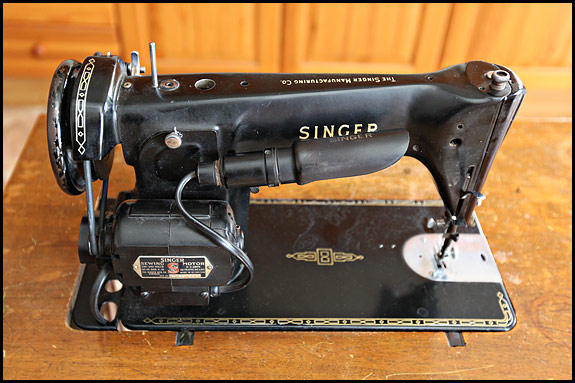
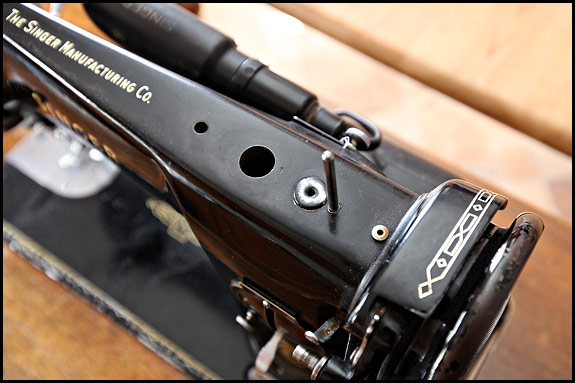
Here’s a couple of pictures of our new baby with one of her bigger sisters …

Picture of Singer 221 Featherweight with Singer 99

Picture of drive end of Singer 99 alongside Singer 221

The elusive spool pin

Standard

Earlier this year I packed a flask and sandwiches and ventured out into the wilds of East Kent, and one of the things I came back with was a Singer 201 in a treadle base.  It moved in with us partly because it’s the later type 201 with the “modern” shape aluminium body and we didn’t have one of those, but mainly because of the treadle base, about which more some other time.

Like the old girl I bought it off, it looked a bit scruffy and smelled of fag smoke but seemed in good working order.  In fact the only thing actually wrong with it was that at some point in its life, the spool pin had gone missing.  Now the spool pin on a 201 Mk2 doesn’t go straight into a hole in the top of the machine like normal.  Oh no.  Instead, it screws into a hole in a solid steel bush 15mm diameter and about 10mm thick, which fits into a 15mm wide hole in the machine.  And that assembly doesn’t just drop into the hole, it’s forced in under considerable pressure.  It needs tools and some determination to get it out without damaging the machine.

So it’s still a mystery to me how come both pin and bush were missing from this one.  And I still marvel at the way in which somebody solved the problem by taking the other (bobbin-winding) spool pin out the machine base, popping it into a handy oil hole, and whacking it with a big hammer.  Check out the pictures I took when I got it home ...


Back view of Singer 201K MkIIPicture of Singer 201 MkII with missing spool pin bush

So obviously we needed a new bush, which is hardly your run-of-the-mill spare part because after all, why would you need one when it’s a forced fit in the top of the machine body so it’s not exactly likely to drop out?  None of the usual sources could help, and because I wasn’t prepared to modify the machine, it was looking more and more like an expensive custom-made replacement bush- assuming I could find somebody to make one for me.

But then once again the internets came to the rescue, this time in the form of a gentleman who’d read my wittering about the bush (I’m not one for beating about it) on one of the Yahoo discussion groups.  He had too many 201 Mk2’s and was breaking some, so … here’s the elusive spool pin and bush, as kindly supplied by Mr Geoff Egan of Tenby Point, Victoria, Australia, who assures me that he did indeed enjoy the couple of beers he had on me yesterday.

Picture of Singer 201 Mk2 spool pin and bush

Convertibility

Standard

Except that’s the wrong word, because apparently “convertibility” refers to the ease with which a currency or a security can be traded for another.

So it looks like there isn’t a handy word to describe the ease with which Singer sewing machines of the 1900’s to 1950’s can be converted from hand-crank to pedal power to electric and back again, which is a bit of a shame really but there you go.  Despite the lack of a word, though, it’s still surprising what you can do with these things.

Take the model 66 that’s on the kitchen table right now waiting for a final polish before we sew it off ready for sale.  In its present form it’s a hand-crank portable, which is to say that you turn the handle to sew, and when you’re not sewing, it lives in a case.  Twenty minutes work will turn it into an electric portable, powered by a refurbished Singer motor of the correct type, controlled by either a period Singer foot pedal or a modern one.  Or we can fit a good quality modern Japanese motor instead.

If you fancy pedal power though, an hour will see that same 66  fitted into one of the two types of treadle base we currently have, and if you want to cover both bases, the machine can go into a treadle base but still retain its electric motor.  The same goes for any of our 66’s or 201’s (and indeed for the 27/28’s and 15’s which we don’t get involved with).  Versatility or what?

In fact the only variant we can’t actually offer at present is a 99 treadle.  But we can put a 99 in one of the tables made specifically for it, into which it folds away when not in use …

Fluff #1

Standard

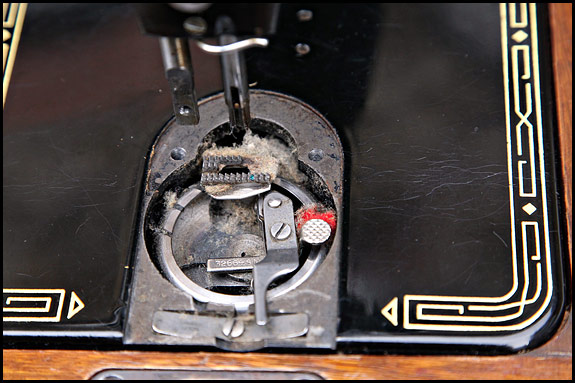
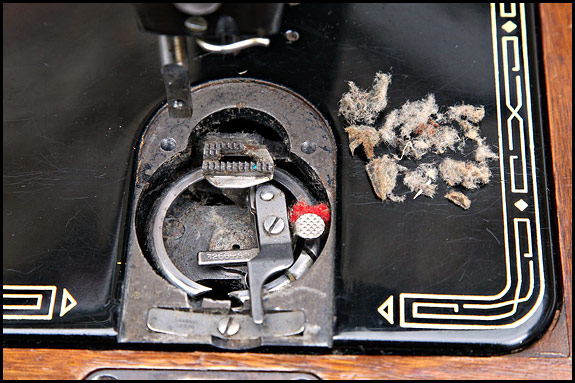
fluff under needle plate of Singer 99k sewing machineAbove we see the very ordinary amount of fluff under the needle plate and around the bobbin carrier of this otherwise well looked after Singer 99, and  below is what came out with just a quick poke round with the tweezers without any further dismantling.  Note that bit of broken needle in the fluff nearest the camera, also the bone-dry red felt which is supposed to be kept oiled but very rarely is.

fluff from under needle plate of Singer 99k sewing machineBy the way, this post is Fluff #1 simpy because there’s bound to be more to come …

So what’s this all about then?

Standard

One of the things about the internets which I get really miffed about is checking out an interesting-sounding website or a blog and finding that I’m looking at a holding page instead of something informative or entertaining like I was expecting.  And here I am writing the text of a blog post which really only amounts to “coming soon”.

That’s because in the last few days we’ve had spuds to dig up, Morello cherries to pick, broad beans to freeze and a couple of sewing machines to finish ready for sale.  That and the fact that four more machines followed me home from yesterday’s all-day circular tour of Essex.  Then there’s all the time I spent working out one particular aspect of this blog setup because we didn’t have a 10 year old boy handy to ask how to do it.  And I won’t even mention all the time it took to organise the spool pin and bush which are currently on their way here from a kindly Singer collector in Australia to replace the bits missing from one of our machines.

But enough of the excuses already!  For now, what you need to know is that this blog will be about some but not all mechanical Singer sewing machines made from around 1930 to the early 1960’s, simply because that’s what we’re into here.  Well OK you might end up reading something about my bike every now and then or our chickens or perhaps the state of the apple trees, or even the odd rant about about “semi-industrial” sewing machines, but it’s all good so do tell your friends …