Ooooh … look what the postie’s just brought!

Standard

picture of jiffy bag and screwdriver bits from brownells

How exciting!  My new screwdriver bits have just arrived, all the way from Montezuma, Indiana, US of A.

Check out the size of the Jiffy bag they came in compared to my dumb phone that’s on top of it. All that was in it was those two screwdriver bits, each in their own little plastic bag, plus a copy of the invoice.

They are really lovely screwdriver bits though, beautifully made, and they’re the exact sizes needed to fit the two Singer screw heads not properly covered by my existing selection of bits.  So I’m a happy bunny this morning, especially as now it’s stopped raining so I can get out on my bike.

Yes, to get tools of this quality, I really did have to order them from a gunsmiths suppliers on the other side of the Atlantic, because nobody makes this class of gear in this country any more, and in case you’re wondering, the answer is an entirely reasonable $5.98 for the two bits plus $7 post ‘n’ pack.

The Singer 201K

Standard

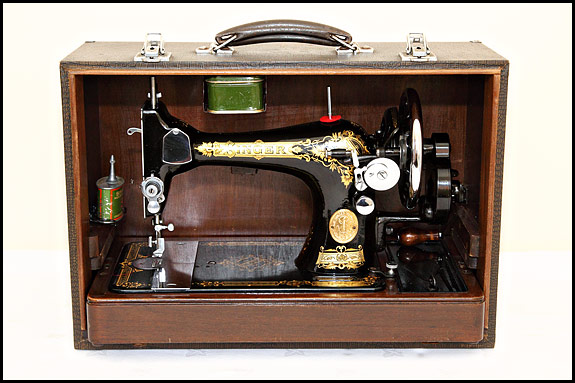
Black and brown Singer 201KMk2 sewing machines

I was going to waffle on about the Singer 201K and the difference between the Mk1 and the Mk2, and have a bit of a rant about the way these things are described on Ebay as semi-industrial sewing machines and so on while I was at it, but it’s become obvious that would have been one hell of a long post.  So I’ll do it in stages.

Before I do though, it occurred to me that I had a good opportunity to take a snap of the two different coloured 201Mk2 heads that were available in the UK side by side, so here it is.

The black one is Elsie’s, carefully removed for the purposes of the picture from the treadle cabinet in which it lives in The Sewing Room.  That one’s exactly as brought home from a house in the far east of Essex which had what must be the most awkward access off the road I’ve ever seen in a built-up area, and believe me I’ve seen some.  So you’re driving along a two-lane dual carriageway which has a 50mph limit, in heavy traffic which is averaging nearer 60.  You’re looking for number 312, and the first number you can actually read is 800-odd.  All the houses are identikit 1930’s semis, and they all have very narrow shared “drives” which are about 4 car lengths from kerbside to front door.  The posties must love it.

Naturally you miss number 312, so you drive another mile or so the the lights with the “No U-turn” sign, and do a U-turn back to the roundabout two miles back the way you came and try again.

Twice.

Then having positively identified the target, there’s the small matter of trying to convey to the driver of the Belgian artic which is right on your tail that you need to stop on the double yellow lines and reverse onto a narrow bit of tarmac.  Yes, it worked in the end, but boy did that truck driver ever get cross.  What a loud horn his wagon had.  But so what.  Have you seen the way they drive in Brussels?  Or at least they did when Elsie and I went through it on a motorbike in 1984 …

Anyhow, getting back on track, the lovely black one is Elsie’s.

That scruffy brown thing is what came home with me last night and spent the night in the bike shed ‘cos it stinks, albeit not as much as the treadle cabinet which it was in does, which is why that’s been banished to the yard for scrapping once I’ve salvaged the useful bits off it.

The machine itself is all there though and will be fine once I’ve eventually fettled it and Elsie’s worked her magic on all the grot.  That’s going to be a slow job, but it’ll have been worth turning up in downtown Catford for last night, too early for the rioting but not too early to be bemused by the sight of about 20 of the Met’s finest who were gathered outside that lovely art deco cinema suddenly start running in all directions for no apparent reason.

’tis a strange world in which we live …

The Workcycles FR8

Standard

Our new bike came on Friday, so when I got back from the shops this morning I thought I’d take a snap of it before it rained.  So I did.  And then it did.  Rain, that is.

Anyhow, as you may have guessed from the title of this post, this fine bicycle is a unisex,  one-size fits all Workcycles FR8, pronounced “freight”.  Presumably whoever came up with the name spends a lot of his time on his phone sending text messages to his m8s.  Be that as it may, our FR8 has come all the way from Amsterdam via Bristol, courtesy of Really Useful Rob at Really Useful Bikes, who deserves not only a plug here but also a medal for his perseverance when the factory quotes him 6-8 weeks delivery and then takes 12.

It got here in the end though and we’re really chuffed with it.  8-speed hub gears, enclosed chain, drum brakes and hub dynamo equals low maintenance, and it’s amazing what it’ll carry with no ill effects.  I’m sure I’ve seen a picture of one on the interweb with a load of stuff in the crate ( or perhaps in the CR8?) on the front, and two toddlers in child seats on the back carrier.

Hmmm … I really must find our spare Copenhagenize “Choose Style Over Speed” stickers, and see if the Slow Bicycle Movement is doing “My Bike’s Heavier Than Your Bike” ones yet …

Picture of Workcycles FR8 bicyclePicture credits: Bicycle by Workcycles.  Hampstead-style planet-saver hessian shopping bag courtesy of Borough Market.  Red grape juice from Lidl (we’re not proud here).  Left foreground: old-fashioned sweet peas and sweet pea Hubert Son’s Peaches (no, honestly) from Ferme de Sainte Marthe, Montfort l’Amaury, France.  Behind: climbing French bean Gazes Brown Seeded, grown from seed swapped at Seedy Sunday in Hove last year (gosh, just how eco is that?).  Background: cooking apple Lady Henniker (makes a nice pie, that does) and pear Williams Bon Chretien (which in case you’re wondering bottles very well indeed).  Fruit and veg grown organically by Elsie, patio weeds grown organically by me.  Scaffold tubes courtesy of the building site down the lane, and I think that’s about it.

Basic sewing machine maintenance – Singer 27K and 28K

Standard

Diane asked this morning what she ought to do about tickling the tappets of her late granny’s Singer 27K which she’s just rediscovered.  The machine still works, so there’s obviously nothing drastically wrong with it, and Diane’s done the sensible thing and downloaded a copy of the book of words, so the question is – should she be doing anything by way of essential maintenance before she starts doing some serious sewing with it for the first time in 40 years?

Well, in my opinion the short answer is “not a lot really”.  I’d start by tilting it back in its base and seeing what the underneath’s like.  If it’s covered in oil and fluff, an old paintbrush will get rid of a lot of that, but if you really want to go to town, a bit of paraffin or a squirt of WD40 on a rag should shift anything you don’t like the look of.  One thing to watch though when you tilt it back on its hinges is that the whole lot doesn’t tend to roll over onto its back, which can lead to fun times if it does – especially if it’s come loose on the hinges.  And beware of old rusty pins and bits of broken needles whilst furtling about under there.  Once you’ve got rid of anything really oily or a bit yukky underneath, get the Hoover out, but before you attack it here’s a couple of tips.

First off, if you open the bobbin plate, you will see the hole shown in this snap …
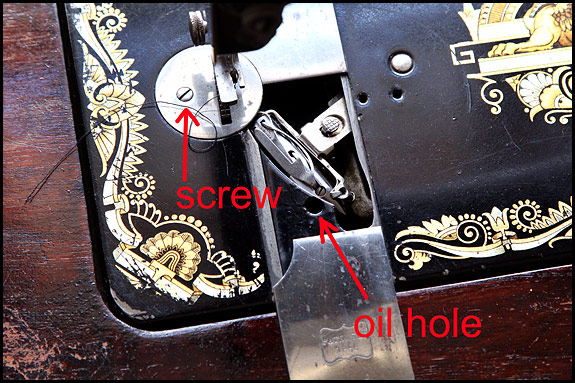
Picture of area under bobbin plate of Singer 27K

Either that hole will have nothing in it except general grot, or it will have a plug of felt which may or may not be oily.  Odds on it isn’t oily.  If it does have  a plug of felt, that will probably be a very nondescript colour and may not even be recognisable as felt, but if it’s level with the top of the hole it usually is.  That’s an oil wick, and it’s referred to in the manual.  The picture above is the bobbin area of Cleo, Elsie’s 27K treadle machine from 1900, and Cleo is feltless on account of I haven’t got round to putting a new one in.  It’s been on my list for ages and it will happen one day, but Elsie is wisely not holding her breath.

My point is (hey, we got there) that if there’s something in that hole and you reckon it looks like a felt plug, be sure to put your finger over it before applying the nozzle of your vacuum cleaner.  If you don’t, you will soon feel a bit of a silly and wish you had.  And don’t ask how I know that.

The second tip concerns the needle plate, under which live the feed dogs, which tend to accumulate fluff.  If you have a screwdriver which fits the needle plate screw (labelled above) properly, have a go at unscrewing it while pushing down fairly hard on the screwdriver so it doesn’t chew up the slot in the screw.  If it doesn’t want to turn fairly easily, either you’re turning the screwdriver clockwise when you should be turning anti-clock or it’s being awkward.  If it does start unscrewing, take it out, take the plate off and do your thing with the Hoover (but don’t suck the screw up it) before replacing it.  If the screw doesn’t want to play, stick your tongue out at it and don’t worry about the fluff for now.

After that, all I would do is follow to the letter what it says in the book about routine oiling, then make yourself a nice cup of tea before knocking up a quick copy of Kate Middleton’s wedding dress for next door’s eldest.

I’m assuming, by the way, that Diane’s Singer 27 is a hand-crank.  If it’s a treadle, there’s a bit more to think about which I can cover in another post.  If it’s been motorised, there’s not a lot you can actually do yourself to improve whatever state the motor’s in, especially when poking round wiring which is bound to be fairly brittle with age is never a good idea.  It is a good idea to check the drive belt though, and to think about getting another before it goes the way of all drive belts.  You can get the belts pretty much anywhere.

Finally, a warning.  If you’re not familiar with proper sewing machine oil, be aware that it’s very “thin” and runny stuff.  Newspapers under the machine and some kitchen towel in the bottom of the base is the rule here before we even get the oilcan out!

PS If you have an early 27 or 28 and you’re wondering why yours doesn’t have that round criss-crossed button thingy seen in the picture above at 2 o’clock to the shuttle, that’s because yours hasn’t been modified with the later shuttle lifter-upper like this one has …

That “K” suffix

Standard

Just so you know, the difference between a Singer 66 and a Singer 66K is the same as the difference between a 99 and a 99K, or indeed a 201 and a 201K i.e. nothing.  Zilch.  Nada.

There is no difference at all.  All that “K” suffix does is tell you that the machine was made in Singer’s Kilbowie factory in Clydebank, Scotland.

At one time, Singer had factories all over the planet making basically the same models, so depending on where it was made, your Singer Model 15, for example, could be a 15K (Kilbowie), or a 15E (New Jersey), a 15A (South Carolina), a 15SJ (Quebec) or perhaps even a 15P (Podolsk, Russia).  And even if you had one of each of those, you still wouldn’t have a full set.

What there is a difference between is machines with different numbers after that suffix.  Those numbers tell you what the variant is, for example a 201K1 is a natural-born treadle machine, whereas a 201K3 is a portable (or more accurately where the 201 is concerned “portable”) electric.

So there you go.  The “K” just means it’s a home-grown Singer.

Get into model numbers any deeper than that and you’re entering anorak territory …

The Singer 28 that Mrs Fallshaw got for Christmas 1938

Standard

Picture of 1938 Singer 28K in caseThis is a machine I found earlier this year which now forms part of our little collection.  Elsie’s particularly fond of this one because not only is it really pretty and it sews beautifully now I’ve tickled its tappets, but it also came with the original sales receipts still in the Singer envelope.  The lovely old tin full of attachments is original, as is everything else except for the can of oil, which is the right age and type but is actually Singer household oil rather than sewing machine oil.  Check out the “Our own machines” page for more pictures of it.

So, Mrs Fallshaw left the Singer shop in Barking with this on Christmas Eve 1938, and hopefully she didn’t have to carry it too far to the bus stop.  She paid £5 15s 0d for her shiny new machine, which if the currency was decimal then would have been £5.75.  What that equates to at today’s prices depends on which website you refer to, but as far as I can tell it’s something over £600.  Definitely at least two weeks’ wages for Mr Fallshaw if he was getting the 1938 national average wage.

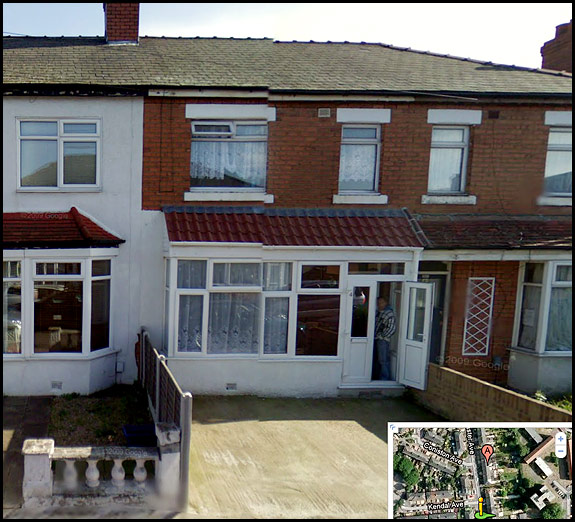
That was the last Christmas Eve before the start of World War 2, and although the Singer shop didn’t survive the bombing, the Fallshaw’s house did.  Here’s the Google picture of it nowadays, which leaves me wondering what they’d make of the replacement of the bay window and the disappearance of their front garden  …

I suppose that before long our Mrs Fallshaw would have been running up the blackout curtains or blinds on this machine, and no doubt during the war years it would have done her proud for repairs and alterations.  Maybe even dressmaking too, if she could get some material.  Wouldn’t it be fascinating to see what’s been sewn on this machine over the years?

Vintage Singer sewing machines for sale

Standard

Just by way of an update for you, I’ve added another Model 99 portable to the “Singers for sale” page today.  This one’s a late type electric portable, so if you’re after a Singer 99 we can now offer you a choice of hand-crank or electric!  Also on the same page is a gorgeous hand-crank Singer 66 portable, complete with original bentwood case in very nice condition indeed.

There’s at least one more Singer Model 99 in the pipeline to add to our stock of vintage hand-crank sewing machines for sale, and in case you’re wondering, the rather laboured wording of this post is intended to appeal to the great god Google …

The Singer “Vibrating Shuttle” sewing machine

Standard

We actually have two Singer sewing machines of the Vibrating Shuttle type in our little collection, and one of them’s the 1938 Model 28 hand-crank portable I got for Elsie earlier this year.  The other’s a 1900 Model 27 treadle called Cleo, of which more when I work out a way of photographing her which doesn’t involve rearranging the sewing room.

Incidentally, in case you’re not up to speed on this stuff, a 28 is to a 27 as a 99 is to a 66, that is to say it’s a three-quarter sized version intended to make it more portable for ladies who are not built like Ukrainian shot-putters, and the easy way to remember that priceless information is that the bigger number is the smaller machine.   As to the Vibrating Shuttle, I have no idea why they called it that because it doesn’t.  It swings, baby!  Here’s a snap of what we’re on about …

Picture of Vibrating Shuttle of Singer 28K sewing machine

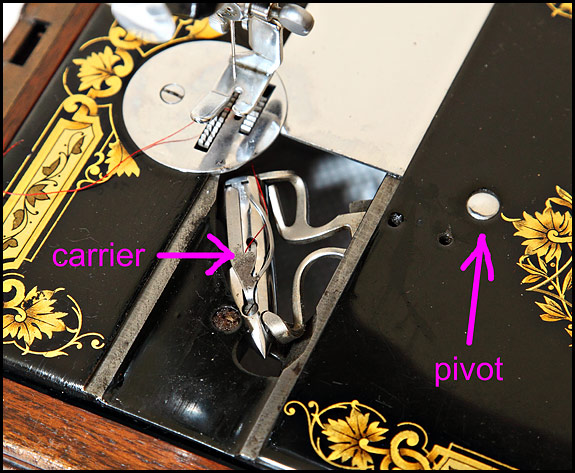
The shiny thing with the pointy end is the shuttle carrier, which contains the “long” bobbin, from which you might be able to see a red thread emerging.  You take the carrier out to change the bobbin, and yes, it is a bit of a fiddle, but once you get the knack it’s easy and you can then allow yourself to feel rather smug about your bobbin-changing.  Actually, you can feel even more chuffed with yourself once you’ve mastered the art of getting the bobbin tension right on one of these, but I won’t go into that now.

The curly metalwork to the right of the carrier in that picture forms the business end of the carrier arm, the other end of which is attached to a pivot under the bed capped by that chromed plug, so once you start sewing, the shuttle swings backwards and forwards in an arc from around 10 o’clock to 7 o’clock and back again, and it does what shuttles do.

Vibrating Shuttle machines certainly work well enough, and incredible though it seems you can still get bobbins and even the boat-shaped shuttle carrier brand new, direct from the Singer UK online store.  So why aren’t we big on them?  No particular reason apart from the fact that the long bobbin doesn’t hold as much thread as the round ones.  Having said that, I guess we should be big fans of the 15-series machines as well as the 66/99’s and 201’s because they also use round bobbins, but we’re not, and for no good reason really …

3-in-One oil is evil

Standard

When I come to power, one of the first things to happen will be the introduction of a total ban on the general sale of 3-in-One oil.  People will still be able to buy it to cure squeaky door hinges or whatever, but only if they sign a properly witnessed form by which they solemnly undertake never to even think about applying it to any part of a sewing machine.

I do wish the firm which makes it wouldn’t push it as suitable for sewing machines, because it most definitely is not.  It is totally unsuitable.  I don’t know what they put in the stuff, but I do know that over the years some of its constituents evaporate and they leave behind a horrible hard waxy brown residue ideal for gumming up the works of an old machine.  Which is exactly what it does.  And it is a real PITA to remove, which is why I’m grumpy about it.

Please, gentle readers of this blog, promise me that you’ll never use anything but proper sewing machine oil to oil a black Singer.  It’s the least you can do for it.

And if your excuse for reaching for the tin of 3-in-One is that your machine is grinding to a halt, you haven’t got any sewing machine oil and Waitrose don’t sell it therefore you can’t buy it, just search Ebay for “Singer oil” and take your pick of several suppliers who will be pleased to send the postie your way with a bottle of it which will last a lifetime for less than a fiver including p&p, which, if our experience is anything to go by, is what your local sewing machine shop would charge you for one – if you had a local sewing machine shop.

Attachments – a crash course

Standard

In response the the question from Lil this morning, here’s brief guide to attachments.  I intend to do something on each one individually in due course, but for now …

We’re talking here about attachments for Singer domestic machines from around 1900 to the 1960’s or so, and the obvious starting point is the bits and bobs that came with the machine when it was new.  Probably the most common set is this one or something very like it:-

picture of Singer attachments and card box

From top to bottom and left to right, that’s the adjustable hemming foot, the binder, narrow hemmer, ruffler, tuck marker, underbraider, seam guide and quilting guide.  There should also be the screw to fasten the seam guide to the bed, but I forgot to include it in that quick snap.  The card box is common, but they also used a lovely green tin with a hinged lid with “SINGER” on it in gold, and then there’s the sought-after black crackle enamel tin with the purple plush lining …

Picture of Singer attachment set in black crackle enamel tin

Above we see basically the same set but with a different (later) type of underbraider and the addition of the two Singer screwdrivers plus three bobbins.  Any avid attachment-collectors seeing this picture will be mortified to note that two of those bobbins are plastic ones and not the kosher item, but they were handy just now and I don’t care.  Besides, we have the little illustrated layout guide for that tin and we have the original packing slip, so there …

OK, that’s the basic set, but there are plenty of other bits and bobs to play with if you can find ’em in good or at least usable condition without paying really silly prices on Ebay.  Just rummaging through Elsie’s attachments box and in no particular order I find two different types of adjustable zipper foot, an edge-stitcher, several varieties of hemmer, a gathering foot, a zig-zag foot, a hemsticher and picot edger (that’s one foot, by the way), and the elusive Darning Foot #121094.  And that’s before we get to the ones in the bags labelled “?” and “mysterious”.

If that’s not enough to keep you amused, though, bear in that irrespective of make, pretty much anything designed to fit to a low-shank machine with side fastening (as opposed to the earler rear-fastening) feet will fit or can be made to fit. your trusty black Singer.

There’s also quite a wide range of buttonholers and zig-zaggers available, several examples of which Elsie has in her collection and some of which work better than others.  We’ll have a look at those sometime too, but I guess that before finishing this post I’d better answer the question which is now exercising you viz. how on earth do you get a straight-stitch machine to do zig-zag?  The answer is you cheat, by using an attachment which shifts your work left to right and back again as it feeds it under the needle …