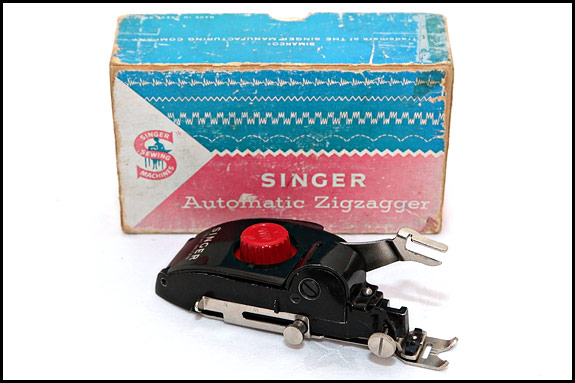
Singer Automatic Zigzagger 161157

Standard

Here’s a picture of a Singer Automatic Zigzagger 161157 ready for action yesterday on Elsie’s treadle 201K Mk2.  Check out how it clamps to the bottom of the presser bar just like any presser foot does, and how it’s driven by that chromed arm which comes forward and slots round the needle clamp …

Picture of Singer Automatic Zigzagger 161157 fitted to Singer 201K

So how, you ask, does this marvellous all-metal, all-mechanical device make a straight-stitch machine do a zigzag stitch?  Easy – the needle stays put and the work zigzags.  No, seriously, that’s how it does it, and it works a whole lot better than you’re thinking it will.  Admittedly it does take a bit of faffing about to get your tension and presser foot pressure spot on, but that’s really just fine-tuning the stitch it makes straight out the box.  Here’s a quick video taken while Elsie was testing one on her 201K Mk2 treadle machine …

The stitch length control on your machine works as normal to set how many zigs ‘n’ zags to the inch, bight (width of zigzag) is set and locked on the attachment itself, and once you get the hang of it, you can go at quite a pace

The nature of the stitch it makes is determined by a cam, the red knob of which can be seen in the picture above. The attachment was sold with a set of four of those red top cams, which make an ordinary zigzag stitch and what Singer called a blind stitch, a domino stitch and an arrowhead stitch.

Three other cam sets were also available, the knobs of which are coloured blue, yellow and white, and each of these sets produces four different decorative stitches of the kind you might find useful if you’re making a cute little retro frock for your first grand-daughter and you’re in a silly mood.  But gosh, you should see the prices those cam sets go for!

Anyhow, here’s some more pictures.  Both these and that video are actually of the one I’ve just listed for sale on the accessories page, and hopefully this marks the start of me finally getting that page organised …
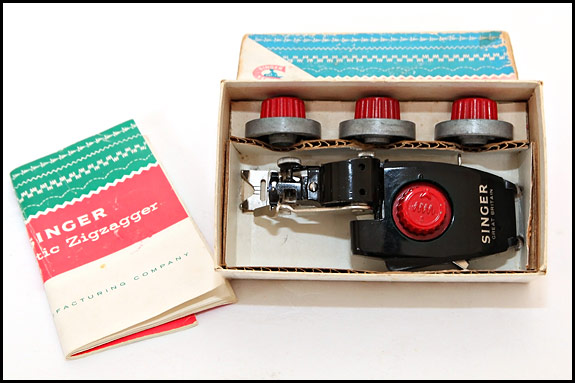
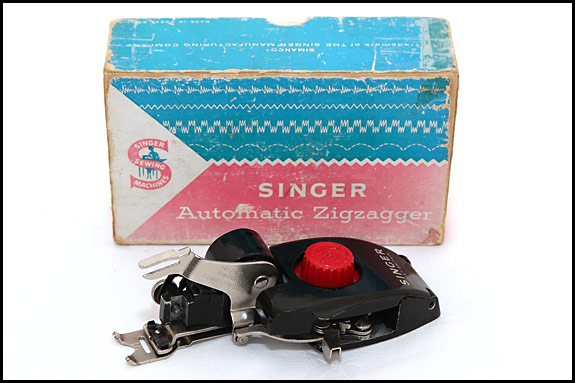
Picture of Singer Automatic Zigzagger 161157 with cams in box

Picture of Singer Automatic Zigzagger 161157

Different picture of Singer Automatic Zigzagger 161157

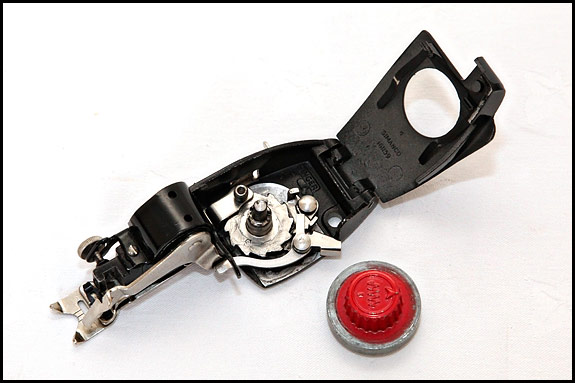
Picture of Singer Automatic Zigzagger 161157 with cam removed

Which way do you thread the needle?

Standard

If you were paying attention last week, you know how to work out which way round the needle goes in any vintage Singer sewing machine.  If you weren’t paying attention, go back and read this post then do try to keep up with us, dear.

So, having got your needle in the right way round, the question now is which way do you thread it?  Right to left or left to right?

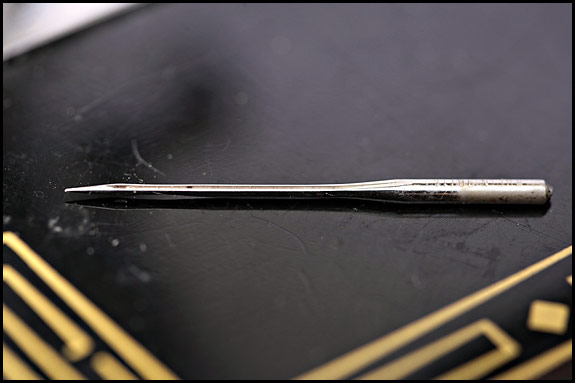
Let’s start with a picture of a needle …

picture of sewing machine needle

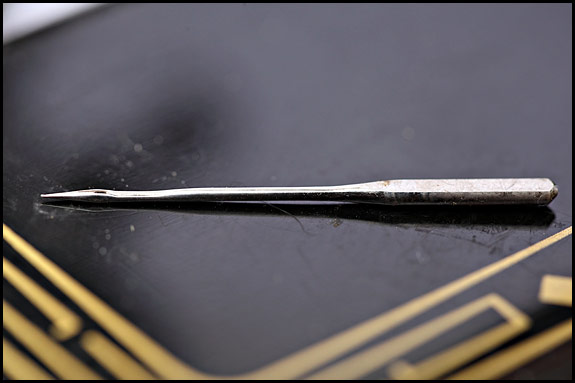
Note that this needle is seen flat side down, and that you can see a groove running along it from the eye to where it thickens up.  If we turn that needle over so the flat on it is facing upwards, we see that the other side is completely different.

another picture of a sewing machine needle

There’s no long groove on this side.  Instead, the needle has a little “cut-away” section just above the eye.  That’s called the scarf.  I have no idea why.

So OK, which way do you thread the thing?  Here’s a clue …

picture showing thread path at needle of sewing machine

If you look closely at that picture, you can see that we’re looking at the long groove side of the needle.  Check out the way that thread runs down from the last guide to the eye of the needle.  Now imagine that needle going down through your fabric to make a stitch.  What will happen as it does?

Yep, that’s right – the thread will tuck itself nicely into that groove.  That’s what the groove is for, and there’s your answer to the question as to which way round you thread the needle.

picture of needle of sewing machine showing thread path

You want the needle threaded like in the picture above, so de thread can get in de groove, maaan.   Yay!  Always thread from the groovy side, baby.

Sorry about that.

But, I hear you say, what if you can’t see that groove?  What if your eyesight’s worse than mine, you change needles by feel and it takes you all morning to actually get one threaded?  Fear not, gentle reader.  Assuming that you have a serviceable fingernail or two, the good news is that you can very easily feel the groove with the end of a fingernail.

So there you go.  Whatever the machine, find the long groove, and that’s the side you point your thread at.

Clarice’s egg

Standard

I’ve been taken to task by a couple of readers of this blog for telling you all about Clarice’s first egg but not showing you a snap of it, so here you go.  That is Clarice herself looking at her egg alongside a so-called “fresh” one from the supermarket.

What she doesn’t know is that unlike the big egg, hers will be a treat to eat.  It will have a nice yellow yolk without her having been fed feed with yolk colourant in it, the white will be a lovely bright white and it won’t be rubbery, and above all Clarice’s egg will have taste – a property sadly missing from the supermarket equivalent if you ask me.  Or Elsie.

Anyhow, there’s the missing picture as requested.  With that, I think we’ve done the chicken news, at least for the time being, so I can now start getting a post together about which way round you thread the needle.  Or maybe about how we pack a sewing machine for courier delivery.  Perhaps even why we don’t get involved with the 15 series.  And I really must do something about attachments …

Clarice has done an egg

Standard

Picture of Rhode Rock hen

I’ve been meaning to bring you up to speed on the chicken front for a while now, but with one thing and another it just didn’t happen.  Sorry about that.  I shall now make amends …

Edna and Ethel, our lovely Wellsummers, decided last month to stop laying in August rather than in October.  Elsie and I decided that in that case we didn’t fancy feeding them expensive feed until next April for no return other than the pleasure of their company and their muck for the compost heap, so they could go and play with all the other hens at the farm down the road.  Which they did.

Now, as any fule kno, Michaelmas Day is September 29th and it is the day that you kill your pig.  But did you know that it is also the day by which you have to get your hens into lay?  Well it is, although I have no idea what happens if you don’t .  But we certainly don’t want to find out, so no sooner were Edna and Ethel gone than we set to renovating and sanitising the hen house and digging over the run in readiness for our new birds, which we got three weeks ago.

Alice and Clarice are Rhode Rocks, Dyllis and Phyllis are Maran Cuivrees, and the simplest way to tell them apart is that the Rhodes have cream legs and the Marans have blue-grey legs.  We’ve gone back to hybrids after maybe ten years of keeping pure breeds simply because organic layers pellets are now over £12 a bag and hybrids don’t stop laying for half the year.  Neither do they go broody.   They’re about 21 weeks old now, and oh boy have we had fun training them to go to bed at night.  Never before have we had hens who just couldn’t grasp the concept of go up the ramp, go through the pop hole, turn left and step up onto the perch.

Until last weekend, every single night, these four went up the ramp, through the pop hole, turned round and settled down squashed together in the entrance looking out.  In the end we took it in turns to go out there, take the front off the house, and as each one sat down in the entrance, pick them up and put them on the perch.  And do it again when they jumped off.  Which they did.  Many times.  Eventually though something connected in their little chicken brains, and these last few evenings they’ve been going to bed just like proper hens.

This naturally left us wondering what we were going to be in for when they started laying.  I think we’d become resigned to the prospect of teaching them where the nestbox is, and still finding eggs of all shapes and sizes all over the place for a few weeks until they got the hang of the process.

It therefore came as quite a shock when Elsie came in from the garden this morning and said “Clarice is in the nest box”.  I went for a look myself and sure enough, there she was, sitting tight on the straw just like a proper hen.  An hour or so later I went out to see how she was getting on, and there she was in the run with the other three.  “False alarm” thinks I, but I wanted to see if she’d at least managed to make herself a nest.

So I took a look, and to my surprise Clarice had made herself a nest of which any hen could rightly feel proud.  And to my greater surprise, there at the bottom of it was an egg.  A small egg, certainly, but a proper egg, with a nice brown shell, hard all over, with a proper egg shape to it, laid all by herself without any fuss or bother at all.  In a nest.  In the nest box.

That’s Clarice on the left in that picture.  Clarice is awesome.

“How A Sewing Machine Works”

Standard

I stumbled upon this video the other night, and was immediately captivated by it.  As soon as it finished, I watched it again.  Then Elsie joined me and we both watched it, spellbound.

This girl is wonderful.

She should be famous.

It’s a crying shame she wasn’t a teacher at my last school.  I wouldn’t have learned anything like as much as I did, but lessons would have been a lot more fun.

Anyhow.  Check out Summer’s explanation of how the bobbin works for yourself, and don’t worry if you don’t find it easy to follow.  Just marvel at her delivery of it …

http://www.youtube.com/watch?v=0yt7TRZOs_U&feature=related

Which way round does the needle go in a vintage Singer sewing machine?

Standard

This is easy.  Honest.  Stick with me to the end of this post, and you’ll be able to saunter up to any vintage Singer machine, take but the quickest of glances at it, and gain the respect and admiration of astonished bystanders by immediately saying whether or not the needle’s in the right way round.  And as I’m sure you realise, that’s a very handy skill to have.

First off though, let’s get the terminology right.  The rod thingy which goes up and down when you sew, and into the end of which you insert your needle, is called the needle bar.  Your needle’s held in the needle bar by the needle clamp, which is what you tighten by means of the clamp screw.  And just in case you’re now wondering what the other rod thingy which doesn’t go up and down but has the presser foot on the end of it is called, it’s the presser bar.

Next we need to consider exactly how the needle fits in the end of the needle bar …

Picture of Singer 99 needle bar and clamp

That’s the needle bar and clamp of a Singer 99K, about which we need to note two things.  One is that the needle bar has a slot in it, here visible above the clamp.  And the other is that just above that clamp, there’s what at first glance seems to be the top of the needle.  Except it isn’t. That little shiny blob is actually the needle stop, up against which you push the needle when you slide it up through the clamp.  That’s what ensures that your needle is set at exactly the right height – as long as you slide it up as far as it’ll go.

Here’s what it looks like if we take away the needle clamp …

Picture of needlebar on Singer 99 without clamp

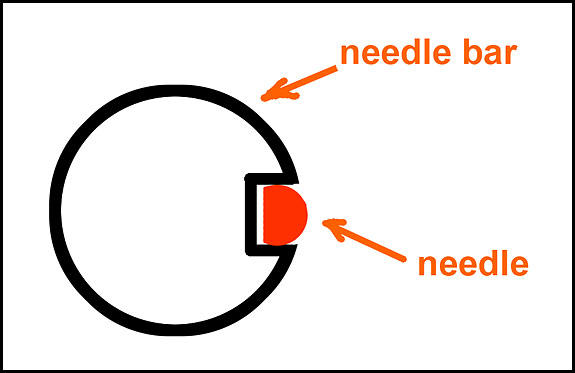
See how the needle actually fits in?  The flat face of the fat end sits against the flat bottom of that slot, so in cross-section it looks like this …

And now you know what determines which way round the needle goes!  It always goes in with the flat on it facing the bottom of the slot in the needlebar.

Going back to that picture at the top, you’ll see that as you’re sitting at that 99, with the screw of the needle clamp pointing to your right, the slot in the needlebar faces left.  Therefore the needle goes in with the flat side to your right, which is actually the most common way round.

Now check out this picture of a rather mucky beige 201 Mk2 without a presser foot …

Picture of Singer 201K Mk2 needle bar and clamp

This time we’re looking towards the left-hand end of the machine.  The clamp screw still faces the right-hand end just like on the 99, but golly gosh – the slot in this needlebar faces right too!  Yep, the needlebar on a 201 is indeed the other way round, which of course means that on a 201, the needle goes in the other way round i.e. flat to the left.

We could actually complicate matters by considering that some needlebars have slots in them which face forward (towards you as you’re sewing), but those didn’t appear until after the rot set in and Singer started making the newer machines, so I’ll keep things simple and not mention them.

So, you now know that it really is easy to tell which way round the needle goes in a vintage Singer.  All you have to do is check which side the needlebar slot faces, then fit the needle so that the flat on it sits against the bottom of the slot.

Next week’s thrilling instalment is tentatively entitled “Now You Know Which Way Round The Needle Goes, How Do You Tell Which Way To Thread It?” …

The Piece of String

Standard

Picture of key on bentwood case for vintage Singer sewing machineOne of things about vintage Singer sewing machines which fascinates Elsie and me is The Piece of String.

You can pretty much guarantee that if the owner of an old machine which I’m thinking of buying says yes, there is a key for the case, then that key will be tied on a bit of string just like in the picture.  It might be thin string or it might be thick string, but it’s always string.   And the ends of it have always been neatly cut off after it was knotted.

And what, you might quite reasonably ask, is so remarkable about that?  Well, nothing really – except could you lay your hands on a bit of string right now if you had an urgent need of it?

If I look out my window, I can see part of a “select gated development” of a dozen new houses 200 yards or so away.  We call it The Ghetto.  Every one of those houses seems to be occupied by frighteningly normal families who each run at least two new cars, one of which is a Chelsea tractor, and it’s a fair bet that in a few weeks’ time, all the Daddies will be out on Sunday morning playing with their new leaf blowers.   I reckon they’re the sort of people who use the word “lifestyle” in everyday conversation.

If you look through their kitchen windows past the bijou pots of half-dead herbs, you’re bound to see machinery and gadgetry and things for every conceivable task.  Likewise their garages are doubtless full of power tools for everything.  But do they have string about the house?

I doubt it.  Naturally Elsie and I have string, but we’re like that.  We have natural string, unnatural string, garden twine, binder twine in a choice of colours – heck, we have parachute cord and we even have hi-viz fluorescent yellow terylene string.  I’ve no idea why we have that hi-viz stuff or where it came from, but my point is simply that we do have string about the premises.  Like every household once had, because at one time people saved useful-looking bits of string.

When did people stop saving bits of string?

Preservation

Standard

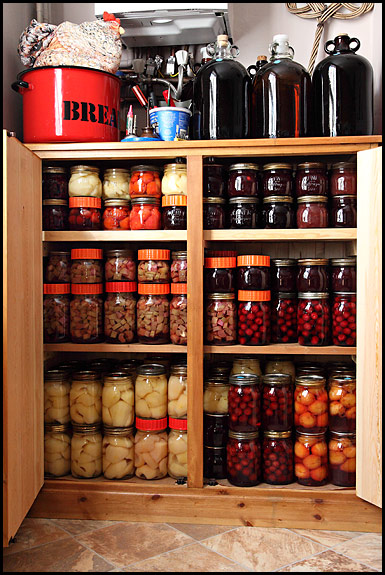
I said yesterday that we’ve been a bit busy on the home front recently, and here’s one reason why.  This is The Store Cupboard, which is now full.

We have bottled pears, damsons, strawberries, blackcurrants, rhubarb, Morello cherries and tomatoes from the garden and the allotment, and bottled plums from the local biodynamic PYO farm.  And we have rhubarb jam, rhubarb and elderflower jam, damson jam, blackcurrant jam and bramble jelly.

I made some of the jam but nearly all of this is Elsie’s handiwork.  It would have been nice if one of us had remembered to do an inventory of how many jars of what are in there, but we forgot. Like we do every year.  What I can tell you though is that we got 20lb of damsons off our own tree and 32lb off one in town which overhangs the path and nobody else takes any interest in whatsoever.  Oh, and the pear trees in the garden yielded 72lb this year, not all of which has ripened enough for bottling yet.  Where we’re going to put the rest of those, I have no idea.

Yes, it’s a great deal of work, but it’s very satisfying work.  And it’s even more satisfying getting up off the sofa in front of the logburner in the middle of winter, opening that cupboard and deciding what to have for pudding.

In case you’re wondering, the demijohns contain what Elsie calls country wines and I call drain cleaner …

The aliens stole our email

Standard

Well somebody did, so I blame them.

Elsie and I have been up past our ears in picking apples and bottling pears and digging up spuds and so on this last few days, so it wasn’t until last night that I realised our email was wonky.

We don’t have a hormonal teenager who’s an authority on Outlook around the place to consult about the problem, so I have no idea how long it was off, but we did get an email from Cecilia last night which she sent on Thursday and I’ve just managed to send myself a test message which worked, so it does look like we’re back to normal now (or as normal as it ever gets here).

If you sent us an email recently and you didn’t get a reply, I’m sorry about that.

If you’re not still miffed with us, would you like to try again?

The original carton!

Standard

Picture of vintage Singer sewing machine carton

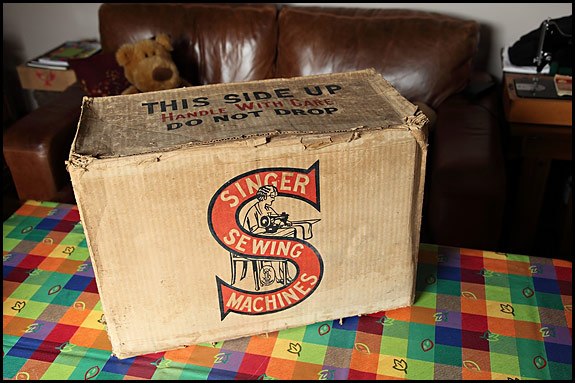
Yes, it’s that kitchen tablecloth of ours again – but look what’s on it this time!  One day in 1949, a brand new 201 portable left the Singer shop in Bristol in that carton.  Yesterday, 62 years later, that same machine came home with us, still in the same carton …