Sewing machines, Ebay and couriers

Standard

Once upon a time, we bought a 66K with lotus decals on Ebay.  I’d previously sent the seller a message asking him if I won it, was he up for packing the machine carefully so there was no risk of the finish getting damaged in transit.

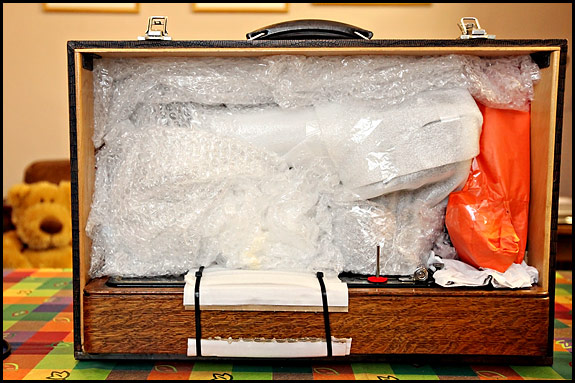
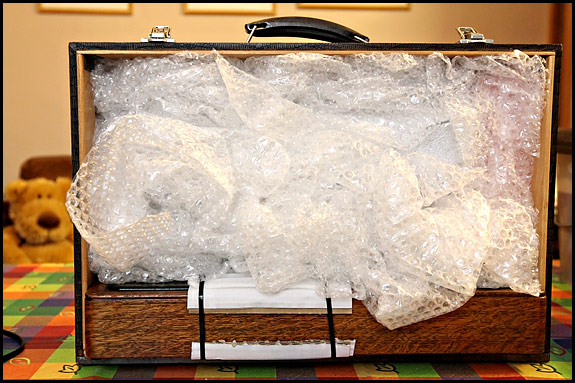
He was, so I sent him a couple of pictures to show how we pack a machine …

Picture of Singer sewing machine packed for courier delivery

Picture of vintage Singer sewing machine packed for courier delivery

I explained that the base would inevitably be wrecked when the case is dropped on its back in transit if the machine isn’t padded out behind as well as securely fastened to the base.  No problem, says he.  He understood my concern.  I needn’t worry.

We still do not know how that machine managed to get here with the case and base written off but no damage to the finish.  What the obliging seller had done by way of careful packing was wrap the column, arm and head in one thickness of Christmas wrapping paper, tied with really thin plastic string.  He’d then tied the machine head to the base with the same string, and that was it.  Case shut, tied once round with more pound shop string, drop it into a carboard carton and that’s it – job done.  (Actually he didn’t put it in a carton.  This was the one which came wrapped in a bin bag – E.)

We assumed he was religious and just put his trust in the Lord.

Whatever, I was reminded of that the other day when I was idly trawling the sewing machine listings on Ebay, as you do, when I spotted a rarity.  I checked out the listing and had a good look at the dreadful snaps of it before deciding the seller was having a larf, and I was about to move on when I noticed that somebody had asked the seller a question and he’d chosen to make that public.

By the way, this is a listing for about 40lb /18kg of full-size cast-iron vintage machine in a wooden base in a suitcase-type case just like the one in those pictures above.  The seller’s somewhat off the beaten track, and he’s specified local pickup only, so sure enough …

Q.  If I paid for a courier to collect the machine from you, could you pad out the inside of the case with lots of crumpled newspapers or something then put it in a really strong carton with some more crumpled newspapers packed round it to protect it?

A.  Courier is fine if you arrange it and pay for it.  The machine comes in a heavy duty box that’s made for moving it in so it won’t need any extra packing.  I’ll just have to put a bit of string round it and a label on the handle.  It’ll be quite safe.

I’d love to see a picture of it when it got to the buyer …

Another Singer 201K for sale

Standard

I’ve put another classic 201K on the Singers for sale page, and this one’s a little bit different …

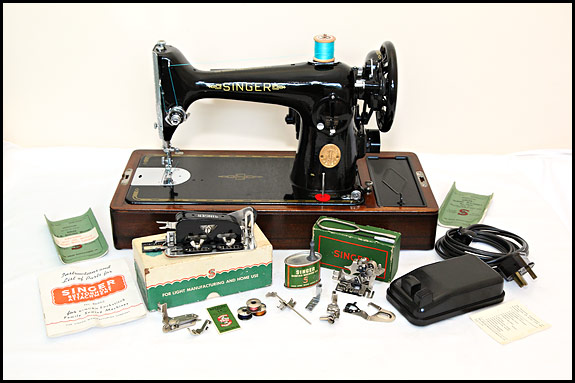
Picture of Singer 201K sewing machine with accessories

This is the 201K3 which until now has been in Elsie’s own collection of portables.  It’s the one I’ve been under orders not to mention when people asked if we have a nice 201 electric for sale.

However, we’ve only got a small house, and with 6 different treadle machines in it which I can’t see Elsie ever parting with, it’s finally been decided that the time has come for some of her portables to go to somebody who’ll put them to better use.  So this one is now for sale.

It’s a little bit different in that we know its history.   The lady I bought from it had recently inherited it from her Mum, who bought it new in 1948.  Apparently it was Mum’s pride and joy, and it was taken into the local Singer shop for a service every two years without fail.    She made her daughter’s Christening gown on it, and in due course her wedding dress too.

After Mum died, it was passed to her daughter.  It was only brought out once, to make a pair of curtains on, then put back in the cupboard.  And there it stayed until it followed me home.

It’s been checked over very carefully indeed and oiled, and I’ve stripped and rebuilt the motor, as well as replaced the mains leads.  This machine is a really sweet runner, and it has one of the quietest motors we’ve ever come across.  Sure it’s got a few superficial bits of pin rash and the odd tiny dink or two, but nothing that stopped Elsie claiming it for her collection as soon as she saw it.

Its “snakeskin” suitcase-type case is a really good one, and we’re including with it all the bits and bobs which came with it when we bought it – original instruction books for the machine and for the motor, oilcan (empty!), a working Singer buttonhole attachment 86662, and a full set of attachments in their card box complete with the list of contents!

Also included is the Singer rubber mat, but I forgot to include that in the pictures …

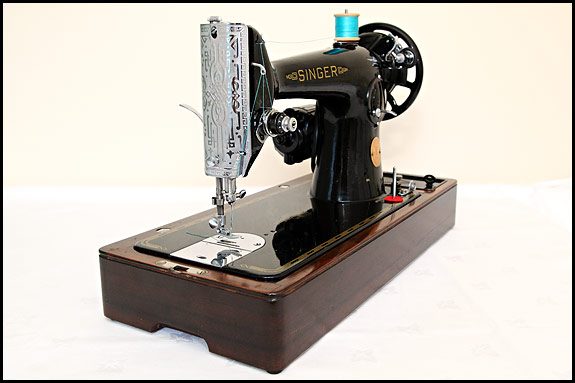
Picture of 1948 Singer 201K3

The Singer Blind Stitch Attachment 86649

Standard

Picture of Simanco 86649

Here’s a picture which will explain one of the many minor mysteries about vintage Singer attachments.  The Blind Stitch Attachment (Simanco 86649) turns up on the internets relatively often as these things go, but hands up if you’ve seen the box for one before.

Thought so.  We hadn’t either until this one followed us home in a cabinet drawer last month, but now we understand.  That box is so flimp it’s about as much use as a concrete trampoline.  It’s no wonder they’re a rarity 50 years on.

Anyhow, this one’s in Elsie’s collection now, and not because of that tatty old box.  Elsie’s claimed it because this one works reliably.  I don’t know what it is about the blind stitchers, but we’ve found that more often than not, they don’t work properly.  Or if they do, they don’t keep working properly.

The really annoying thing is I just can’t figure out why!  The problem is that every now and then they don’t do the sideways hoppity-skip like they should, and the reason for their misbehaviour is that sometimes that ratchet on the side follows the actuating arm on the down stroke instead of staying put where it was rotated to on the up stroke.  In other words, the ratchet always rotates clockwise on the up stroke like it should, but sometimes it then rotates anti-clock on the down stroke.  Which it shouldn’t.

Taking these things apart, cleaning them and lubricating them never seems to make any difference, and it’s still beyond my powers of reason to work out why, if Singer wanted it do what it’s supposed to do, they designed it quite like they did.

So there you go.

Now you know what the box looks like, and you also know why we rarely sell Singer Blind Stitch Attachments …

The Singer Adjustable Buttonhole Scissors

Standard

I haven’t a clue how common Singer Adjustable Buttonhole Scissors are, but it took me a fair old while to track down a nice pair for Elsie.  Here’s the front and the back of the box …

Picture of Singer adjustable buttonhole scissors box - front

Picture of Singer adjustable buttonhole scissors box - back

The scissors themselves are really well thought-out, and they’re made of very good steel so they keep their edge well.  They’re a doddle to use – you set them to the length of cut required in your buttonhole by means of the adjusting screw, and take a test cut in a scrap bit of material to check the length.  There’s a cut-length scale engraved on one of the blades, but as far as we’re concerned that’s more of a guide than an accurate setting.  In the next picture, they’re set to half an inch.

Picture of vintage Singer adjustable buttonhole scissors

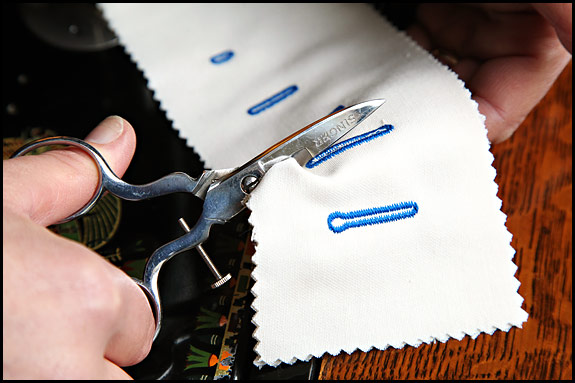
Having set them to the right length, all you do then is line them up in your buttonhole and cut.  Carefully …

Picture of vintage Singer adjustable buttonhole scissors in use

In this picture, Elsie’s just about to start the cut.  Hopefully you can see that the cut starts at the “heel” of the blades, and that when the blades have closed by the right amount to give the required length of cut, the adjusting screw will stop them closing any further.

We like ’em.  They really do make buttonholes less fraught …

The Greist Buttonholer

Standard

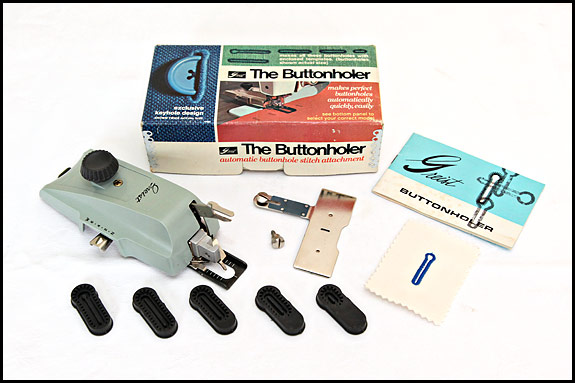
Picture of complete Greist buttonholer model #1

I just put a particularly nice one of these up for sale on the Bits ‘n’ Bobs page, so I thought a little bit of background information might come in handy.

I’m not an authority on Greist, but I do know that the firm originated in Chicago, and judging by the 19 pages of lovely old typesetting about them here, they used to be called Griest!

In later years they produced attachments on a contract basis for various makers of sewing machines including Singer, as will be immediately apparent to anybody looking at this picture who owns a Singer 489500 or 489510 buttonholer (the “Jetson” ones, about which I really ought to do a post sometime).

Anyhow, we’ve got a nice one for sale now in a good box complete with all its bits including the standard template set.  Brian seems to like it …

The aluminium feet

Standard

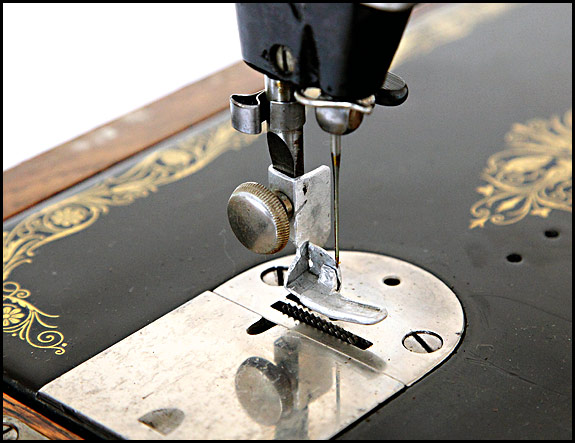
Picture of handmade aluminium presser foot

Yes, that is a very strange presser foot indeed.  And no, I’d never seen anything like it either.

All I can really tell you about it is that it’s one of the two presser feet we found lurking in the base of that machine when we bought it in last month, they’re both hand cut and folded from aluminium sheet, and I have not the faintest idea what they’re in aid of, as folks used to say.

However, knocking one of these up is certainly the sort of exercise I used to get set when training as a precision engineer in my yoof, so my money’s on somebody learning to be a metal-basher of one kind or another.

One thing’s for sure – it’s just taken me nearly 15 minutes to work out precisely what shape you need to cut out of a piece of aluminium sheet before you start bending it into the more complex one of these two, and in what order you do the six folds …

Oiling your vintage Singer – part 2

Standard

OK … we’re going to assume here that you’ve de-fluffed your machine above and below decks to the best of your ability, and that nothing of any importance ended up in your Dyson while you were doing that.  You’ve thrown out that tin of horrible 3-in-1 oil that you would have used if you hadn’t had the error of your ways pointed out to you, and you’ve got some loo roll or whatever handy to mop up the drips.  And if you haven’t got the real instruction book made from dead trees, you’ve got a PDF off the interweb so as soon as you’ve taken the bobbin out and unthreaded your needle, you are, as people keep saying, good to go.

Now if it hasn’t already occurred to you that the diagrams in old Singer books are not always clear about where exactly you’re supposed to be poking the spout of your bottle of oil, it soon will.  Don’t worry though, because on a vintage Singer, if it looks like an oil hole, it probably is – especially if it’s on the top of the machine.  And if it isn’t an oil hole, you won’t have done any harm by applying a couple of drops of oil there by mistake.

Ideally you do the top oil holes first with the needle at the top of its travel so the works are best aligned for having oil dropped on them, but how much oil to apply?  The textbook answer is “a drop or two every 8 hours sewing” but that’s a counsel of perfection, so my advice would be to use your common sense and if in doubt, apply too much rather than too little.  You won’t jigger anything up, and the excess will just drain out in the fullness of time.

Incidentally, while you’re concerning yourself with the oil holes on the top of your machine, it might be an idea to check that nobody’s whacked a spool pin into one of them.  The book might not be clear about your oil holes, but it will be clear about where your spool pin(s) should be.

Turning now to the front of the column, if there’s an oil hole on the bobbin winder, it’ll be just to the right of where your bobbin fits on, and one drop in there will do it.  Much more than that risks oil getting on the rubber tyre, which is Not Good.  When you’ve done that, give it a bit of a twirl to start the oil soaking in.  While you’re in the area, if you have the screw in – screw out type of stitch length adjustment, wind that out as far as it’ll go and put one drop on the top of the threaded bit before winding it back in to spread the oil.

If your machine has a cover plate on the back of the column which is held on by a thumbscrew, swing the plate out the way and take a look inside.  Now rotate the handwheel and see what moves and what doesn’t in there.  You might need a torch.  Ideally you want to get some oil wherever two parts move against or rotate in each other, and also on any gears you can see, so give the handwheel a few turns when you’ve done your thing in there to work the oil around a bit.  Don’t forget to put the cover plate back.

Slide your slide plate (aka your bobbin cover) open, and see if you can see a bit of red felt.  Or a bit of felt that might once have been red.  If so, that needs a couple of drops of oil on it, and if your book of words says to oil anywhere else in the bobbin area, that’s what you do while you’re there.  By the way, note that if there’s a hole in your needle plate (the chromed plate on the bed through which your needle pokes), that hole is NOT an oil hole, and neither is/are the threaded hole(s) in the bed a couple of inches to the right of the needle.

And before we move on to furtling behind your faceplate, a couple of notes for 201 owners.  Don’t squirt oil down that oil-hole that’s on the column itself until after you’ve done the underneath (that’s the hole labelled “OIL” I’m on about – the one that’s more or less behind your bottom spool pin).  And strange though it seems, that felt pad inside the chromed thing on top that you twiddle to alter your presser foot pressure is actually meant to be kept oiled.  The theory is that it soaks down and stops the rod seizing up that your presser foot’s on the end of, but personally I wouldn’t bank on that.

Now you need to take off the faceplate (if it’s not obvious, your book will tell you how), and once again see how everything does its thing when you turn the handwheel.  The routine here’s the same – a drop or two on anything that’s moving against anything else, plus a drop on both the presser foot bar and the needle bar.  That’s the rod that goes up and down when you lift and release the presser foot, and the one that your needle’s on the end of.

OK, having put the faceplate back on and checked you’ve done everything on the topside of the machine, all that’s left to oil is the workings down below.  This is a lot easier if you take the machine head out of the base and lay it on its back on several thicknesses of newspaper, but if you don’t fancy doing that, don’t worry.  Just do the best you can with it hinged up as far as it’ll go and propped there by whatever does the job, and take comfort from the fact that most old Singers keep running for donkey’s years despite not having been oiled properly since the Coronation.

If you can turn the handwheel with the head on its back or propped up as far as it’ll go, do that and marvel at the way things go in all directions under the bed when you do.  Once again, the idea is to get oil wherever anything moves against something else, and most of those places are obvious.  Note though that there are rods running left to right which at first glance seem not to move much if at all when the handwheel’s turned.  They actually just twist a bit backwards and forwards all the time, and the way you oil those is to try and get a drop or two right at each end, where the rod stops and a threaded thingy goes into it.

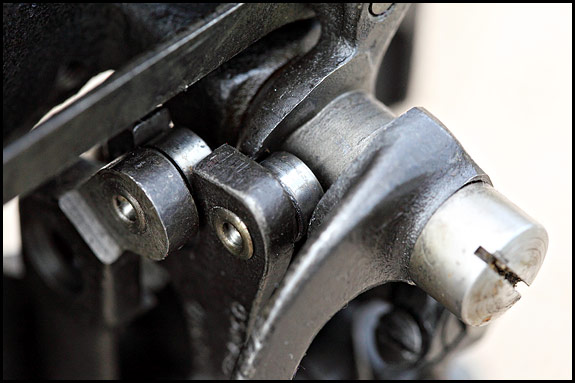
If you’re oiling a 66 or a 99, there’s one particular area where the diagrams are not much help at all.  There’s a couple of steel rollers about 8mm diameter hiding in the works under the bobbin area, and they are not easy to see if your machine’s hinged open in a case or a treadle base.  They’re not easy to photograph in situ either …
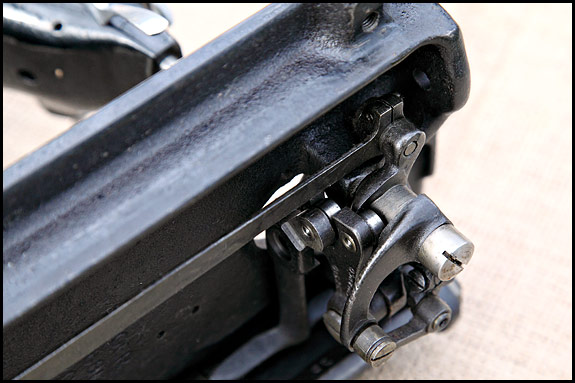
So I had to cheat with these two and remove the feed dog and the connection to it so you can see what’s what, and then take the snaps from the back of the machine.  As you can probably appreciate now, those two rollers are not obvious, particularly if you can only see this area from under the front of the machine.

Try and get some oil on them if you can, but don’t worry too much if you’re not sure whether you did.  Truth is most people never go anywhere near them with a bottle of oil.

One last point for owners of 201’s.  You know I said don’t squirt oil into that hole at the base of the column until after you’ve done the underneath?  If you do, the surplus oil will drain down into the cylindrical metal housing round the gears at the bottom of the column, and drain straight out of it when you tip the machine back to get at the underneath.  So for 201 owners, the last job underneath is to get some oil into the corresponding gear housing that’s under the bobbin area, drop the machine down onto its base and then squirt a goodly dose into that oil hole marked “OIL”.

Finally, don’t forget that you’ll need some kitchen roll or whatever under the machine for a day or so until all the excess oil’s drained away.  We also fold a few sheets of loo paper and put them under the presser foot overnight to soak up any drips, then wipe carefully round the needle clamp and presser foot before sewing with some scrap fabric to make sure we’ve got rid of any excess.
Pumpkin seeds

Standard

Elsie has a thing about pumpkins.  She used to grow all kinds of strange ones, but nowadays it’s just Crown Prince for roasting and Lady Godiva for the seeds.  And I’ve been meaning to do this post for a fortnight now …

That’s a few Lady Godivas which have been opened in the traditional way i.e. by the application of a clean spade, and from which Elsie has extracted most of the seeds.  They’re all slimy and horrible when you pull them out of the flesh, so the next step is to wash them and get all the gloop off, after which they look like the ones in that colander to the right of the picture above.

And that’s what they look like after a few days spread out in the sun, still with their very delicate outer skin which tends to fall off.

Now, just in case there’s somebody out there who’s not familiar with them, I should perhaps explain why we go to all this trouble to end up with a couple of storage jars full of dried home-grown organic pumpkin seeds.  It is because they are scrummy.  Very scrummy, in fact.  And no doubt very good for you too, at least until somebody somewhere sooner or later announces that eating them increases the incidence of St Vitus Dance in vegans with ginger hair and a lisp, so we should all avoid wacky stuff like this and just eat crap from supermarkets like normal people do.

Meanwhile, we chuck a small handful in a small frying pan, put a lid on it to stop them jumping out, turn the gas up full under it, and keep shaking the pan until the seeds have just about stopped popping (as in popcorn, more or less).  We then take the lid off, tip the toasted seeds out, let them cool just a bit until they no longer burn the mouth, then scoff the lot between us.

There – a post about pumpkins, and not a word about Linus van Pelt, The Great Pumpkin and sincerity.

OK, that’s pumpkins done.  Next up is probably going to be Oiling Your Vintage Singer Part 2, with particular reference to the Singer 99K, but it might be something about the strange aluminium feet.

Who knows?

Oiling your vintage Singer – part 1

Standard

I’ve been asked to do some stuff on oiling vintage Singers, so I’d best get started!

In order to oil your old machine, you need three things.  You need the right oil.  You need a means of getting the right amount of the right oil in the right place.  And you need to know how much of this right oil to put where.  OK, you also need some kitchen roll, loo roll or whatever to mop up drips of oil which didn’t end up where you wanted them to, so maybe we ought to make that four things.

Let’s start with the oil.  Don’t use 3-in-1 oil.  You need good quality sewing machine oil, not 3-in-1 oil.  Proper sewing machine oil is very thin/runny stuff indeed, and you get it online or from your friendly local sewing shop if you’re fortunate enough to still have one.  They won’t sell 3-in-1 oil, which is a Good Thing, because you don’t want 3-in-1 oil.  Or olive oil, as was used on the last 66K we bought.  Not WD40 either, or anything which might get used on a car, motorbike or boat, like 3-in-1 oil.  That is not what you want.  Despite what it says on the tin, 3-in-1 oil is not ideal for sewing machines.  Far from it.  It is evil.  If you do use 3-in-1 oil, horrible things will happen to your sewing machine, the birds will stop singing and you’ll never win the lottery.

We buy our nice sewing machine oil by the litre from an industrial sewing machine supplier, but you can get 125ml (I think) bottles of kosher Singer oil online including p&p for much the same price as most shops charge for it (around £4) and that will last you ages.

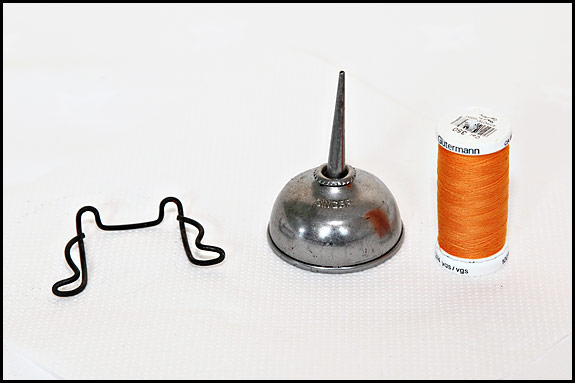
Incidentally, when your vintage Singer was new,  it left the shop complete with either a green tin of Singer oil or a small Singer oilcan …

That’s the smaller of the two sizes of the green Singer sewing machine oil tin, with both sizes of Singer oiler and a standard reel of Gütermann for size comparison.  Whatever the size of tin or oiler, it was held in place inside the case or cabinet by one of three types of clip.  There was one made of flat spring steel strips which held the green oil tins, and there was a strange-looking black device made from folded sheet steel which held the round oilers.  Unfortunately I couldn’t find examples of either type to photograph without moving and opening more machine cases than I could face doing this morning, but here’s the third and most common type of oil can clip …

That one fastens to the case by screws through those two upright loopy bits at the back of it, and if it’s been strained open a bit it will also hold the small green Singer oil tin.  Incidentally, one reason why the clips are missing from many old cases is that they can put a nasty old scrape in the finish of your machine if you’re not careful when putting it in the case or taking it out – particularly when they’re on the inside of a bentwood case.  However, if your case is missing the oiler/oil tin clip and you want to replace it, as far as I know the only way to tell which type it originally had is to work out which are the holes made by the clip screws.  If the hole centres are 30mm apart horizontally, you need the clip shown above.  If there’s two holes one above the other, you need the flat spring steel type which takes the green oil tin.  Two holes not 30mm apart means you need the black sheet steel queerthing which unfortunately I haven’t got a picture of for you.

OK, back to your brand new bottle of Singer oil.  When you take the top off it, you need to cut the tip off the spouty bit, and for that you need a clean cut very close to the top.  Cut it too far down and the hole will be too big, your oil will go everywhere and you won’t half grumble.  Do that right and you’re in business, although if you’re really keen on maintaining your machine, sooner or later you’re going to want something which gives you better control over how much oil you deposit where.  What you will want is called a precision oiler, which you get online or possibly from a fishing tackle shop (they’re used by anglers for oiling their reels, or whatever you call the wossname on the rod that the fishing line is wound on).

Now, I was going to say that we have here, from the left, my large, medium and small oilers, a reel of Sew All, then three common types of period oiler.  Then it occurred to me that I could, for the benefit of our militant feminist reader, say that left to right is Mummy, Daddy and Baby oiler.  But actually it’s good, better and best oiler, so let’s stick with that.  Good oiler is a regular fixture on Ebay.co.uk, and the tiddler’s on Ebay.com.  Better oiler took a lot of finding on Google and I’m currently trying to get a few for sale, so hopefully more about that one in due course.  In use, better oiler is just as good as best oiler and it’s cheaper, but best oiler’s made just that bit better and I like that.

The red oiler was hiding in the bottom of a cabinet we bought ages ago and would be fine if it didn’t leak, as would the Perfect Pocket Oiler next to it.  That also came with a machine but its cap didn’t, and that one’s quite common.  You even see it branded Imperial Typewriter Co.  The one on the right’s a lovely little thing which we suspect is American, and which would be a delight to use if it didn’t leak like the other vintage ones do.

On thinking about it, you know I said you need three things and we then updated that to four?  Well, better make that five because now we’ve done oil and oilers, you also need your instruction book, which we’ll be referring to in part 2 …

PS  Don’t use 3-in-1 oil 😉

Vintage Singer cabinets, treadle bases – and 1929 UK prices

Standard

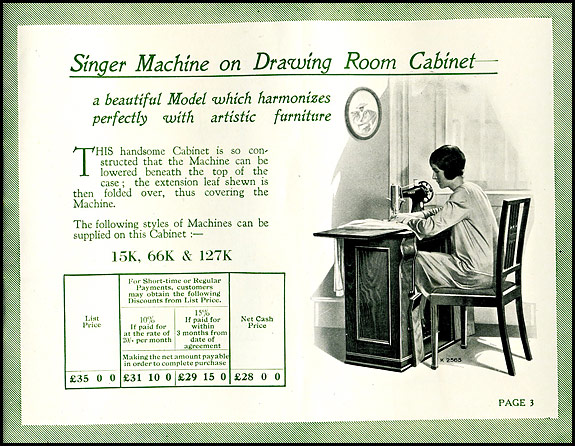
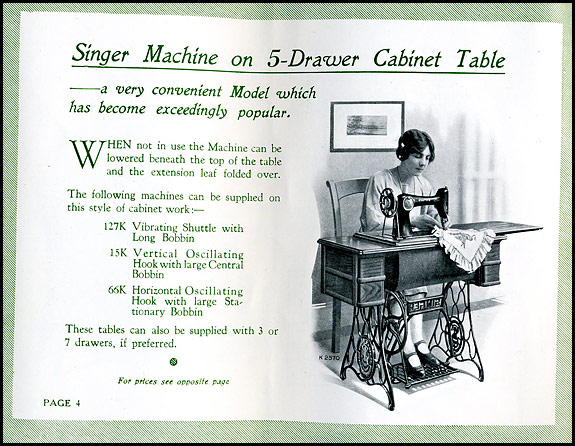
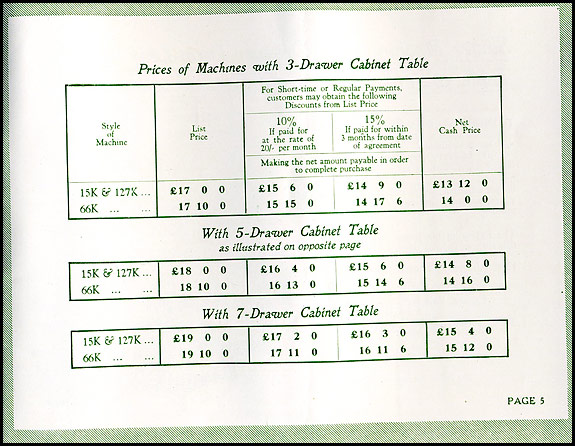
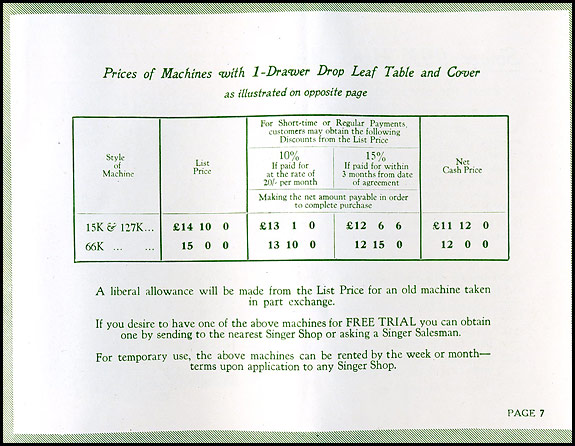
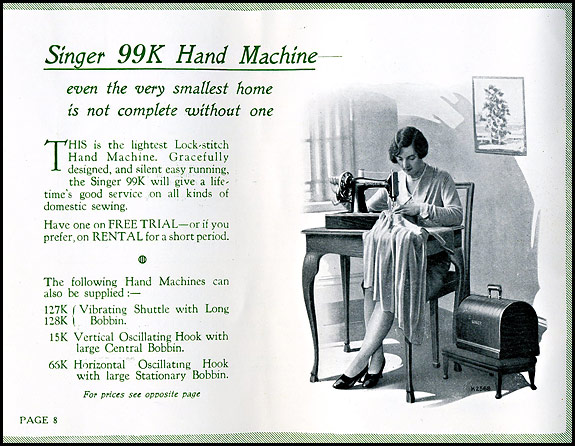
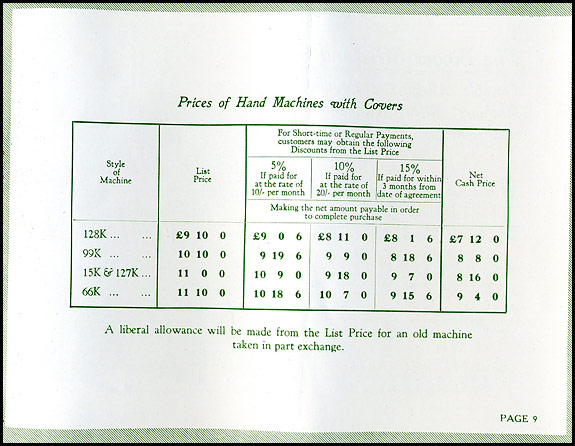
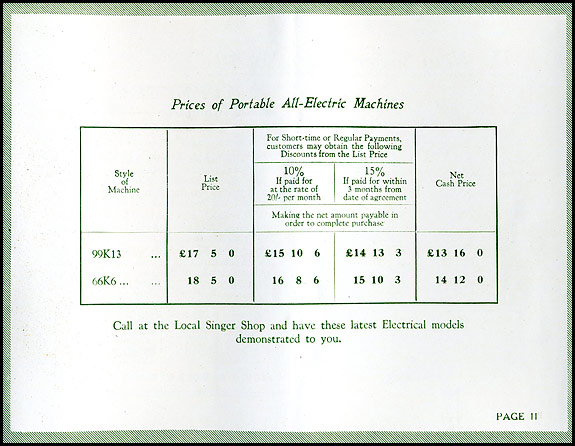
Hurrah!  I finally got the scanner working properly again and Elsie’s just found the 1929 Singer Illustrated Price List after I put it back in the wrong place in The Sewing Room, so here we go with a look at some of it.  By the way, when Singer said “List Price” they meant the total price when bought on “Singer Easy Terms”, and “Net Cash Price” is what it cost when paying with folding money.

That’s the later and final version of the 1900 Drawing Room Cabinet (the one that Elsie got for her birthday which I posted a snap of the other week).  We’ve also just got one of these from 1920, but more of that anon.  All we need now is some artistic furniture for it to harmonise with.

Just to give you some idea of how expensive these things were in 1929, if we take for example the 66K in a 5-drawer priced at £18/10/0 on HP or £14/16/0 for cash and base the calculation on average earnings, according to measuringworth.com the equivalent cost today is £3530 on HP and £2820 for cash!  In other words, something like twice the cost of a really good bicycle, which actually sounds about right to us.

Picture of Singer 201K in 7-drawer cabinet table (treadle base)

While we’re on the subject of cabinet tables, here’s a snap of Elsie’s 7-drawer, which currently lives in a corner of the front room with her 1940 201K in it.  I’m not sure what the original machine was, on account of the lady who sold us the treadle base had sold the head for a fiver to “a woman who advertised a couple of years back wanting old sewing machines to go in shop window displays”.  A pox on All Saints!

In case you’re wondering, the wire that’s plugged into that socket goes to a Singerlight which you can’t see on the back of the machine, that recess is exactly 48 inches wide, and yes the belt is a bit loud but that’s ‘cos it’s a brand new one I put on last week.  It’ll soon quieten down.

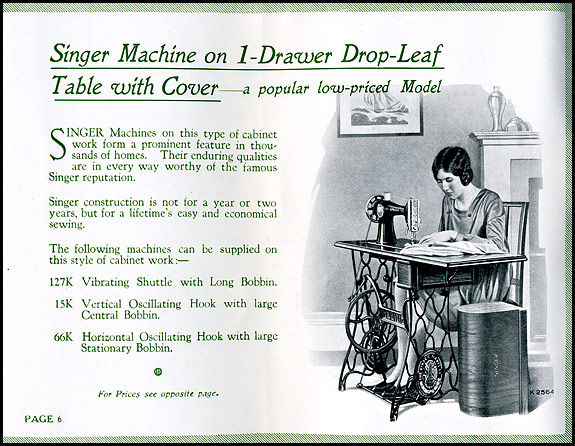
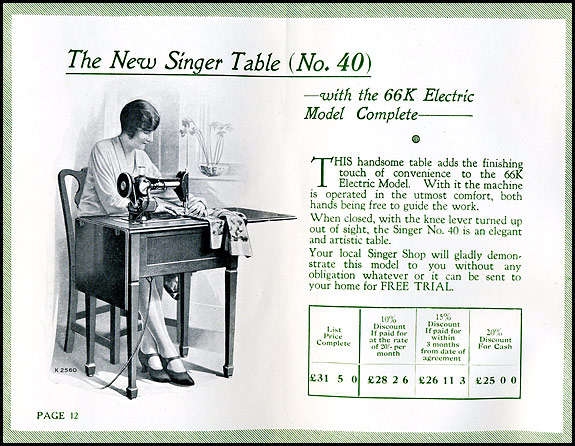
That’s the 1929 incarnation of the Victorian treadle machine i.e. the coffin-top one.  Until we acquired this price list, I always thought that when they introduced the fold-down treadle machines they discontinued the “put the lid on it” ones, but obviously not.  OK, it was a cheaper alternative to a 3-drawer cabinet table, but surely it must have seemed a bit old-fashioned?

Love the way you could get a free home trial or rent one by the week, but most of all I just love that footstool carefully placed to show off the lid …

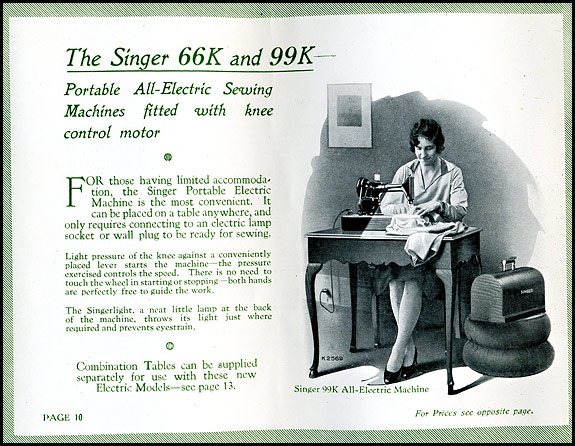
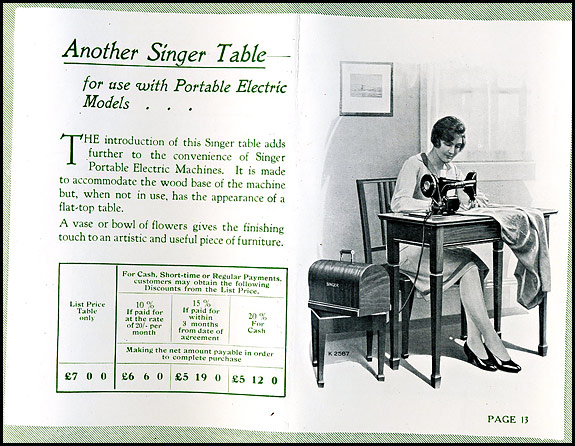
Ahah!  So if you’ve got an electric portable, you put the lid on a pouffé!  Either that or it’s a couple of spare wheelbarrow tyres.  Whatever, note that these are electrics with knee-lever control (as opposed to foot pedal).

I don’t know if these tables were popular at the time, but I do know that you don’t see many of them nowadays.

This is a new one on me, and I wonder why there’s no model number?  Anyhow, as I understand it, you drop your portable electric still in its base into a big recess on the top of the table, and presumably the knee-lever attaches via a hole in the front of the table.  Seems a bit pointless to me, because surely the only advantage over just plonking your portable on the kitchen table is that the bed of the machine is now flush with the table top?  And against that you’ve got a table which can’t be used for anything else because when you’re not using the machine, you put the lid over it.

It seems a poor thing compared to that cabinet table which used to be available with the recess into which you dropped your hand-crank portable (still in its base) to turn it into a treadle machine.  And if you’re wondering how on earth that worked, the answer is that at the time, some of the portable bases had two big holes in them under the handwheel, with a slot between.  Drop your machine into the cabinet table, run a treadle belt down through one hole, round the treadle wheel, back up through the other hole and over the pulley, trim and join belt in the usual way and flick the “finger” of the hand crank out from between the handwheel spokes.  Bingo – your hand crank portable is now a treadle machine. (And having faffed with the belt like that to get it in place and the right length , it’s all set up so you don’t need to repeat the performance.)

To revert to hand-crank portable, you just slip the belt off treadle wheel then lift it clear of handwheel.  Lift the machine out of the recess, the belt slips through the slot between the two holes, and off you go, pausing only to grab the lid from off that matching footstool,  When it’s treadle time again, you just reverse the process.

Anyhow, that’s the main part of the 1929 price list, and I’ll do the 1940’s one before much longer, courtesy of Colette …