Singer 66 and Singer 99 slide plate – how to remove and replace it

Standard

The slide plate is the chromed steel plate which slides open to reveal the bobbin in its carrier.  Some folk call it the bobbin plate but it’s not – it’s the slide plate, and judging by the number of vintage Singers out there without one, a lot of people force it off, can’t get it back on, and lose it.  Here’s how not to do the same thing yourself.

For starters, let’s see how to remove it, and in the process, discover why you can’t (or at least shouldn’t be able to) slide it right off …

Picture of Singer 99K slide plate partly open

There’s the slide plate slid open a bit, in the same way that you’d slide it open to change your bobbin.  To take the slide plate off, you need first of all to turn the machine’s handwheel towards you until the needle is at its highest point. Then, lift the end of the plate which is nearest the needle up a bit (like 3mm or 1/8th inch) against the pressure of a spring which you can’t see.  This works best if you only open the slide plate 1cm or so like in that picture, but the main point to watch is that you don’t pull it up any higher than you see in the picture below.  All you’re aiming to do is slide the plate over the other one.

Picture of Singer 99K Slide plate raised for removal

There’s actually a bit of Photoshoppery in the picture above because in reality, the plate will only stay like that with your finger holding it up.  Anyhow, it’s this next stage which sounds a bit of a faff (or if you’re German, a pfaff) but it isn’t really.  Actually doing it is not complicated at all.

Having lifted the end of the plate up a bit, you now need to keep it raised while with your other hand you push the plate towards the needle.  What you want is for the slide plate to ride up, first over the other plate (the needle plate), then as you keep pushing it along, over the first feed dog it comes to, like this …

Picture of Singer 99 slide plate slid forward onto feed dog

While you have the plate in that position,  the other end of it will look just like in the picture below.

Picture of Singer 99K slide plate and retention spring

And there you finally see what holds the slide plate in!  Yep, it’s that double-ended spring.  See how the two grooves in the underneath of the slide plate fit over the ends of the spring?  No?  OK then, just for you …

End view of Slide plate of Singer 99K and spring

Now you’ve seen that and you understand how it fits in, it won’t come as any surprise at all to find that if you push the slide plate just another 3mm or so towards the needle, the back end of it clears the spring …

Picture of Singer 99 slide plate removal

Et voilà – you’ve successfully removed the slide plate of a Singer 99 (or indeed a 66 ‘cos it’s just the same)!
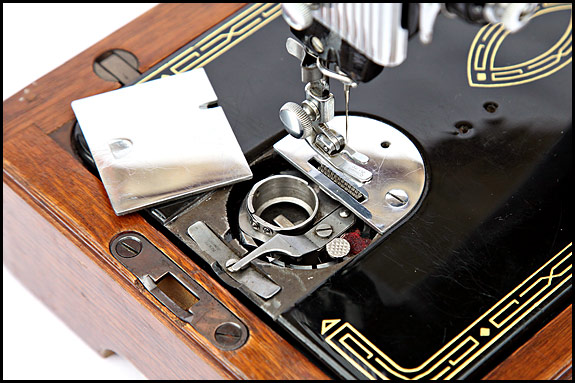
Picture of bobbin area of Singer 99K with slide plate removed

And at this point I should have taken another snap to illustrate why when you slide open the slide plate normally, you can’t slide if off the end of the machine.  But I forgot to.  No biggie though – if you turn your slide plate over, you’ll see the reason.  That’s right – those grooves which fit over the ends of the spring don’t go all the way along the underneath of the plate, which is why you have to take it off the other way like you just did.

Replacing the slide plate is easy.  Drop it in place (the right way round) with the end nearest the needle over the feed dogs, and line up the grooves in the other end with the ends of the spring, like this …

Picture of Singer 99 slide plate replacement

then wiggle it over the spring ends like this …

Photo of Singer 66 or 99 slide plate replacement

and then keep pushing towards the end of the machine until it drops into place.  Job done!

Finally, a Dire Warning.  Here’s a picture of the magic spring with that arm thingy swung out of the way so you can clearly see the screw which holds it in place …

Picture of Singer 66 and 99 slide plate spring retaining screw

Judging by the size of that screw head, you would think that it’s on the end of a fairly normal kind of a screw.  But it is not.  Oh no.  Not at all.  That screw is a really skinny little thing, which is very easily snapped off by the over-enthusiastic application of a screwdriver.  When it snaps, it can be a real PITA to extract in order to replace it so that the spring is held in place and your slide plate will stay put.

If that spring is loose on your machine, take it very easy indeed when tightening that screw …

Vintage Singer 99 handcrank – times two!

Standard

On Saturday I bought two more machines – a 99K handcrank from a lady in a bungalow in Kent, and a 99K handcrank from a lady in a bungalow in Surrey.

Both machines turned out to be from the same production run of 35,000 Model 99’s, which was commissioned at the Kilbowie factory in Scotland in June 1938.

I wonder what the odds are on me picking up two machines from that one batch on the same day 73 years later,  and then finding that out of 35,000 identical machines numbered from 854677 to 889676, we have two here with serial numbers which are only 197 apart …

The Singer Enclosed Cabinet No.51

Standard

Before we get to the nitty-gritty about this cabinet, I must apologise for these less than wonderful snaps of it and get the excuses out the way.  The Sewing Room measures 7ft x 9ft, it has a small window in the narrow end opposite the door, and right now there is this cabinet plus two treadle machines in it.  There’s also baskets of fabric, a large bean bag (I have no idea why), Stoner’s bean bag (awaiting repair) and six other sewing machines in their cases.  So there is not a lot of room.  Hence these very wide angle shots …

Picture of Vintage Singer cabinet no.46

Picture of Singer Cabinet no.46 with Singer 201K Mk2

So OK, that is Elsie’s 201K21 (that is to say, 201K Mk2, treadle version) in her fairly dark Cabinet No.51, and yes Hawkeye I do know there isn’t a drive belt on it.  There will be when I get round to it.  It’s on The List.

This thing measures 21 inches wide by 17 inches front to back, and it’s the Singer standard 31 inches tall.  To go from closed to ready to rock, you open the front doors first because the left-hand one supports that flap, which you then simply swing over from its closed position.  And as I’m sure you’ve already worked out, that adds 21 inches to the left of the base, so if you’re going to put one of these in an alcove, you need a minimum width of 42 inches.

Having opened the doors and turned the flap over, you’re left looking at this …

Picture of top of Singer Cabinet #46 with machine down

except of course there will be a drive belt in place on yours.  All that’s left to do then is lift up that hinged flap in the foreground, grasp the arm of the machine, swing it upwards away from you on those hinges you can see at the back, drop the front flap back down, and lower the machine into position.  C’est un doddle, as the French say.  There’s even a big spring thing lurking under the cabinet top which takes some of the weight as you raise and lower the machine.

Picture of drawer of Singer Cabinet no.46
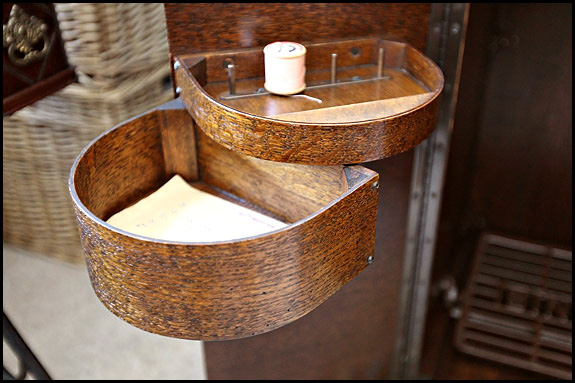
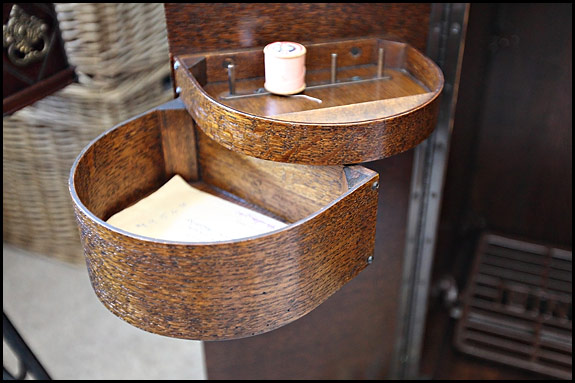
That really neat tray with the swing-out drawer (for want of the proper word) under it lives inside the left-hand door, and is well handy.  It’s also a headscratcher if you’ve never seen a picture like this before, because the spring catch which holds it closed is quite strong and it’s not at all obvious how it opens up.

And now to the treadle mechanism, as seen below …

Picture of interior of Singer cabinet #46

What we see here is the treadle plate at the bottom with the horrible brown rubber mat on it which is always rock hard from age, and at the top is a nicely varnished bit of curved plywood with a metal edge.  That’s a typical Singer touch, that is – it’s to stop any oil dripping down inside the cabinet (or worse still onto your legs).  It’s even hinged at the front and suspended from the machine base at the back by a bit of chain, so it rises and falls as you raise and lower the machine head.  Neat or what?

The thingy with the small wheel in the top right is the bobbin winder on the folded-down 201, and that rod is what is properly called the pitman rod, the bottom end of which is fixed to the back of the treadle plate by a ball joint.  The top end of the pitman rod is normally connected to the crank of the treadle wheel, which hopefully you can just make out behind all that other ironwork (most of which is the skirt guard).  That’s how the up-and-down motion of the treadle plate is converted into circular motion of the treadle wheel, around the circumference of which the drive belts passes to drive the machine head.  Or would if I’d got round to re-fitting the one on this machine.

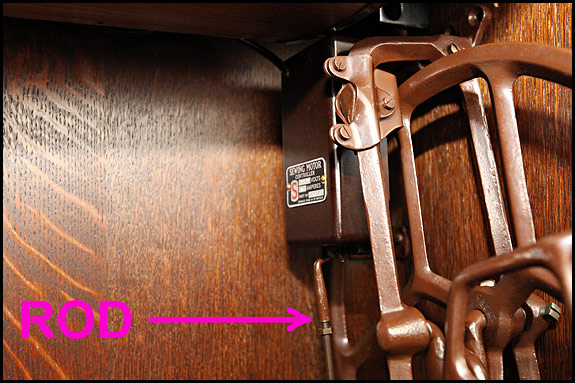
However, as you can see, the top of this particular pitman rod is not connected to the treadle wheel.  It’s connected instead to that brown metal box, which is seen more clearly in this snap …

Detail of speed controller in Singer cabinet #46

The brown metal box is the Singer Sewing Motor Controller, and the pitman rod actually connects to the slidy-in-and-outy bit at the bottom of it, by means of which the controller does the controlling of the motor, assuming of course that one is fitted to the machine in the cabinet.  Now, if you’re one step ahead of me here, you’ve already realised that this is very cool indeed.  Yep, the treadle plate either drives the machine, or it acts as a foot pedal to control the speed of a motor attached to it, depending on what you connect the top of that rod to.  And changing it over is no big deal at all.

So that’s the Cabinet No.51.  I’m not sure what the colour choice was in the local Singer shop, but nowadays you see them in anything from a light oak to a very dark oak, and they are certainly very sturdy, well made bits of furniture.  They’re also heavy.  Elsie and I can cart one up the stairs between us if we take our time, but they’re a bit awkward to get in and out of the back of the car.  If you do ever move one by car, don’t forget to take the head out of the cabinet first! And at the risk of stating the obvious, it’s a good idea to fit castors to a No.51 once you’ve got it home and sorted to your liking!

Although they’re at least 50 years old, these cabinets are more common than you might think, and indeed it often seems to me that every second household in south Wales and in the north-west must had one with a 201 in it in the 1940’s.  They do tend to have their share of scratches and scrapes, as well as the almost-inevitable water rings on the top where the plant pot with the aspidistra stood on it, but you’d be surprised what you can do with those wood restorers they sell in B&Q.

Points to watch if buying at auction or particularly on Ebay include check whether all the treadle mechanism is still there and avoid one if it is but it’s rusty.  If a cabinet’s got that damp at some point in its life, odds on there’ll be some veneer lifted somewhere or maybe even rotted.  Also watch for strained hinges on the top flap caused by repeatedly lowering it without the left-hand door open under it, and doors that don’t close properly because one or both of the (very long) hinges is stuffed.  One other thing – when checking out any enclosed cabinet with a view to purchasing it, be prepared for it being really grotty inside and having a strong pong when you open it up …

Singer Cabinet No.51 will take a 15, a 66 or a 201 of either flavour, and we usually have one available at a sensible price which is clean and tidy but perhaps still has scope for improving the surface finish.

The joy of Ebay #1

Standard

Mentioning bobbings and neddles in that last post has reminded me to share with you a couple of other little gems which I spotted recently on Ebay.

First off, a listing with a bog-standard 1930’s Singer 99 described as a “vintage sewing machine which is very heavy because it is made from thick black plastic with gold details.” Oh yes, that vintage plastic is so much heavier than this cheap plastic you get nowadays.  And did you know that a magnet doesn’t stick to modern plastic like it does to this good old stuff?

Better still though was a listing which stopped me in my tracks.  Never before had I seen a sewing machine on Ebay with a starting price of £300 and a Buy It Now price of £500.  So what, you wonder, was up for auction?  Some ancient machine, perhaps one with a faded sticky label underneath upon which is written “I made this one myself” and below that the signature of Isaac Singer himself?  Some never-before-seen prototype from the Singer factory in Podolsk?  A pristine example of the very rare steam-powered Model 13 from 1911 complete with the original gusset-grauncher and other attachments?

Ermmm … no.  What it said in the description was “sewing machine and table circa 1903”, followed by details of its condition and serial number.  That was below a picture of a common-or-garden Singer 185 on the usual table (what I’m fairly sure is called a “combination table”).

Now, I find it difficult to understand how anybody might think that a modern-looking machine like a 185 could have been made in 1903, but I find many other things difficult to understand too.  So, being a helpful sort of a bloke, I sent the seller a message which just said “You might like to know that the machine in your picture was first made in 1958 and the table is also 1950’s”.  This prompted a reply to the effect that the seller had looked up the serial number on the Singer site and it was definitely 1903, so there.

Fair enough.  I left it at that, but I did notice that the listing re-appeared in due course with a start price of £20, a Buy It Now of £100 and the description changed to “circa 1950’s”.  Not surprisingly, it still didn’t sell.

It’s interesting how many Singer sewing machines you see listed on Ebay which were made in 1903.  Except they weren’t made in 1903. If you go to the Singer site and look up serial numbers with a K prefix, it does indeed say 1903.  But, as is obvious to most people, that means a machine serial number starting with a K.  It doesn’t mean a motor serial number starting with a K, which practically all UK ones do and always have …

Bobbins for vintage Singers

Standard

Or as is often included with a sewing machine for sale on Ebay, bobbings.  If you’re lucky there’s sometimes a packet of neddles with it too, but anyhow …

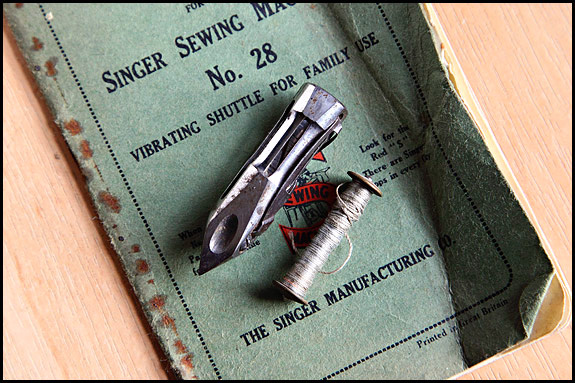
First off, here’s a snap of a bobbin and shuttle out of a 28K.  This is of course the Vibrating Shuttle that doesn’t, and this particular one is in the state most of them tend to be found in unless Granny looked after her machine really well and it’s been kept dry ever since she turned her toes up.  There’s only one Singer long bobbin (as it is known), you can still get them from Singer, and they will fit any Singer Vibrating Shuttle machine.

Picture of Singer Vibrating Shuttle with long bobbin

Round bobbins are a different matter, and the first one we need to consider is this horrible thing …

Picture of plastic 66-type bobbin for vintage Singer sewing machine

Now a plastic bobbin is all very well in your modern machine with a plastic bobbin-carrier, but it has no business in a vintage Singer.  None whatsoever.   Not even if it does fit on the bobbin-winder.  You can get into your feng shui as much as you like, but believe me you’ll never up your positive qi if you put one of these in your lovely old 99.  Not a chance.  Guaranteed to put your chakras out of alignment too if you ask me.   In fact, all things considered, the best thing you can do with any nasty plastic bobbins you find is to donate them to Auntie Sandra so she can use them in her nasty plastic Singer Touch ‘n’ Tangle.

No, what you want is proper bobbins, made of metal, like these …

Picture of bobbins used in vinatge Singer sewing machines

Having said that, though, you only want the one on the left if you have a 221 or 222 Featherweight or a 301.

And if you have a Singer Model 15 of any flavour it’s the one in the midlle you want, although as far as I know, the 15 bobbin also fits stuff we don’t get into here such as the 223, 227, 228 and 237.

It’s the one on the right we’re interested in, and that one is properly known as the Metal Singer 66 Bobbin.  It fits the 66, the 99 and the 201 which are the ones that Elsie and I mainly interested in, though I do have a weakness for a nice 185 and it fits those too.  Actually it fits a whole heap of other machines as well such as the 285 and the 401, but that’s uncharted territory as far as I’m concerned.

OK so far?  Right.  So if, as is often the case, you have an assortment of bobbins which look like the two on the right, how do you tell which one is the kosher article for a 66, 99 or 201?  It’s a doddle.  You look at ’em side-on …

Side view of three different vintage Singer bobbins

The one in the middle is the one for the 15’s, and it is flat. Yes, I know there’s a raised lip round the hole up the middle, but the top itself is flat.  So is the bottom.  Except there is no bottom, because a bobbin is eitherwayuppable.  Check out the one on the right and there’s your answer – if the bobbin is slightly domed like that, it’s a 66 bobbin, whether it has holes in it or not.  That’s the one you want for a 66, 99 or 201.  I told you it was easy.  However, we’re not quite done yet because you need to be aware of one final thing.

Beware of metal 66 bobbins bought new off the internets.  Some factory out east has churned out gazillions of nice shiny 66 bobbins recently which apparently work perfectly well with machines built from the 1960’s on, but not with a vintage machine.  They are No Use.  You know when you put a bobbin on the winder there’s a little sticky-outy thing which goes in the small hole in the side of the bobbin and if it doesn’t, the shaft turns but your bobbin stays put?  Well, on this particular (anonymous) make of new 66 bobbin, the hole’s in the wrong place.  And the only sure-fire way to tell if they’ll work with your vintage machine is to actually try one on the bobbin-winder …

The most toys

Standard

Obviously I don’t know any better than you do who actually has the most toys, but I do know that at this morning’s count we had 24 vintage Singer sewing machines scattered around the house.  I also know that the 4 which are on the kitchen table need to be off it PDQ, or we shall be eating off plates on our knees later on.

So, you ask, what prompted that particular line of thought about the most toys?  Well, Elsie found my Festival Hat this morning, still with a few badges on it.  He’s a snap of one side of it, modelled by Stoner …

Picture of Stoner the Bear wearing my Festival Hat

Cabinets and treadle bases for vintage Singer sewing machines

Standard

I really do need to do a whole heap of stuff about cabinets and treadle bases for vintage Singers, but apart from not having the time right now to do it in depth, the big problem I have is making space to take pictures of the ones we have here.  Cleo, Elsie’s 1900 27K treadle, lives right under the window which makes photographing it a bit tricky, and we’d have to move her 1909 66K treadle and rearrange half The Sewing Room to get a halfway-decent shot or two of that.  There’s also the nice Number 46 cabinet in there with Elsie’s 201K/2 in it waiting for me to reassemble the treadle mechanism in it, and come to think of it, that’s actually going to be photographable once I’ve done that.  So there is hope.

Then there’s the convertible treadle base which has moved in behind the kitchen door and is quietly waiting for us to work out what to do about the polyurethane varnish some muppet coated the top of it with.  It’s a shame they did that, and it’s even more of a shame they didn’t clean the top up before they slapped the horrible stuff on.  But the base is a bit special, so it’ll be worth it.

The Number 46 cabinet which is currently serving as a kind of extension to the kitchen table has been there so long now that Elsie will have to remind me what we decided we were going to do with it, and I won’t even mention the 1950’s Singer worktable which followed me home from Essex with a 99 in it and lives in the bathroom now because (a) Elsie doesn’t really like it and (b) there’s nowhere else for it to go even if she did.

Anyhow … here, courtesy of a 1930 Singer catalogue is your common or garden Granny’s treadle base, which is properly called a Cabinet Table,  into which you can fit any full size Singer made before the free-arms that came in around 1965.  As far as we’re concerned here, that means a 27, a 127, a 66 or a 201.  Or a 15 if that’s what you’re into.

Catalogue picture of vintage Singer treadle machine

In case you’re wondering where the fifth drawer is, it’s a long wide one which tilts down across the front.  It’s that plain section of front without a knob in the picture above, below where the machine sits.  There were several variations on this theme, all with the wide centre drawer, but with either one, two or three drawers each side, the latter being the least common nowadays.

The Victorian and early Edwardian bases shared the same cast ironwork, but instead of folding the machine down into the table top and swinging the flap over the hole like in the one above, you disappear the machine on an early treadle by hiding it under a wooden box-type lid which locks down into place (or more usually doesn’t nowadays because nobody’s seen the key since that big party on Armistice Day 1918).  That type’s referred to as a Coffin Top unless you’re in the US of A, in which case it’s a Casket Top.

I’m not exactly sure when the cast-iron legs were finally dropped, but the replacement used exactly the same top and similar treadle ironwork, with the iron legs replaced by relatively plain wooden ones which don’t look as “Granny” but are a heck of a sight easier to keep free of cobwebs.

Elsie’s got one iron-legs and one wooden-legs treadle table in The Sewing Room, and we’ll come back to those once I’ve taken some snaps of them.  We’ll also look at the usual vintage enclosed cabinets.  Judging by the number of them that keep cropping up on Ebay in a terrible state, every house in the north-west must have had one in the front room between the wars with a 201 in it.

Talking of front rooms, the one Singer cabinet we don’t have but really want is the Drawing Room Cabinet Number 21.  They’re not quite as rare as hens’ teeth, but one in very condition is, and to complicate matters, most of the nice-looking ones seem to be in either Cheshire or Welsh Wales.  But we’re determined to track one down.  Many folk think they’re hideous, but we think they’re wonderful, and if you also think that the frontage of St Pancras Station is lovely, you will too.

Here’s an awful video of a lovely example of a what we call a Drawing Room Cabinet but some folks call a Parlor Cabinet, which I thought was a different one, but either way it’s a #21.  Whatever,  if you’re prone to vertigo or to motion sickness, grab a couple of Kwells now.  There’s no commentary on it, and in case you’re wondering, the machine’s a 66K with Lotus decals.

“Your Singer needs new brushes, madam”

Standard

Or “It’s yer brushes, lady”, depending on how thick the carpet is in the shop.  If there is one.

But what does it mean?  Well, first off we need to know what brushes are.  They are bits of carbon on the end of little springs, and here’s a picture of two pairs of brushes from vintage Singer motors.  The top pair are more or less new, and the bottom pair are past their best before.

Picture of two pairs of Singer sewing machine motor brushes

The motor on your vintage Singer has two of those brushes, and their purpose is to conduct electricty from wires which don’t move to a bit of the motor which does, in order that the motor might turn and drive your sewing machine.  That particular moving bit of the motor is called the commutator, it’s a kind of rotary switch made of copper segments, and it lives on one end of a shaft at the other end of which is the little pulley with your drive belt on it.  Those springs push the carbon against the commutator, which is whizzing round at a fair old rate when you step on the go-faster pedal, so not surprisingly the carbon very slowly wears away.

How it works in practice is that the brush itself and its spring live in a square brass tube with a closed end against which the spring presses, and that fits in the motor like this …

picture of motor brush and commutator of vintage Singer sewing machine

It’s held in place by that curved bit of phosphor bronze, to bottom end of which is soldered that wire with the hairy insulation on it, which as far as we’re concerned here goes to your foot pedal.  That’s how your expensive electricity gets from there to the rotating commutator, which is that copper-coloured segmented thingy under the end of the brush.

It’s a bit of a pig to photograph clearly, so here’s a slightly different view at no extra charge …

Picture of brush and commutator of Singer sewing machine motor

So now you know far more about Singer motor brushes than most people do, and if you run a vintage Singer electric, sooner or later this new-found knowledge will come in handy.  How so?  Well, when one day you notice that your machine is making a funny metallic noise and your investigations confirm that it’s coming from the motor, you won’t need me to tell you that it’s yer brushes.  They have worn out, and if you keep trying to run your machine like that you will do it No Good At All.

New brushes are readily available online at £3.50 or so a pair including p ‘n’ p, and it’s not a big job to change them.  So, you ask, is it a DIY job then?  Well, if you’re possessed of an ordinary screwdriver, common sense, patience and an affinity for things like this, I can’t see any reason why not.  If you look at the back end of the motor, you’ll see at the top and at the bottom a screw head hiding down a hole.  Undo the top one, take it out and you’ll see that a section of the casing lifts off, revealing exactly the view in those pictures above.

What you need to do is ease that square brass holder out, taking care not to let the brush and spring drop into the innards of the motor.  Having successfully extracted the brass thingy and removed the spring and dead bush, take a Q-tip, soak it in lighter fuel, meths, vodka or even WD-40, stuff it up the open end, pull it out and marvel at the amount of carbon dust that was in there.  Repeat as necessary, but it doesn’t have to be clinically clean.  Then insert your nice shiny new brush and spring into the brass thingy, and reassemble right way round.  Which, though not difficult, is admittedly easier said than done the first time you try.

But fear not, because if you screw up, you have these pictures to refer to, and you also have a real life example of the correct assembly.

Oh yes you do.

You haven’t touched the bottom one yet and that’s identical …

Vintage Singer sewing machine attachments

Standard

Picture of collection of sewing machine attachments

Lots of them, ranging from boxed sets of attachments as supplied with most pre-1965 Singer machines through to Singer buttonholers  and Singer-fit buttonholers.  Zigzaggers too.  Some in better condition than others, but none of them rusty and all of them well usable for their intended purpose.  And that’s just the ones in boxes.  There’s also a 2-litre icecream tub somewhere in The Sewing Room which is full of individual attachments in ziplock bags …

And they’re all waiting for Elsie to have a sort-out, so we know what stays in our collection and what we can let go.

But right now there’s the pears to pick and get ripening before we bottle ’em, the brambles to pick, and the last of the damson jam to make. The first of the sweetcorn’s not far off, there’s garlic to harvest and beans to pick for drying, as well as the rest of the spuds to dig up.  I’ve got a wayward rose hip bush to demolish and some major organising of log piles to do before much longer too, so I can get some more sawn up and stacked under cover.  Then before we know it, it’ll be time to pick the apples, and I really should think about finishing off the decorating of the bathroom which sort of got put on hold at Easter. Or maybe it was in February …

All things considered, I really can’t see the Great Attachment Sort-Out happening any time soon, so until it does, if you’re after any attachments for a vintage Singer sewing machine, just drop an email to sidandelsie @ btinternet.com without the spaces and we’ll happily help you out if we can.

Singer knee lever sewing machines

Standard

Typical!  We’ve had a knee-lever Singer 99K lurking in a corner of Elsie’s sewing room for ages, and today we sold it.  And no sooner had I closed the front door behind the proud purchaser than I realised I hadn’t taken any pictures of it set up ready to sew or of the inner workings!  So here’s a brief explanation of the knee-lever controller, minus some snaps which really would have been a big help.  But I’m sure we’ll manage somehow.

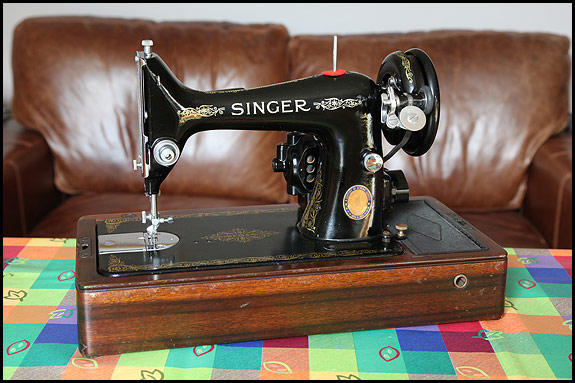
OK, check out that page from the 1930 US Singer catalogue, which shows a knee-lever 99K all plugged into that cute wall light fitting and rarin’ to go.  Now take a squint at this picture, which is of the 99 we sold today, sitting quietly on our kitchen table with its awesome 1960’s plastic tablecloth which stops sewing machine oil soaking into the wood  …

Picture of Singer 99K sewing machine

Notice how it looks much like any other early 99K – until you spot that hole to the right of the base.  That’s the magic hole into which you insert the Knee Lever, which is the black metal queerthing hanging in the back of the case …

Picture of Singer sewing machine case with knee lever

The down-pointy end of that is the one which plugs into the hole in the front of the case, and t’other end is the go-faster bit.

OK so far?  How it’s used is simplicty itself.  Place the machine on your table close to the front edge of it, plug the usual old Singer plug into the socket under the balance wheel, then insert the knee-lever into that hole on the front.  It only goes in one way and there’s a bit of a knack to it, but once you realise exactly how it fits, you’re laughing.  You then switch the power on at the wall socket (‘cos nowadays we don’t run sewing machines off a light fitting) and prepare to do some serious sewing.

It’s at this point that you wonder why on earth the lever doesn’t hang more or less straight down, as you might expect it to.  It actually hangs at about 7 o’clock, and that seems all wrong – until you realise that Singer in their wisdom wanted you to sit more to the left than you perhaps normally would, so you move your chair accordingly.  Et voilà, the lever falls conveniently against your right knee (or lower thigh, depending) and off you go.  A gentle right-wards pressure speeds the motor up nice and progressively, and when you return your leg to its resting position, the motor slows and stops.

How it works is simple.  Inside the compartment on the right of the base, under a slightly different black steel lid to the usual one in that this one has a screw holding it shut, is the mechanism of the speed controller.  It’s pretty much the same as is in the usual floor pedal.  When you insert the knee-lever into the magic hole, it connects via an ingenious linkage to the actual speed controller thingy, which doesn’t care in the slightest whether its innards are moved by a lever or by a button on a box on the floor.

So now you know how it all works, you’re wondering why.  As in, what’s the point?  Well, for a start, if you’re not blessed with two feet which work pretty much normally, and especially if you’re in a wheelchair, the knee-lever is brilliant.  You don’t have a foot pedal kicking about on the floor with a wire running from it up to the machine, and there’s only one wire coming out the plug under the balance wheel.  And after that, I’m struggling …

I have no idea when Singer dropped the knee-lever variant, but it was certainly after 1951 because the 99 in that snap is a Centenary model.  Nor am I sure for which models it was available, but I do know that I’ve seen a knee-lever 66, a 99 and a 201.

Elsie’s not a big fan of knee-levers, and as far as I’m concerned they’re just an interesting variation on the normal.  From my point of view, though, they have two drawbacks. One is that they’re a pig to re-wire because of the way the wiring’s crowded in on the machine (and in view of their age, most of them need re-wiring).  The other’s that although the actual conversion to foot pedal control is straightforward enough, you’re left with that hole in the front of the base and you need a new lid for the side compartment.

I think that’s it.  If it isn’t, do leave me a comment!