Category Archives: Vintage Singer sewing machines

Singer 185K for sale

Standard

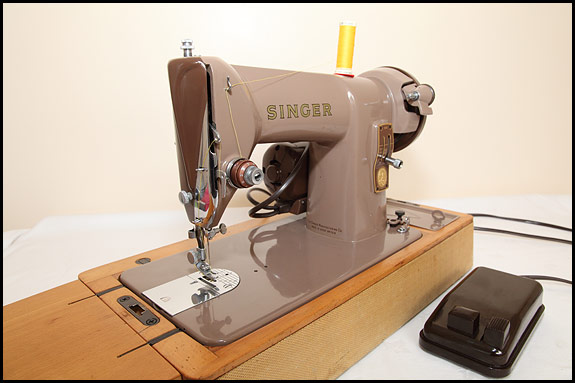
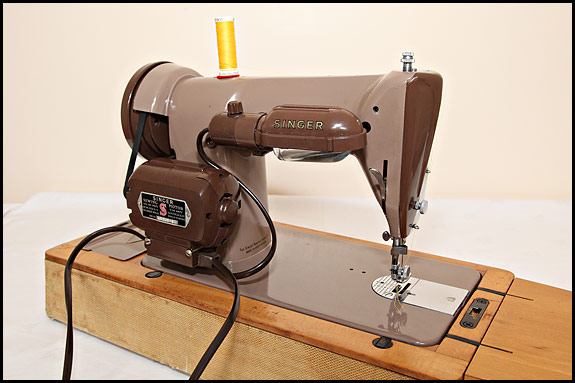
I haven’t the faintest idea why Singer decided in 1958 that it would be a good idea to start sending machines out with a light-coloured textured fabric stuck to the sides of the wooden base, but I do wish they hadn’t.  50 years on I can honestly say that I’ve never seen a 185K with a base that looks good .  Most of them look pretty dreadful nowadays, and that’s a shame really, because it’s a sweet little machine …

Photo of Singer 185K sewing machine, front view

Picture of Singer 185K sewing machine, rear view

So nice is it, in fact, that we’re happy to offer a good 185K for sale if the base is better than most.  This particular machine is a good one, and the base, though somewhat scruffy, is better than most, so I’ve just listed it on the Singers for sale page!

Despite looking like the kid sister of a 201 Mk2 (or if you want to be specific, of a 201K23), the 185 is actually just a 99 that’s had a make-over.  Mechanically it’s still a 99, it’s still got a cast-iron body, and there’s still no plastic in it anywhere apart from the spool pin on some of them.  In other words it’s still a “proper” Singer, and any attachment that works with a 99 will work with a 185.

It’s got the reverse facility like the later 99’s, and it shares with the very late 99’s the plug-and-socketless electrics i.e. the foot pedal and the mains lead on a 185K are permanently wired into the motor.  Depending on your viewpoint, that’s either a retrograde step taken to save Singer the cost of fitting the special motor plug and socket, or it’s a big improvement over having two components which were perhaps liable to accidental damage.

One thing you can’t argue with though is the fact that when properly set up, a good 185 like this one does sew a lovely straight stitch.  And given just ordinary care and a drop of oil every now and then, it’ll go on doing that for at least another lifetime.

Finally, though, a warning.  Don’t confuse the 185 with the 275 which replaced it and which looks at first glance very much like it.  It’s not.  The oscillating hook of a 275’s driven by a horrible rack-and-pinion type mechanism, which from the engineering point of view is naff to say the least, and from the user’s point of view is both noisy and liable to cause vibration. (There was also the 285, which you don’t want either because it’s the same dog with different spots.  A 285 is just a 275 with a plug and socket on the motor.)

If you want the authentic modern small portable electric with which to make that smart knee-length sheath dress with the “oh-so-neat” three-quarter sleeves while listening to early Cliff Richard records, the one you want is definitely the 185K.

The joy of Ebay #2

Standard

Having bought perhaps more than our fair share of expensive mistakes on Ebay, Elsie and I did finally perfect the art of looking at a listing for a sewing machine and predicting what it’ll probably be like in the flesh, so to speak.  That’s why nowadays it’s very rare indeed for us to bid more than a machine’s worth to us for spares.

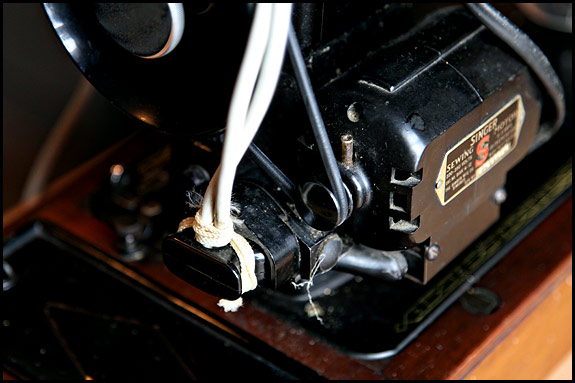
Here’s a classic example.  Check out this snap of the motor plug on our latest acquisition, a machine which was listed as “working perfectly and in very good condition” …

Photo of modification to Singer sewing machine motor plug

At one time we’d have been dismayed to find half the motor socket missing and the plug going into it held together with string because that’s broken too, but now we just marvel at the ingenuity of that awesome bodge-up.  It’s really clever, that is, because not only does it hold the two halves of the plug together, it also ensures that the two cables enter it at the right angle to minimise the strain on the individual wires.  And it’s so neat, too!

So why aren’t we miffed about that?  Because judging by the angles that this machine was not photographed from when the seller listed it, it was highly likely that something in this area was a bit iffy.  And if there’s a foot pedal included with an electric machine but it’s not in any of the pictures, it’s a fair bet that something asscociated with it isn’t kosher.  Besides, broken sockets on Singer motors and motor plugs with missing screws are par for the course.

That’s why when we bid on a machine on Ebay nowadays, we only bid up to what it’s worth to us for spares – in this case, the base, case and compartment lid we needed for one of Elsie’s machines, plus a fiver in the reasonable expectation of being able to add a few bits and bobs to The Spares Cupboard.  Which reminds me.  If you’ll excuse me, I have a cupboard to tidy up before Elsie gets back from town on her bike …

Michaelmas Day and the birth of a Singer sewing machine

Standard

So Michaelmas Day has been and gone.  We didn’t have a pig to kill, but hurrah we did manage to get all the hens into lay by then, so we still haven’t found out what happens if you don’t.  It’s probably as well.

Actually it’s a bit silly saying that we got them into lay, because of course they did it all by themselves.  It was a bit touch and go with Dyllis though, but she finally got it together with two days to spare.  She’s very much her own hen is Dyllis.  A strange bird indeed.

Anyhow.

Here’s a link to a film which you might like to take a look at.  It’s a pity we can’t see all 70 minutes of it anywhere, and it would have been nice to see the bit we can see at the proper speed, but even so we found these clips fascinating.  We’re still wondering how many sets of decals that girl used to put on per shift, and how long it took her to get up to speed.

And in case you’re wondering, “c/u” in the text on that page is close-up, and “gvs” is general views.

Have a nice weekend, folks.

How we pack a sewing machine for courier delivery

Standard

It’s a shame I didn’t think to take a few snaps of a machine we bought off Ebay last year from a bloke in Scotland.  The seller assured me that he knew how to pack it, and what’s more had loads of bubble wrap, so it should get here safely and I needn’t worry.  But of course it didn’t.  The short story is that he’d wrapped a few bits of bubble wrap round the column and the arm, popped it into the suitcase-type case, wrapped that with one thickness of bubbles then basically just wrapped a carton round it.  And he was a bit mean with the parcel tape too.

The nett result was a split wooden base and some nasty dinks in the finish of the machine itself.  The split base was down to the parcel having ended up on its back in transit, which caused the head to pull the retaining catch out and try parting itself from the base on the side away from the hinges.  And the dinks were caused by the metal tray which held the tin of attachments against the top of the case being pulled out on impact, leaving a heavy metal box free to rattle about against the machine.  Writing “fragile” in small lower case letters with a blue biro in a couple of places on the brown cardboard outer had obviously not helped at all …

Here’s how we do it, but first off a statement of the obvious.  Old sewing machines are heavy.  They are in fact very heavy indeed.  A 28 or a 99 in a suitcase-case type weighs 15kg.  A MkI 201 in the same type of case weighs 21kg.  And if you’ve never picked one up so you’re struggling to imagine how heavy 21kg might be, think bag of cement.  Or bag of coal.  Anyhow, they’re heavy.  But alas, heavy doesn’t mean they can’t be damaged in transit …

Picture of sewing machine being packed for sending by courier

Here we see the start of the process.  That’s a 201K MkI in that case and as you can see, Elsie’s started wrapping everything above the machine bed in bubble wrap and recycled plastic foam packing sheet.  The bed is tied down to the wooden base with those heavy-duty black nylon cable ties, tightened down onto thick card packing so they don’t dig into and mark the woodwork.

Picture of a vintage sewing machine being packed for parcel carrier

At the stage shown above, all the space behind the upper part of the machine is packed out tight with whatever we have available, be it secondhand bubblewrap, plastic foam, bits of expanded polystyrene sheet or even crumpled up brown paper.  Anything, in fact, except polystyrene packing beans, which are no use whatsoever for this application.

That orange on the right is the foot pedal and wiring, padded out then wrapped in several layers of packing tissue until it fits snugly between the column and the side of the case.  Having got that in, we then lay the case on its back and check carefully that the machine doesn’t try to settle down if we push on it. If it does, we stuff more packing behind it until it doesn’t.

Picture of vintage sewing machine being packed

And that’s about as much packing as we could get in before the bit which is a real faff.  Once we get to this stage, Elsie spends ages trying the lid on, taking it off, putting a bit more packing in, trying the lid again and so on, until we’re as sure as we can be that nothing’s likely to move inside the case unless it hits the ground at a bad angle when dropped from a considerable height.

Once the lid’s on, we can’t rely on the catches to keep it shut, so the case is tied shut with polypropylene binder twine going both ways round it.  We then wrap the whole thing up with several layers of bubble wrap, a process which involves an enormous roll of bubble wrap and both of us on hands and knees on the kitchen floor.  It must be quite entertaining to watch.

After that comes a carton, and this is where the expanded polystyrene beans come into their own.  The case sits in the carton on a couple of inches of beans, then the space all round and on top of the case is packed tight with beans before I get to play with the parcel tape gun.  After that comes the addressing, and, for what little good it does, the ritual “FRAGILE” and “THIS WAY UP” marking in upper case with a fat felt tip marker.

We’re not done yet, though.  The last step is to get more binder twine and tie up the outer carton both ways, before crafting two thick twine hand holds on top of it.  And before you start thinking how considerate it is of us to do that for the greater comfort of the poor blokes who will be handling this great weight, let me tell you it’s no such thing.  It’s just another thing we can do to increase the odds on the carton remaining right way up for at least most of its time in transit.

So that’s how we do it.  And having just written this post, we’ve now sold a machine which is going down to Cornwall by courier on Monday, so I’ll try and remember to take some snaps of that one being packed from start to finish …

The identification of vintage Singer sewing machines

Standard

Or how to tell t’other from which, as they used to say in Lancashire.  They might still do, actually, but I digress …

If you’re on the phone to somebody who’s put a for sale ad in the local rag which just says “Old Singer sewing machine for sale” or something equally informative, you obviously need to know a bit more about what exactly it is that they found in the attic when they moved in and now think might be Worth A Few Quid.  If you’re lucky, they might have put a picture in the advert.  And if you’re really lucky, it might not be a lot worse than this specially-taken rubbish snap.

Rubbish snap of old Singer sewing machine

Before we go any further, though,  A Word Of Warning.  On a very hot and incredibly humid summer afternoon, I once drove for well over two hours through horrendous traffic to buy a Red Head.  That’s a rare-in-the-UK Singer with distinctive decals which I think are OTT but Elsie thinks are lovely.  I’d talked about it on the phone to the person selling it, and I was fairly sure of its condition.  We’d agreed a price.  When I got there, I was ushered into the kitchen and shown the machine.  It was a clapped out and very ordinary early 66 with the most boring decals Singer ever used, and those in a very poor state.

“Hang on” says I.  “This isn’t the machine in the photo in the advert.”

“No, but does that matter?  They’re all much the same.”

“Are you serious?” says I. “You don’t have the machine you advertised?”

“Well I couldn’t find my camera so I used a picture I found on the internet.  I can’t see it makes that much difference.”

There’s not a lot you can say to that, so I just bid her a cheery “Die soon” and drove over two hours home to Elsie and a large glass of Merlot.  The moral of this story is

ALWAYS ask the advertiser if the picture in the advert is a picture of the actual machine for sale

So, getting at last to the point of today’s epistle, I’ve evolved a standard way of extracting the information necessary to identify a machine on the phone, and it seems to work.  Believe me though the process can be a bit like pushing jelly uphill with a fork at times, particularly if the advertiser’s getting on a bit and doesn’t hear so well, or their attention is split between me, their sewing machine, the television and what sounds like a shedful of kids running amok.

But whatever.  What follows only works for the common domestic Singer machines produced in the UK between around 1900 and the mid-1960’s, and it only enables you to identify the basic type.  If you need to know whether the article in question is a 15-88 or a 15-91, for example, this is not going to help you one bit.  But if you want to know if what they’re selling is a 127 or a 201, or even if you just want to know what Grandmother’s old Singer is, stick with this and with any luck you’ll soon be able to tell.

The person on the other end of the phone needs to be looking at the machine in question as if they’re using it, that is to say with the big wheel end to their right and the end with the needle to their left and no, that’s not patronising.  Always remember that whoever’s looking at it might be completely clueless!  Besides, check out a few snaps of sewing machines for sale and be amazed by how many have been photographed just like that picture above.  So, here we go – but first Another Warning …

You cannot identify a machine by what it says on the cover of its instruction book

Even when the owner swears blind it’s the original one which came with the machine when Mum bought it off Auntie Marjorie in 1953.  I don’t know how anybody’s supposed to actually know stuff like that, but I do know that you quite often find that the owner of a 27 or whatever is totally convinced it’s a 99 simply because there’s a 99 instruction book in the compartment in the base.  Anyhow, here we go …

1.  If you look at the vertical column of the machine, just above the bed (the flat metal base), there’s a round-ish metal Singer badge.   Is there a small rectangular metal plate with two or three numbers and one letter on it just below that badge?  If there is, the number on that plate is the model number and your problem is solved.  If there isn’t, read on.

2.  If the tension adjustment knob (the one with those discs and the springy thing behind it) is on the metal plate on the very end of the machine and it faces left, the machine is a Model 15.  If however the tension adjustment knob is mounted straight onto the black metal of the machine and faces the user, it isn’t a 15 so we need to dig a bit deeper.

3.  It will either be an early machine of the “vibrating shuttle” type which takes a long thin bobbin, or a later machine which takes a round bobbin, so look at the left-hand side of the machine bed.  If it has a small round plate under the needle and two rectangular plates which run from front to back and meet up in the middle, it’s a vibrating shuttle machine.  If instead it has a D-shaped plate under where the needle is and a more-or-less square chromed plate at the left-hand end of the bed, it’s a round-bobbin machine.

4.  If you’ve established that it’s a vibrating shuttle machine, measure how long the bed is.  If it’s getting on for 15 inches, you have either a 27 or a 127.  If it’s nearer to 12 inches, you have a 28 or a 128.

5.  If the bobbin winder thingy on the right is about 2 inches above the bed, it’s either a 27 or a 28.  If the bobbin winder’s higher up, roughly in line with the middle of the handwheel, it’s probably a 127 or a 128.  So for example a long bed machine with a low bobbin winder is a 27, and a short bed machine with a high bobbin winder is a 128.  OK?

(The bobbin winder position isn’t conclusive, simply because there were some transitional models made and some 27’s and 28’s have had their low-level winders replaced by a “high-level” one at some point in their life.  However, if the machine’s got the higher-up bobbin winder and there’s a round metal button on the shuttle carrier which ejects the shuttle when you press it, you almost certainly have either a 127 or a 128.)

6.  That takes care of the vibrating-shuttle machines.  Moving on now to the later round-bobbin machines, if it looks “old fashioned”, it’s all metal, it’s black and it’s not a 15, it’s almost certainly going to be a 66, a 99 or a 201.  Does the spool pin on top of the machine upon which you plonk your reel of thread go into a chromed steel plate about 2 inches long with rounded ends?  If so, it’s a 201.  Specifically, it’s what’s referred to as either a 201 Mk1 or an “early type” 201.

7.  If the machine is black and there’s no chromed plate under the spool pin, is the bed of the machine about 12 inches long?  If so, it’s a 99, which is perhaps the vintage machine most commonly seen nowadays still in reasonable condition.

8.  If the bed’s about 12 inches long but the machine is beige/brown and the oval Singer badge is on the same rectangular metal plate as the stitch length adjustment lever, it’s either a 185 which is OK because that’s basically a tarted-up 99, or it’s a later 275/285 which is basically naff.  The quick way to tell them apart is that if both the stitch length adjuster knob and the lever which raises the presser foot are plastic, it’s a horrible 275/285.

9.  If the bed’s about 15 inches long, there’s no chromed plate under the spool pin on top of the machine and there’s no small plate with a model number on below the metal Singer badge, you have a 66.  That’s the big sister of the 99.

10.  If the machine looks fairly modern, the top of it’s more or less flat, there’s no chromed metal plate with rounded ends under the spool pin but it still says “201K” under the Singer badge, it’s the later type 201 which is usually referred to as the Mk2.

If you’re still scratching your head, odds on it’s a later machine or an industrial, or possibly a 19th Century one.  Most of those will be outside our territory, but by all means send us an email at sidandelsie @ btinternet.com without those spaces if you’re stuck and we’ll see if we can help you solve the mystery.
Which way do you thread the needle?

Standard

If you were paying attention last week, you know how to work out which way round the needle goes in any vintage Singer sewing machine.  If you weren’t paying attention, go back and read this post then do try to keep up with us, dear.

So, having got your needle in the right way round, the question now is which way do you thread it?  Right to left or left to right?

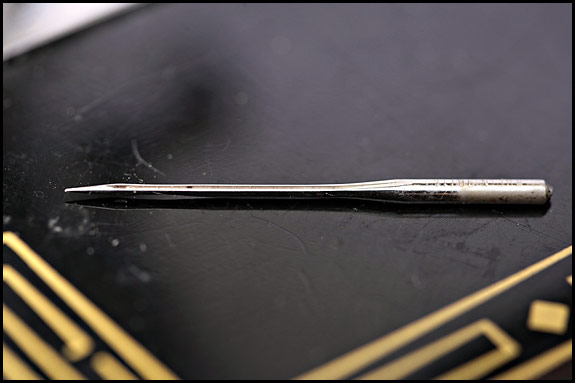
Let’s start with a picture of a needle …

picture of sewing machine needle

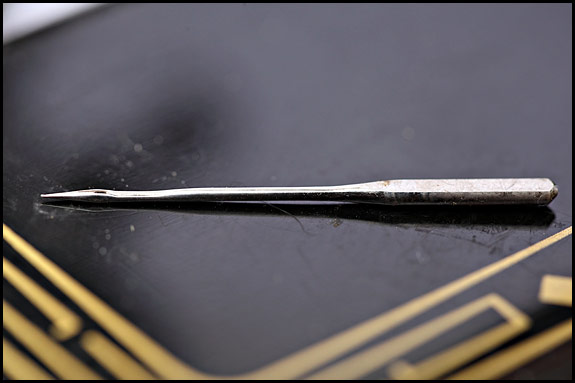
Note that this needle is seen flat side down, and that you can see a groove running along it from the eye to where it thickens up.  If we turn that needle over so the flat on it is facing upwards, we see that the other side is completely different.

another picture of a sewing machine needle

There’s no long groove on this side.  Instead, the needle has a little “cut-away” section just above the eye.  That’s called the scarf.  I have no idea why.

So OK, which way do you thread the thing?  Here’s a clue …

picture showing thread path at needle of sewing machine

If you look closely at that picture, you can see that we’re looking at the long groove side of the needle.  Check out the way that thread runs down from the last guide to the eye of the needle.  Now imagine that needle going down through your fabric to make a stitch.  What will happen as it does?

Yep, that’s right – the thread will tuck itself nicely into that groove.  That’s what the groove is for, and there’s your answer to the question as to which way round you thread the needle.

picture of needle of sewing machine showing thread path

You want the needle threaded like in the picture above, so de thread can get in de groove, maaan.   Yay!  Always thread from the groovy side, baby.

Sorry about that.

But, I hear you say, what if you can’t see that groove?  What if your eyesight’s worse than mine, you change needles by feel and it takes you all morning to actually get one threaded?  Fear not, gentle reader.  Assuming that you have a serviceable fingernail or two, the good news is that you can very easily feel the groove with the end of a fingernail.

So there you go.  Whatever the machine, find the long groove, and that’s the side you point your thread at.

“How A Sewing Machine Works”

Standard

I stumbled upon this video the other night, and was immediately captivated by it.  As soon as it finished, I watched it again.  Then Elsie joined me and we both watched it, spellbound.

This girl is wonderful.

She should be famous.

It’s a crying shame she wasn’t a teacher at my last school.  I wouldn’t have learned anything like as much as I did, but lessons would have been a lot more fun.

Anyhow.  Check out Summer’s explanation of how the bobbin works for yourself, and don’t worry if you don’t find it easy to follow.  Just marvel at her delivery of it …

Which way round does the needle go in a vintage Singer sewing machine?

Standard

This is easy.  Honest.  Stick with me to the end of this post, and you’ll be able to saunter up to any vintage Singer machine, take but the quickest of glances at it, and gain the respect and admiration of astonished bystanders by immediately saying whether or not the needle’s in the right way round.  And as I’m sure you realise, that’s a very handy skill to have.

First off though, let’s get the terminology right.  The rod thingy which goes up and down when you sew, and into the end of which you insert your needle, is called the needle bar.  Your needle’s held in the needle bar by the needle clamp, which is what you tighten by means of the clamp screw.  And just in case you’re now wondering what the other rod thingy which doesn’t go up and down but has the presser foot on the end of it is called, it’s the presser bar.

Next we need to consider exactly how the needle fits in the end of the needle bar …

Picture of Singer 99 needle bar and clamp

That’s the needle bar and clamp of a Singer 99K, about which we need to note two things.  One is that the needle bar has a slot in it, here visible above the clamp.  And the other is that just above that clamp, there’s what at first glance seems to be the top of the needle.  Except it isn’t. That little shiny blob is actually the needle stop, up against which you push the needle when you slide it up through the clamp.  That’s what ensures that your needle is set at exactly the right height – as long as you slide it up as far as it’ll go.

Here’s what it looks like if we take away the needle clamp …

Picture of needlebar on Singer 99 without clamp

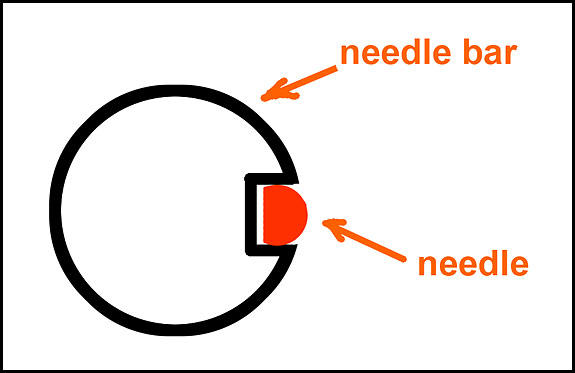
See how the needle actually fits in?  The flat face of the fat end sits against the flat bottom of that slot, so in cross-section it looks like this …

And now you know what determines which way round the needle goes!  It always goes in with the flat on it facing the bottom of the slot in the needlebar.

Going back to that picture at the top, you’ll see that as you’re sitting at that 99, with the screw of the needle clamp pointing to your right, the slot in the needlebar faces left.  Therefore the needle goes in with the flat side to your right, which is actually the most common way round.

Now check out this picture of a rather mucky beige 201 Mk2 without a presser foot …

Picture of Singer 201K Mk2 needle bar and clamp

This time we’re looking towards the left-hand end of the machine.  The clamp screw still faces the right-hand end just like on the 99, but golly gosh – the slot in this needlebar faces right too!  Yep, the needlebar on a 201 is indeed the other way round, which of course means that on a 201, the needle goes in the other way round i.e. flat to the left.

We could actually complicate matters by considering that some needlebars have slots in them which face forward (towards you as you’re sewing), but those didn’t appear until after the rot set in and Singer started making the newer machines, so I’ll keep things simple and not mention them.

So, you now know that it really is easy to tell which way round the needle goes in a vintage Singer.  All you have to do is check which side the needlebar slot faces, then fit the needle so that the flat on it sits against the bottom of the slot.

Next week’s thrilling instalment is tentatively entitled “Now You Know Which Way Round The Needle Goes, How Do You Tell Which Way To Thread It?” …

The Piece of String

Standard

Picture of key on bentwood case for vintage Singer sewing machineOne of things about vintage Singer sewing machines which fascinates Elsie and me is The Piece of String.

You can pretty much guarantee that if the owner of an old machine which I’m thinking of buying says yes, there is a key for the case, then that key will be tied on a bit of string just like in the picture.  It might be thin string or it might be thick string, but it’s always string.   And the ends of it have always been neatly cut off after it was knotted.

And what, you might quite reasonably ask, is so remarkable about that?  Well, nothing really – except could you lay your hands on a bit of string right now if you had an urgent need of it?

If I look out my window, I can see part of a “select gated development” of a dozen new houses 200 yards or so away.  We call it The Ghetto.  Every one of those houses seems to be occupied by frighteningly normal families who each run at least two new cars, one of which is a Chelsea tractor, and it’s a fair bet that in a few weeks’ time, all the Daddies will be out on Sunday morning playing with their new leaf blowers.   I reckon they’re the sort of people who use the word “lifestyle” in everyday conversation.

If you look through their kitchen windows past the bijou pots of half-dead herbs, you’re bound to see machinery and gadgetry and things for every conceivable task.  Likewise their garages are doubtless full of power tools for everything.  But do they have string about the house?

I doubt it.  Naturally Elsie and I have string, but we’re like that.  We have natural string, unnatural string, garden twine, binder twine in a choice of colours – heck, we have parachute cord and we even have hi-viz fluorescent yellow terylene string.  I’ve no idea why we have that hi-viz stuff or where it came from, but my point is simply that we do have string about the premises.  Like every household once had, because at one time people saved useful-looking bits of string.

When did people stop saving bits of string?

The original carton!

Standard

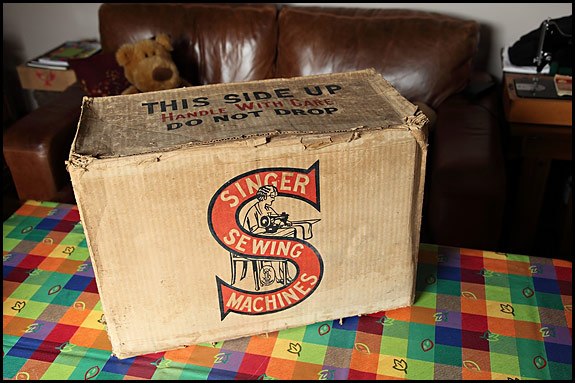
Picture of vintage Singer sewing machine carton

Yes, it’s that kitchen tablecloth of ours again – but look what’s on it this time!  One day in 1949, a brand new 201 portable left the Singer shop in Bristol in that carton.  Yesterday, 62 years later, that same machine came home with us, still in the same carton …